[FirearmsNews] Shooting Instruction Offer in Wake of Manchester Attack
By Yonatan Stern
On Yom Kippur, the holiest day of the Jewish calendar, a British Muslim, literally named Jihad, rammed his car through a crowd of Jews entering a prominent Manchester synagogue, then exited the vehicle and carried a mass stabbing attack before being shot dead by responding police officers. His rampage left two Jews dead and scores injured.
This attack, while not surprising, illustrates the vulnerability of Britain’s Jewish community. Many years of open borders with mass Islamic immigration, coupled with woke government policies criminalizing criticism of Islam and a prohibition of self-defense by the native British population against Islamic invaders have left the English population (and the Jewish community in particular) as easy prey to Muslim immigrant terrorists, hell-bent on erasing Britian’s European heritage, and replacing it with an Islamic caliphate ruled by Sharia law.
Ironically, the concept of a right to bear arms did not originate in the US Constitution, but rather in the English Bill of Rights of 1689, which states: "the Subjects which are Protestants may have Arms for their Defence suitable to their conditions and as allowed by Law". The concept of Castle Doctrine also emanates in English Common Law, which dates back to 1604 and Sir Edward Coke's writings, which established the home as a person's castle, a sanctuary from which they could not be forced to retreat in the face of an intruder. And believe it or not, as late as Victorian times, it was common for civilians to carry concealed pistols in Britain for self-defense.
Despite these positive beginnings, gun rights as well as the right to self-defense have been so eroded over the last century in Britain, that today, neither Protestants nor Jews have the right to either possess firearms, or use them for self-defense. The only people seemingly above the law and able to use weapons are the government, criminals, and Muslim terrorists.
Many generations of law-abiding British subjects obligingly surrendered their weapons when called to do so by the crown and accepted the limitations imposed on them for the use of the firearms they were given the privilege of keeping. Center-fire semi-automatic rifles were banned in 1988 and standard handguns were outlawed in 1997.
What the English are left with today includes a variety of shotguns, including double-barrel, pump-action and semi-auto, as well as bolt-action center-fire rifles, rimfire semi-auto rifles, and ‘Long Barreled Pistols’ known as ‘LBP’s’, which are standard pistols and revolvers, with a barrel of at least 12 inches and an overall length of 24 inches (some of these handguns also have a steal rod permanently attached to the bottom of the grip in order to make minimum length requirements).
It needs to be said that even these UK-legal firearms are subject to strict licensing and may only ever be used for “sporting purposes”, with self-defense strictly forbidden.
Obviously, with British Jews being such a vulnerable target of violent antisemitism, immigration to the US is the obvious answer for their long-term survival. These are the types of immigrants we need in the US. Wealthy, educated people with a work ethic who will bring needed skills to our society (much like the Boer immigrants fleeing from anti-white violence in South Africa).
However, such a move is not likely to happen overnight. For those stuck there for the time being, armed self-defense is the only solution. The British police cannot and will not stop Islamic terror attacks against the Jewish community, and in the words of Thomas Jefferson, “when tyranny becomes law, resistance becomes duty”. That’s why we at Cherev Gidon Israeli Tactical Training Academy have decided to offer FREE defensive firearms training on UK-legal firearms to British Jews who are willing to obtain firearms certificates and secure their communities.
Thoughtful and generous, indeed. Kol hakavod!
It goes without saying that anyone even mentioning the idea of self-defense as a reason for applying for a firearm certificate will have it automatically denied, and anyone actually using a firearm for self-defense in Britain will almost undoubtedly face criminal prosecution, but as the saying goes, “It’s better to be judged by 12 than carried by six.” The way I see it, if you are being violently attacked by an Islamic terrorist, and you have the choice to either be stabbed to death like a good citizen would, or violently resist with a firearm and face criminal charges, I’ll choose the latter.
Those British Jews who agree with me and are willing to be there to defend their communities, while being well-aware of the potential consequences for doing so, are welcome fly across the pond to come get trained with us. We will make sure to keep the training discrete and your identity private.
To sign up, contact us via our website:
Cherev Gidon Israeli Tactical Training Academy located in Honesdale, PA. CherevGidon.com
About the Author
Yonatan Stern is an IDF veteran and professional firearms instructor who specializes in training Synagogues and other houses of worship against violent attacks. He is the director of Cherev Gidon Israeli Tactical Training Academy in Honesdale, PA, and is a contributing writer to Firearms News.
Yonatan can be reached at: mefaked@cherevgidon.com
Direct Translation via Google Translate. Edited. by Daniil Pelymov
[REGNUM] October marks the 545th anniversary of the Great Stand on the Ugra River—the legendary event of 1480 that ended the three-hundred-year Mongol-Tatar yoke. In the words of Nikolai Karamzin, it marked the beginning of "a great era, the triumphant restoration of our state independence, combined with the final fall of the Great or Golden Horde."
This turning point was unique: unlike the Battle of Kulikovo Field, it was not a brutal slaughter, but a battle that never took place. And in addition to the courage of the Russian soldiers and the strategic calculations of the commanders, thanks must also be given to skillful PR, counter-propaganda, and well-timed diplomatic alliances.
WAS THERE A BOOT?
An ambassador from Akhmat, Khan of the Great Horde, arrived at the court of Ivan III, Grand Prince of Moscow. He presented the ruler of the "Urus" with a basma—a gold plate bearing the image of the Horde ruler. Since the time of the great Genghis Khan, it had been customary for anyone who presented the basma to have the right to judge and administer justice in the name of the Great Khan in all regions conquered by the Horde.
Although Genghis Khan's empire, and later the Golden Horde, had disintegrated, the Great Horde, the successor to the steppe empire (whose khans had their headquarters in the old capital, Sarai on the Volga), considered itself the mistress of Rus'. Khan Akhmat, determined to consolidate the Genghisid possessions from Khorezm to Ryazan and Moscow, set out to remind Prince Ivan who the true master was.
But Ivan Vasilyevich, who was related to the last dynasty of Byzantium, the grandfather of Ivan the Terrible, who in some documents already called himself tsar (and in Western sources was called emperor), did not consider himself a subject of the khan.
Later historical and folkloric sources preserved an episode: in response to the ambassador's demands that he pay all tribute arrears from Rus' and recognize Akhmat's authority, the prince threw the basma on the floor and trampled the gold plate with his boot. Modern historians consider this beautiful story a fabrication—or rather, a rumor deliberately started during the reign of Ivan III. But the fact remains: not a penny has arrived in Sarai from Moscow since 1472.
In response, the khan, as his predecessors had done since the 13th century, sent a punitive expedition. The Horde army reached the Oka River but was unable to cross—detachments sent by Ivan III repelled the attempted "landing." The Great Horde realized the gravity of the situation.
THE WEST WILL HELP
Exactly one hundred years after the Battle of Kulikovo, which marked the beginning of Russia's liberation from oppression, in September 1480, the Horde army marched from Sarai to Moscow. In preparation for the campaign, Akhmat (or, as Eastern chroniclers called him, Akhmed Khan) adopted the same strategy as Temnik Mamai. The Horde entered into an alliance with Lithuania.
In the 1470s, Ivan III annexed Novgorod Land to the Russian state, for which Akhmat had issued a charter in 1471 to the Polish King and Grand Duke of Lithuania, Casimir IV. Therefore, the khan hoped that Warsaw would become his ally.
The year 1480 should have been an exceptionally opportune time for an invasion. Akhmat had just concluded a war with another fragment of the Golden Horde, the Crimean Khanate. The Prince of Moscow was distracted by affairs in the West, as the Livonian Order had launched a war against the Pskov lands. Moreover, the "game of thrones" continued in Russia, as Ivan III's brothers, the appanage princes Boris of Volotsk and Andrei the Great, opposed him.
It was at this moment that Akhmat Khan decided to strike from the south, from the banks of the Ugra River – along this left tributary of the Oka River, the border of the two great principalities, Moscow and Lithuania, then ran.
“The ill-named Tsar Akhmat... came against Orthodox Christianity, against Russia, against the holy churches and against the Grand Prince, boasting of destroying the holy churches and capturing all Orthodoxy and the Grand Prince himself, as was the case under Batu,” the chronicler testified.
Fifteenth-century sources indicate that panic broke out among some of the boyar elite. "The rich and fat, money-grubbing princes" advised the prince to flee from the Tatars. The courtiers Ivan Oshchera and Grigory Mamon insisted (as they would say today) on a pragmatic approach: after all, they pointed out, even the great Dmitry Donskoy chose to hide in Kostroma when Khan Tokhtamysh marched on Moscow. But some boyars, nobles, and ordinary Muscovites insisted on engaging the Horde.
And Ivan – who will go down in history as Ivan the Great – chose the second option.
MAN-MADE LUCK
The prince ordered his army to advance to the Oka River. One of the Grand Duke's brothers, Andrei Menshoy, the appanage ruler of Vologda, led the detachment that captured Tarusa. The Grand Duke's son, Ivan the Young, led the troops that advanced to Serpukhov. Moscow itself was occupied by an army summoned from Murom.
However, Ivan sent his wife, Grand Duchess Sophia, and their children, as well as the prince's treasury, "into evacuation." At the same time, the prince ensured political stability by making peace with his brothers Boris and Andrei Bolshoi, so Akhmat's plan failed here.
To strengthen the spirit of Muscovites, the miraculous Vladimir Icon of the Mother of God was transported to the capital; according to legend, it protected the city from the invasion of Tamerlane in 1395.
The Moscow army was indeed lucky, but it was largely “created” by Prince Ivan himself.
The Crimean Khan Mengli Giray, who was a temporary ally of Moscow in the fight against the Great Horde, attacked Podolia (present-day Vinnytsia and Khmelnytskyi regions of Ukraine, then under the control of Poland and the Grand Duchy of Lithuania). King Casimir was forced to divert attention, and Akhmat never received aid from his Western ally—the latter merely granted the Horde unimpeded passage through Lithuanian lands.
Nevertheless, the Great Horde itself seemed to be a serious military force.
"MATTRESSES" IN A TOUGH DEFENSE
Yes, the Russian capital was protected by a well-developed system of defensive fortifications: fortified towns, earthen ramparts, and natural obstacles (rivers, lakes, swamps). This fortified line was no panacea against Tatar raids—it's enough to recall that even under Ivan the Terrible, the Crimean Khan successfully "marched to Moscow." The capital was even more vulnerable under his grandfather, Ivan III.
It was clear where exactly Akhmat could break through the defensive lines: between Serpukhov and Kolomna or downstream along the Oka River. Therefore, the Grand Duke's regiment, led by Voivode Daniil Kholmsky, advanced there as early as July 1480.
By October 1480, “the Grand Prince… sent his sons and commanders to the Ugra (the left tributary of the Oka) with all his forces, and, having arrived, they stood on the Ugra and occupied the fords and crossings.”
Everything was ready for a decisive battle, which, however, never really began. Skirmishes broke out periodically (including with firearms—arquebuses and primitive cannons called "tyufyak"—but neither side dared to engage in any active action. The Russian army had taken up a favorable defensive position, making crossing the Ugra a rather laborious undertaking.
Moreover, Akhmat was worried by news from deep in the rear, on the Volga. The khan received reports that ships under the command of Prince Vasily of Zvenigorod and the Crimean prince Nur-Daulet had launched a military expedition that threatened the khan's headquarters, Sarai.
Nevertheless, the standoff continued, and both armies (not only the Horde's, but also the Russians') suffered losses. Ivan III even planned to retreat deeper, to Borovsk, to engage the Horde in battle at a more favorable location.
To bolster the troops' morale, Metropolitan Vassian of Rostov issued the celebrated "Message to the Ugra," calling on Ivan III not to fear the enemy. The archbishop addressed the Grand Duke as "a good shepherd who gives his life for his sheep" and urged him "not as a mercenary, but as a true shepherd" to defend the "flock" entrusted to him from the "approaching wolf."
But in the first week of November 1480, Khan Akhmat suddenly abandoned further confrontation: having learned of the approach of the Russian-Crimean "expeditionary force" to the rear of the Horde and convinced that he would not receive help from Casimir, the Khan ordered a retreat.
The failure at the Ugra River was a political blow to the reputation of the last significant ruler of the Great Horde. Instead of restoring suzerainty over Rus', he suffered a fiasco.
During the subsequent wintering, on January 6, 1481, Akhmat was killed in the Don steppe, sparking yet another "zamyatnya"—a power struggle. The khan's death effectively marked the disintegration of the Great Horde into independent uluses (states). Any revenge or return to the times of Batu Khan or even Tokhtamysh was no longer an option.
Over time, the events of 1480 became steeped in legend. In the popular imagination, the "standoff on the Ugra" and the "Ugorshchyna" acquired the status of a miracle—just as Dmitry Donskoy predicted in The Tale of the Battle of Kulikovo: " And if God changes the Horde, my children will not give way to the Horde." That is, if the Horde's power weakens, the descendants of the victor of the Battle of Kulikovo will stop paying tribute to their oppressors.
SECRETS OF THE UGRA RIVER'S BANKS
Archaeologists increasingly refer to the Ugra Valley as a "river of memory." Every layer of earth here preserves traces of that autumn of 1480, when the outcome of three centuries of Horde rule was decided. In recent decades, especially in the 21st century, research at the sites has yielded a wealth of material that not only confirms the chronicles but also adds new details to the portrait of Ivan III's reign.
Excavations are being conducted within the Kaluga Region, within the Ugra National Park. A cluster of ancient settlements associated with the events of the autumn of 1480 is concentrated here. According to scholars, these settlements formed the border fortifications of the Russian state at that time. Kaluga archaeologist Igor Boldin, who and his colleagues have been exploring these lands for several decades, notes: "There are archaeological finds from that period—from the chronicled sites of Lyubutsk and Vorotynsk, which I excavated for many years."
Over three decades, under the leadership of Boldin and Galina Massalitina, approximately 10% of the ancient settlement has been uncovered in Lyubutsk. Each excavation yields fragments of pottery, metal objects, pectoral crosses, fired remains of buildings, and even rare glass jewelry. Of particular value are arrowheads and spherical cannonballs from arquebuses—the first direct evidence of armed clashes on these borders. Among the finds are ancient coins from the late 15th century, which, according to archaeologists, confirm active trade even in the border regions.
Lyubutsk, located at the confluence of the Ugra and Oka rivers, has proven to be a true "time capsule." The cultural layers here intertwine traces of various eras—from pre-Mongol times to the late 15th century. Boldin said that every summer, specialists continue their research at this monument, crucial for the entire Upper Oka archaeology: "We study how the people who met the autumn of 1480 on the banks of the Ugra lived, what they breathed, and what they ate."
In 15th-century layers, archaeologists are finding clay shards, bone needles, copper jewelry, forged nails, and even fragments of glass bracelets—all of which help reconstruct the lifestyle of those who witnessed the great conflict.
Interestingly, modern finds are forcing historians to rethink the nature of the settlement itself. While it was previously believed that the riverbanks formed a continuous "military camp," it's now clear that permanent settlements, trade centers, and craft centers were located adjacent to the military fortifications. Archaeologists conclude that by the time of the clash with Khan Akhmat, a distinctive borderland system had already developed in these lands, where military and civilian life coexisted side by side.
Spas-Gorodok, one of the most important defensive points, is no less interesting. Traces of fires, charred remains of buildings, arrowheads, pottery, and small household items have also been found here. All of this speaks to the tense events witnessed by the residents of the borderlands. "Each find is not just an artifact; it is the voice of time, speaking to us through the earth," Boldin emphasized.
The Great Standoff on the Ugra River Museum-Diorama, opened in 2014 on the grounds of the Vladimir Skete of the Tikhonov Hermitage, plays an important role in preserving the memory of the standoff. It is located in the village of Dvortsy in the Kaluga Region and is located within the grounds of the Vladimir Skete of the Tikhonov Hermitage. The entire epic confrontation is recreated here: a huge panel depicts the camp of the Russian regiments, the smoke from the fires, the figures of warriors, and armor gleaming in the sun.
Artist Pavel Ryzhenko, the creator of the diorama, achieved a striking immersive effect—the viewer literally finds themselves on the riverbank, accompanied by the roar of cannons and the clang of weapons. The museum's halls display authentic archaeological finds discovered on these very banks: fragments of pottery, iron arrows, pectoral crosses, and coins from the 15th century.
Archaeological discoveries in recent years are becoming part of the region's cultural life. The Kaluga United Museum-Reserve regularly hosts exhibitions entitled "Archaeology of the Upper Oka Region," where, alongside antiquities, exhibits related to the settlement are displayed. These finds breathe new life into memory—not dry historical fact, but living testimony to the courage and daily work of the people of that era.
The annual military history festivals held on the banks of the Ugra River in November play a special role in preserving historical continuity. Hundreds of reenactors, historians, and simply concerned individuals from across Russia come here. Cannon fire echoes across the fields, and scenes from the lives of 15th-century Russian soldiers are recreated. The abbot of the Vladimir Skete leads a prayer service for the unity of the Russian people, and archaeologists tell visitors about the new discoveries that annually enrich the museum collections.
These expeditions, exhibitions, and festivals create a unified space of memory. Here, archaeology becomes more than just a science, but part of a national idea—a reminder that it was on the Ugra River, among these quiet hills and spruce-lined banks, that the centuries-long struggle for Rus' freedom culminated. Every discovered cross, every shard of clay pot is a piece of that great feat that made Rus' independent.
[FacebookReel] Video description:
This historical video explores the shocking technological mismatch between Japanese fighter pilots and American B-29 Superfortress bombers during World War II's Pacific air war, revealing how Japan's best pilots found themselves powerless against bombers flying at unprecedented altitudes above 30,000 feet.
Through detailed accounts from the first B-29 raid on Tokyo on November 24, 1944, to the atomic bombings of August 1945, discover how Japanese aces in Ki-61 "Tony" fighters, Ki-44 interceptors, and even the advanced Ki-84 "Frank" desperately struggled to reach bomber altitudes while their engines failed and controls became useless in the thin air.
Learn how the B-29's revolutionary pressurized cabins, turbo-supercharged engines, and computer-controlled gun turrets created an impenetrable "altitude sanctuary" that rendered Japan's air defenses obsolete, forcing pilots to resort to desperate ramming attacks and ultimately contributing to Japan's decision to surrender.
This meticulously researched video features firsthand pilot accounts, technical specifications, and strategic analysis that explains how American technological superiority, not just courage or numbers, determined the outcome of the Pacific War's aerial battles, forever changing military aviation doctrine and demonstrating that in modern warfare, industrial capability and engineering innovation can prove more decisive than traditional warrior spirit.
#2
YouTube is full of videos like this. Those video is mostly a love-fest by the narrator who apparently is in love with the sound of their own voice. It often sounds like Kamala Harris wrote the script because the narrator keep repeating themself with word salads and wording designed to drag the video out in order to generate more ad revenues.
Most of those videos can be said in ten to fifteen minutes clips if the narrators ever get to the F**king point!
#4
And then LeMay ordered them to fly lower because (a) they could carry bigger bomb loads at lower altitudes, and (b) they could actually hit the target, which they couldn't do from 30k.
Posted by: ed in texas ||
10/20/2025 14:44 Comments ||
Top||
Text taken from the Telegram channel of militarymaps
[ColonelCassad] How dangerous are neural networks in war: an observation from the "Military Chronicle"
Major General William "Hank" Taylor, commander of the US 8th Army in South Korea, publicly spoke about his experience using ChatGPT in decision-making.
At first glance, this seems quite rational and progressive. The Pentagon generally encourages the idea of integrating AI into all areas of military activity, but experiments are typically conducted in closed environments to prevent leaks. However, by using a publicly available neural network for decision-making, the general risks losing his security clearance for improper handling of classified data.
In addition to the risks of official proceedings, the use of a neural network in decision-making carries more systemic risks and threats. The problem with using neural networks begins with the fact that they are often perceived as an all-knowing, universal, and precise tool.
In reality, they are statistical text generators, so the more serious and complex the topic of discussion becomes, the less relevant and useful the artificial assistant's responses become.
Furthermore, the AI algorithms themselves call into question the feasibility of their use at the strategic level. The main problem often cited is "hallucinations." A language model very skillfully and beautifully presents any statement, even a completely false one, and can substantiate it brilliantly.
Furthermore, GPTs cannot take into account all factors and are better suited to specific, easily measurable data. As a result, dozens of factors that often make up the "fog of war" can be missed. However, the conclusion will be presented extremely convincingly, which inclines the decision maker to approve the generated solution.
The effect is amplified by the fact that ethics and user-focusedness are maximized in many models. Using your request history and behavior patterns in your chat history, the neural network understands what you want to see and provides you with the most appropriate option for your psyche. And that's important: not the correct option, but the acceptable one.
Naturally, the Pentagon is well aware of these risks. They also recognize that the country that first solves the problem of optimally integrating AI into combat control will become the leader in a new arms race—a technological one. Therefore, despite the fact that the US Department of War is allocating huge funds ($200 million only to private companies this year) for research in this issue, it is not currently directly integrated into the AI management architecture, because in the form of open models, like Chat GPT, it carries too many risks.
This will continue until language models evolve into fully-fledged artificial intelligence, capable of not only producing acceptable results but also copying many human brain processes, including synthetically recreating neural network activity mechanisms.
[ZeroHedge] For those unclear on what a Black Pill Moment means, I’ll share my take on the definition:
Black Pill Moment: A “Black Pill Moment” is when someone grasps a harsh, pessimistic truth about the world, leading to despair or hopelessness if they let it sink in. It’s a grim realization that things may be beyond repair, hitting like a gut punch.
Red Pill Moment: A “Red Pill Moment” is when someone sees a tough truth about the world, shattering old beliefs but leaving hope that change is possible if enough people act. It’s like waking up to a challenging reality with resolve to fight for better.
Blue Pill Moment: A “blue pill moment” is when someone avoids a harsh truth, choosing the comfort of denial or ignorance, like believing “ignorance is bliss.” Some psychiatrists call SSRIs like Prozac “blue pills” for creating an “I don’t care” mindset, numbing people to reality.
In the 1999 movie, The Matrix, Neo is offered a red pill or a blue pill by Morpheus. The red pill means waking up to the harsh truth of reality, rejecting illusions (like the Matrix’s simulated world), while the blue pill means staying in comfortable ignorance, unaware of the truth.
After reading editorials about Texas’s mandated digital ID for apps, supposedly to protect children, I researched how many states and countries have mandatory or voluntary digital ID systems. (Voluntary is the trojan horse for future mandatory) What I found opened my eyes to what could be labelled a “black pill moment”—the global push for digital IDs is far advanced, likely past the point of no return, aligning with the UN’s 2030 goal of universal legal identity and enabling a globalist digital currency system that could control access to everything.
In September 2015, all 193 UN Member States adopted the 2030 Agenda for Sustainable Development. Sustainable Development Goal (SDG) 16.9 aims to provide legal identity, including birth registration, for everyone by 2030. This goal supports a global push for universal digital identity. The World Bank’s Identification for Development (ID4D) Initiative, a key partner, consolidates civil registries and promotes digital ID services. ID2020, tasked with implementing SDG 16.9, works to ensure everyone has a digital identity by 2030. The World Bank, World Economic Forum, and companies like Palantir, have created a global partnership to build a unified digital identity system.
Currently there are approximately 8,300,000,000 people in the world. According to the World Bank’s ID4D initiative the number of actual people without any “official” proof of identity is only 850 million. Only 10% of the world’s population do not have a personal digital ID.
Based on the latest global reports, only 12 countries (out of 198 worldwide) still lack any foundational national digital ID system – such as electronic credentials, biometric verification, or programs that could eventually link to the World Bank’s ID4D framework for universal legal identity. In stark contrast, 186 countries already have at least basic digital ID elements in place, paving the way for interoperability with global systems.
I began my research by manually checking each country’s government website, but after the first 30 – all of which had ID4D digital ID systems – I realized the scale of adoption was overwhelming. Not wanting to waste time on the remaining 168, I did something I never imagined- I enlisted Grok to handle the nitty-gritty and time consuming work of scanning those government websites country by country. Grok confirmed the relentless global march toward total coverage revealing that 186 countries out of 198 have digital ID systems already in place.
The holdouts are often in regions with limited infrastructure or political instability. For example, North Korea is one of the holdouts because they have their own internal digital tracking system that is not set up to be “linked” (“interoperability”) to the ID4D digital ID Globalist World Bank system.
The countries not yet set up with digital ID’s that can be linked to the digital ID World Bank system in the future are: Somalia, South Sudan, Central African Republic, Yemen, Libya, Syria, Afghanistan, Chad, Eritrea, Tuvalu, Nauru and Oceania. [2]
All Third or Fourth World countries, either severely challenged or failed altogether.
According to the World Bank ID4D website, adoption is accelerating and they expect this list to shrink by 2026.
But what about the United States, “land of the free and home of the brave?” Are we protected against the digital ID world beast system?
I cover in more detail how the very same globalist technocrats who are developing and implementing digital ID systems and AI data banks in the United States are also developing digital ID systems and AI data banks around the world. Built into all these massive data collection systems is “interoperability” to eventually connect to the World Bank beast tracking ID system
Peter Thiel’s company Palantir is among the technology companies involved with digital ID initiatives linked to international development efforts, including those supported by the World Bank and aligned with UN SDG 16.9. Peter Thiel is a technology advisor to President Trump.
Another illustration of the close connections between U.S. systems and global ID initiatives is Sam Altman, CEO of Open AI and a key AI advisor to President Trump. Altman has called for “international partnerships” on AI regulation, proposing a global body comparable to the International Atomic Energy Agency (AP News, June 6, 2023,). This aligns with Agenda 2030 Goal 17 which emphasizes global partnerships. Why should the system that is supposed to protect our country be regulated by an international organization as Altman suggests? In 2023 Sam Altman started “World Coin” to give people a digital ID by scanning their eyes.
The recent legislation in Texas is just one part of the massive system being put in place here in the “land of the free.” Even though the United States does not have a national identity card, we have state-issued driver’s licenses which are quickly being transformed to biometric digital ID’s. As of October 17, 2025, at least 18 U.S. states have fully implemented or are actively issuing biometric-enabled digital driver’s licenses (also known as mobile driver’s licenses or mDLs), where biometrics (such as facial recognition or fingerprint scanning) are used for secure access and authentication on mobile devices.
This app for biometric digital ID was advertised next to an article about Texas mandating digital identity for age verification.
Even if all 50 states do not go biometric on their licenses, multiple systems of womb-to-tomb data collection on every citizen are in the works through several of President Trump’s initiatives. One of those is an electronic health tracking system called “Making Health Technology Great Again.” Apple, Google, Samsung, Amazon, OpenAI, Anthropic, Epic, Oracle, Athena Health and Noom are a few of the big tech companies that will be involved in setting up a centralized national health record database in the United States. Making Health technology Great Again/MHTGA will make medical record sharing possible nationwide. If leadership changes in the future this very system can be linked to the World Bank digital ID beast system.
EG.
The new Sign-up process for SSA acct. login.Gov, or ID.ME requires a photo to be taken of a person's State ID (both sides) or their US Passport. To do this, a person is required to give the FED Gov control and access to a person's phone to take the picture. Now they have your cell IMEI code, access and Traceability/Track-ability, Home address, and etc.. etc..
Plus the Gov has instant access to a person's state/local Voter info, can check party affiliation and more.
PLUS ...
A majority of businesses and Gov sites have moved to E-commerce E-access and require dual authentication processes.
So say a person's Digital access was taken (Gov blocked Cellphone), they would be locked out of their own life, living and $$$$$. (eg. Canada)
So it's 1984 already, and still growing given automated AI usage.
The difference between theory and reality: this is all no doubt true, but politics is the art of finding a balance in what is possible, not demanding the theoretical ideal and losing all.
[Townhall] Israel’s failures and the October 7th massacre.
There was a rabbi who wrote a book claiming that certain Zionist organizations could have gotten more Jews out of Europa ...the land mass occupying the space between the English Channel and the Urals, also known as Moslem Lebensraum... during World War II had they wanted to. The book was banned in Israel and was only sold in ultraorthodox neighborhoods under the counter. He wrote a second book which he showed to a very famous "Rebbe" (the leader of a chassidic group). The latter told him not to publish the second volume. "It is forbidden to tell the world how badly these people behaved."
While Hamas ..the braying voice of Islamic Resistance®,... committed the largest slaughter of Jews since the Holocaust, the state of Israel made multiple decisions that helped the terror group succeed. I do not write these words lightly. I would rather not write them at all. The High Court has given the state 30 days to start a formal inquiry into what went wrong. Since so many of the relevant players are still involved in government or have friends in high places, there is a better than 50 percent likelihood that the final report will be a whitewash. There is a chance that it will give witness to very painful truths, but the tooth fairy riding in Santa’s sleigh may be more likely.
I write these words as the new "peace" arrangements include 200 Paleostinian Authority (PA) coppers on the Rafah border between Gazoo
...Hellhole adjunct to Israel and Egypt's Sinai Peninsula, inhabited by Gazooks. The place was acquired in the wake of the 1967 War and then presented to Paleostinian control in 2006 by Ariel Sharon, who had entered his dotage. It is currently ruled with a rusty iron fist by Hamas with about the living conditions you'd expect. It periodically attacks the Hated Zionist Entity whenever Iran needs a ruckus created or the hard boyz get bored, getting thumped by the IDF in return. The ruling turbans then wave the bloody shirt and holler loudly about oppression and disproportionate response... and Egypt. Every article purred that the cops in question were trained in Jordan or Egypt, like somehow that guarantees that they are professional. Well, the last time I was around a PA policeman, he stood behind me and detonated a massive bomb. He too was well-trained. At trial, the PA’s lawyers tried to argue that he had been fired due to his desire to blow up and kill Jews. Our lawyers whipped out his final pay stub—two weeks before his detached head rolled around the side of King George Street.
Does anyone remember the Paleostinian psychiatrist, Nidal Hasan, a doctor and major in the U.S. army who shot up his base and killed 13 fellow unarmed soldiers and maimed another 32? He took advantage of Fort Hood policy that forbade personal weapons and shot unarmed soldiers until he was stopped. He was a major in the U.S. army, yet he expressed very clear jihadi sympathies—to the point of communicating with Anwar al-Awlaki ... Born in Las Cruces, New Mexico, zapped in Yemen, al-Awlaki was a dual citizen of the U.S. and Yemen. He was an Islamic holy man who was a trainer for al-Qaeda and its franchises. His sermons were attended by three of the 9/11 hijackers, by Fort Hood murderer Nidal Malik Hussein, and Undieboomer Umar Farouk Abdulmutallab. He was the first U.S. citizen ever placed on a CIA target list... , whom Barack Obama I think when you spread the wealth around, it's good for everybody... later droned. It makes no difference if it is a doctor, lawyer, or "policeman trained in Jordan." Paleostinians are trained to hate Jews, hate Israel and hate the West. And like Hasan, many wait for their opportunity to contribute to jihad, like the two guys from east Jerusalem who shot up a very crowded bus stop just over a month ago. The PA cop behind me killed three, including a pregnant woman (twins) and her husband, and maimed 81.
Israel helped set the stage for the murderous rampage in southern Israel:
*By leaving Gaza completely, Israel guaranteed Hamas and its friends nearly two decades of uninterrupted time to build hundreds of kilometers of tunnels, import endless tons of weapons, and plan for their attack.
*Israel treated Yahya Sinwar’s brain cancer. Later, he was released in the Shalit deal. One cannot overstate the importance of certain individuals to the direction of history. No one could have replaced Isoroku Yamamoto in planning the Pearl Harbor Attack or Elon Musk for Tesla and SpaceX success. Sinwar was the man who made Ocftober 7th so deadly. Israel should have let him die. Actually, Israel should have shot him and all other convicted terrorists. But mercy overcomes the courts and politicians and 1,200 people are dead for their caring about the wrong people.
*Israeli companies have made billions of dollars by supplying Gaza with food, water, gasoline, heating oil, and electricity. Even when Hamas was actively whipping missiles at Israeli civilians, the companies bided their time and continued the lucrative supply business. The Israel Post used to send an armored car periodically to Gaza to exchange worn out Israeli bills with fresh, new ones.
*The Israeli government formally allowed for Qatar ...an emirate on the east coast of the Arabian Peninsula. It sits on some really productive gas and oil deposits, which produces the highest per capita income in the world. They piss it all away on religion, financing the Moslem Brotherhood and several al-Qaeda affiliates. Home of nutbag holy manYusuf al-Qaradawi... to send millions of dollars per month into the enclave. The money was supposed to buy quiet and keep locals funded and fed. Instead, it created the Hamas billionaire class, some of whom are dead, and the rest of whom are looking over their shoulders.
*Israel let UNRWA run the schools and social services in Gaza, thus freeing up Hamas to prepare for war against the Jews of southern Israel.
*Israel removed much of the weaponry in southern towns and kibbutzim. These arsenals were meant for such occasions as the appearance of faceless myrmidons in the fields. A few reports that have been released describe some places being overrun and destroyed with others putting up a game defense and actually repelling the hundreds of faceless myrmidons trying to enter various towns. Much of it came down to the individuals present and how well they could organize a defense on zero notice.
Now, Israel may say, "Hey, wait a minute. Sure, the PA will have cops on the border so that the Egyptians don’t have to see us. But we have a big buffer. Anyone going in either direction must come through us as well." And today maybe that is true. But as the farce of "Hamas is disarming!" and "a new technocratic MIT-heavy government is convening!" is rammed down Jerusalem’s throat, Israel’s buffer will get smaller and smaller until the IDF is gone. Paleostinians want to kill Jews and wipe out Israel. Many say that out loud. "We’ll do another 100 October 7th attacks!" they bellow. And Israel and the West say that no, it’s just the outliers, they don’t represent the people. The leaders are light on protecting the people because they don’t see themselves or their families in any danger. Women soldiers manning the watchtowers warned over and over again that an attack was forming and had started. Their superiors ignored them or failed to move the information up the chain of command. A swift response at the beginning of the attack would have blunted much of the murder and mayhem. In many places it took hours before the first good guys showed up. The Israeli Air Force, the one that did so well over the skies of Iran, was AWOL the entire morning of October 7th. Why?
When an armistice was declared for World War I, a French general said that there would be an interlude and war would begin again in 20 years. Israel may have won the war in terms of getting hostages back, weakening Hamas, destroying much of Gaza, etc. But will Israel win peace? Will Israel win the next phase, meaning can Israeli farmers walk right up to the Gaza border wall and safely pick their potatoes? Can a mother put her children to sleep in Sderot and not have to plan how to get the kids into the "safe room" in less than a minute? If Israel lets the international community dictate the future of Gaza, then Israel is cooked. Israel must figure out how to protect its citizens and stand on its hind legs to not let any move be made that endangers Jews tomorrow or 10 years from tomorrow. When international forces are in Gaza, the IDF will not be able to act decisively in order to remove a threat.
Israel did not commit the October 7th pogrom, but she contributed to many of the conditions that led to its occurrence and brutal results. Is Israel going for Round 2 by letting Jew-hating PA coppers "patrol" the Rafah border? Will the latter help Hamas bring in weaponry under the nose of the trusting Israelis? Where does this all end up?
Posted by: Skidmark ||
10/20/2025 10:09:49 AM ||
Comments ||
Link ||
[1800 views]
Top|| File under:
#1
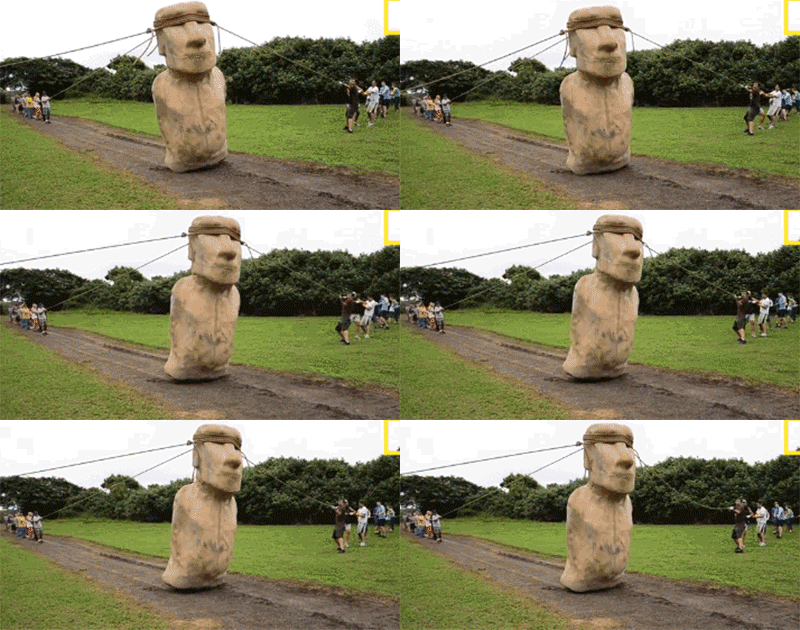
A few of the Moai, the oldest ones, were carved from Basalt. And you cant carve basalt with copper.
Huge mystery how they got there because...
Logistically, there's no basalt quarry on Easter Island and there are no mines in the entirety of Polynesia that can procure ore to manufacture copper, iron, or steel tools.
A multi-volume chronology and reference guide set detailing three years of the Mexican Drug War between 2010 and 2012.
Rantburg.com and borderlandbeat.com correspondent and author Chris Covert presents his first non-fiction work detailing
the drug and gang related violence in Mexico.
Chris gives us Mexican press dispatches of drug and gang war violence
over three years, presented in a multi volume set intended to chronicle the death, violence and mayhem which has
dominated Mexico for six years.
Rantburg was assembled from recycled algorithms in the United States of America. No
trees were destroyed in the production of this weblog. We did hurt some, though. Sorry.


 ..the braying voice of Islamic Resistance®,...
 ... Born in Las Cruces, New Mexico, zapped in Yemen, al-Awlaki was a dual citizen of the U.S. and Yemen. He was an Islamic holy man who was a trainer for al-Qaeda and its franchises. His sermons were attended by three of the 9/11 hijackers, by Fort Hood murderer Nidal Malik Hussein, and