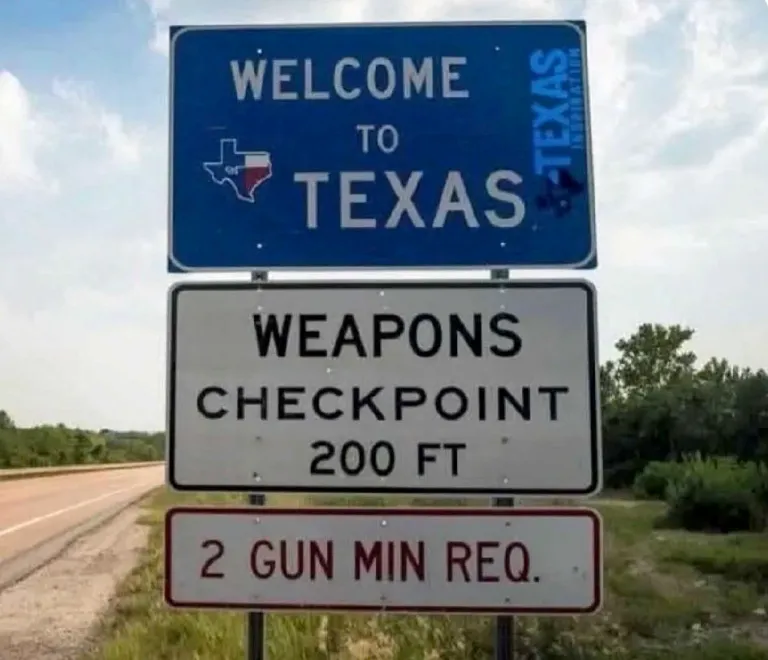
[BabylonBee] AUSTIN, TX — In a landmark move for the state, the Texas legislature overwhelmingly passed a bill to ban the sale of assault rifles that have a capacity of less than 30 rounds.
Governor Greg Abbott was expected to sign the bill into law as soon as it hit his desk, limiting Texas gun owners to purchasing assault rifles with copious round capacities.
"It's dangerous to have assault rifles in our community that can't fire more than 30 rounds before reloading," said Texas state senator Billy McCoy, who co-authored the bill. "It's irresponsible, and we can't let it keep happening."
Passing the bill wasn't easy. Democrat and Republican legislators frequently butted heads on the exact nature of the bill, with Republicans initially wanting to ban assault rifles with a capacity of less than 100 rounds and eventually being forced to compromise. Still, some Republicans referred to the "Spray-And-Pray" bill as merely a stop-gap measure.
#2
Ref: ^#1
BB aside
I agree the owners data needs to be erased.
If the Government tracks and keeps records of ownership, it but one reason, and that is future confiscation and population control.
"Specifically, Senator Ted Cruz asked about ATF’s 920 million-record illegal registry and how many documents they’ve added in the 4-year gap since the ATF last updated those figures. "
BUT!!! With that said.
How do we know if they really will erase the data, and did not just back it up to 2x 1TB thumb drives, for later use?
#8
Even if the federal registry is destroyed, many states have their own registry. Using CT as an example: any handgun purchase has a state form (DP-3) that goes to the police department the purchaser lives in. Also the CT State police require any purchase of a firearm to be approved by the CT version of NICS. The CT State Police are known to keep a database of what person owns what guns, although it is often inaccurate.
[RodMartin] Battlefield humiliation did more than embarrass the CCP. It exposed the rot in Beijing’s military model, badly set back its bid to become a major arms exporter, and upended its calculations on Taiwan.
China didn’t just lose face in Venezuela
...a country in Central America that sits on an enormous pool of oil. Formerly the most prospereous country in the region, it became infested with Commies sniffing almost unlimited wealth. It turned out the wealth wasn't unlimited, the economy collapsed under the clownish Hugo Chavez, the murder rate exceeded places like Honduras and El Salvador. A significant proportion of the populace refugeed to Colombia and points south... and Iran. It lost something much more important: credibility.
That matters because modern arms sales aren’t really about steel, explosives, radar signatures, or glossy brochures. They are about confidence. They are about prestige. They are about whether foreign governments believe your weapons will work when the shooting starts, your doctrine will hold when it is tested, and your regime knows what it is doing.
When those things fail in public, the damage doesn’t stay on the battlefield. It spreads into diplomacy, deterrence, alliance politics, and global arms exports.
The word is out: China won’t show up for its allies. And the weapons it sold them are junk.
The CCP has spent years trying to persuade the world that China is the coming military superpower, that its systems can hold America at bay, and that countries wanting something cheaper, simpler, and less politically encumbered than U.S. weapons should look East. Russia has long run a version of this play, making itself the world’s third-largest arms supplier, with weapons sales its second-largest export.
China has been trying to imitate that as it grows its own arms exports. Its pitch is the same: America is tired, decadent, expensive, and overcomplicated; we are rising, smart, capable, and ruthless enough to win.
But that pitch has been taking on water for some time. Ukraine already showed Russia’s much-vaunted strength to be a Potemkin village. China’s own vulnerabilities received unwelcome scrutiny during last year’s Operation Sindoor, when India’s clash with Pakistain tested Chinese systems in combat and punctured the aura Beijing has tried so hard to build. Venezuela and Iran ...a theocratic Shiite state divided among the Medes, the Persians, and the (Arab) Elamites. Formerly a fairly civilized nation ruled by a Shah, it became a victim of Islamic revolution in 1979. The nation is today noted for spontaneously taking over other countries' embassies, maintaining whorehouses run by clergymen, involvement in international drug trafficking, and financing sock puppet militias to extend the regime's influence. The word Iran is a cognate form of Aryan. The abbreviation IRGC is the same idea as Stürmabteilung (or SA). The term Supreme Guide is a the modern version form of either Duce or Führer or maybe both. They hate JewsZionists Jews. Their economy is based on the production of oil and vitriol... have now made the problem impossible to ignore for both Russia and China. Chinese systems that were supposed to deter, blind, protect, or complicate American operations were annihilated in the opening minutes of combat.
The result was not merely embarrassment. It was a live demonstration. Bad weapons do not just lose wars. They lose customers, and allies.
Arms exports aren’t just a source of revenue. They’re a source of influence. They create dependencies, long-term relationships, maintenance pipelines, training arrangements, intelligence opportunities, and diplomatic leverage. A country that buys your fighters, missiles, or integrated air defense systems buys a relationship as well. The seller gains a foothold.
But they’ll only buy if they think your stuff is good.
The deeper question is why China’s weapons failed so spectacularly.
Posted by: trailing wife ||
04/11/2026 00:00 ||
Comments ||
Link ||
[1790 views]
Top|| File under: Govt of Iran
The Wall Street Journal said Iran will have to rely on Russia and China to rebuild its missile program.
That assessment dovetailed with a CNN report that indicated China was working to ship air defense systems to Iran amid the two-week ceasefire with Israel and the US.
Citing three people familiar with recent intelligence assessments, CNN reported Saturday that US intelligence indicates China is preparing to deliver to Iran shoulder-fired anti-air missile systems known as MANPADs.
#6
CNN reported Saturday that US intelligence indicates China is preparing to deliver to Iran shoulder-fired anti-air missile systems known as MANPADs
I read that as a warning to China not to let any of the more entrepreneurial elements of the PLA even think about supplying MANPADS. China needs Hormuzian oil more than we do.
#7
I read somewhere a long time ago, after the IDF had pretty badly mauled the Syrians, Russians claimed the problem was not Russian weapons but the cowardly and incompetent performance of Syrian troops trying to use those weapons. Not a good way to build customer relations but what else could they say?
Posted by: Abu Uluque ||
04/11/2026 13:00 Comments ||
Top||
Direct Translation via Google Translate. Edited by Azat Rakhmanov
[REGNUM] Xi Jinping's meeting with Zheng Liwen, chair of Taiwan's opposition Kuomintang party, which took place on the morning of April 10 in the East Hall of the Great Hall of the People in Beijing, appears, in Chinese political terms, to be more than just a rare inter-party meeting.
This was the first contact between the CPC and Kuomintang leadership in ten years. It was presented as both a historic and practical signal: a commitment to peace, a rejection of the split, and a return to a developmental path for relations across the Taiwan Strait.
Most systemic experts and bloggers agree on one thing: the meeting was not only a demonstration of the shared will of Chinese people on both sides of the Strait to maintain peace and oppose separatism, but also a unique benchmark for unification.
Uh huh. Unification. Suuuure it is.
The choice of location in Chinese political culture is never random. For Chinese citizens, the East Hall is associated with events of national significance, including the return of Hong Kong and Macau.
The Chinese interpret this symbolism unambiguously. It is meant to remind both domestic and foreign audiences that there is one China on both sides of the strait, and Taiwan is considered an integral part of it.
The conclusion that can be drawn from this is that no matter how complex the circumstances, pan-Chinese issues must be resolved by the Chinese themselves, and the path to resolution lies through peaceful dialogue, not through external pressure or force.
Did anyone tell the Chinese army about the peaceful dialogue part?
The main message of the negotiations is clear: Taiwan is not a temporary compromise, but part of a shared historical and civilizational space. Appealing to "common roots," a common culture, and blood kinship serves not only an emotional but also a political function: it creates the basis for the legitimacy of the course.
So the CCP continue to believe, because they must. But like the Jews and Temple sacrifices, the Chinese of Taiwan have moved beyond such things.
From mainland China's perspective, the historic goal of unification can be postponed, but it cannot be abandoned. Xi Jinping has voiced this principled position.
But Communist Chana’s is not the only vote on the subject…
Xi Jinping and Zheng Liwen's invocation of Sun Yat-sen, the founder of the Republic of China and revered on both sides of the Strait as the Father of the Nation, is noteworthy. This is an attempt to build a historical bridge between the CPC and the Kuomintang, demonstrating that the idea of national rejuvenation and unity transcends current party divisions.
Zheng Liwen's support for this line confirms that the Kuomintang remains a convenient channel for the mainland to communicate with that part of Taiwanese society that is not ready to completely sever ties with China.
Or at least not willing to actually tell the CCP so.
The program announced today by Xi Jinping is remarkable for its combination of ideological, political, and economic instruments. Beijing is offering Taipei not abstract reconciliation, but a model of integration in which the mainland market, investment opportunities, youth exchanges, trade, and access to the resources of China's modernization play a key role.
.
In other words, unification is presented not only as a question of sovereignty, but also as a beneficial process, and the previous emphasis on military pressure has been reduced to “soft integration.”
This does not mean abandoning the hard line: behind the rhetoric of peaceful development there still lies a firm commitment to the inadmissibility of external interference.
But the big question remains: can this strategy work in Taiwan, where the political landscape is increasingly fragmented, the ranks of the aging Kuomintang supporters are thinning under the pressure of the ruling Democratic Progressive Party (DPP)'s radical rhetoric, and the local identity of young people is strengthening faster than Beijing would like?
That is indeed the question.
The answer to this question will determine whether the current dialogue will remain merely symbolic or become a prologue to a new stage in the mainland's struggle for the island's future.
Chinese media are deliberately framing the event within an international context. The logic is simple: the world has seen the cost of a major war too clearly, as seen in the Middle East, to ignore this experience.
“Nice little island ya got there. Sure would be a shame if something bad happened to it…”
The separatist agenda of the DPP politicians is considered by the Chinese side to be the main source of instability in the Strait, and therefore the main target of political containment.
China believes that if Taiwanese secessionists continue their course of secession, they will push the island into the abyss. Moreover, a potential conflict in the Taiwan Strait would exceed most wars, past and present, in terms of destruction.
‘Struth. That Three Gorges Dam looks wonderfully sturdy, but with all that fly ash in the mix… Destruction in that quarter would be excessively destructive.
The analysts' assertion is based not only on military considerations, but primarily on economic and technological considerations. Taiwan is the core of the global semiconductor industry, and companies located on the island hold the overwhelming majority of global capacity in the advanced manufacturing sector. If war breaks out, supply chains would be disrupted instantly.
Which is why they started building factories in America last year, to avoid those nasty Trump tariffs.
Under the worst-case scenario, global GDP could shrink by nearly 10% within the first year of the Taiwan Strait War, with total economic damage reaching $10.6 trillion. Taiwan itself, according to experts, could lose up to 40% of its economy.
How much value would the scorched earth have to China then, beyond the moral victory?
But the issue goes beyond economics. Massive high-density missile strikes, electronic warfare, and a naval and air blockade will lead to widespread infrastructure destruction on the island and at least in the coastal zone of mainland China. Not to mention the massive human losses and irreversible environmental consequences.
Therefore, official Beijing's assertion that "Taiwan independence" is a path to self-destruction becomes the central conclusion of most Chinese political analysts.
The only viable alternative is said to be maintaining adherence to the “1992 consensus,” which implies a rejection of separatism despite the parties’ different interpretations of the nature of a united China.
In the PRC, peaceful unification is seen not only as a way to avoid war, but also as a necessary condition for the “great revival of the Chinese nation.”
[Alt-Market.US] As much as many centrists and libertarians are opposed to Donald Trump’s ongoing strikes against Iran, I have to say, the downstream result might end up becoming one of the most libertarian results I have ever seen. For decades, small government activists like those in the Ron Paul movement have been calling for a comprehensive US divorce from NATO and the shutdown of America’s military bases overseas. Trump has, either deliberately or inadvertently, set this very process in motion. Invoking Ronulans is a non-starter for me.
The refusal of most of Europe (and Australia) to provide support in the reopening of the Strait of Hormuz might seem like geopolitical orbiting — In other words, getting involved could hurt them more than it would help them. Of course, these nations are far more exposed to the Hormuz closure and the slowdown in energy exports than the US. You would think their interests would demand a securing of the strait.
Europe is already struggling for energy resources due to the Ukraine war (a war they are deeply involved in), and this is where we stumble upon the ideological disconnect.
EUROPE’S GOAL IS WWIII AND THEY EXPECT AMERICA TO MAINTAIN THE STATUS QUO
Europeans are perfectly willing to engage in war tensions with Russia while risking energy inflation and WWIII, all over a country that had minimal strategic or economic importance to them before the conflict. They have consistently called on the US to provide weapons and funding and intel to the Ukrainians, which we have obliged. And, they have called for American troops to stand at the forefront should a wider war erupt.
NATO and European governments love America...but only as a shield that benefits them. To be clear, it’s true that years ago NATO allies invested troops and equipment into the wars in Afghanistan and Iraq, but one could also argue that, at that time, the establishment was in sync on both sides of the Atlantic.
There was no large scale movement to cut foreign aid scams (like Trump shutting down USAID). There was no movement to secure borders and prevent mass immigration. There was no movement against globalism beyond a handful of us in the alternative media working diligently to expose the truth. In the era of the early 2000s, the status quo was in full effect and Europe was happy to help in the Middle East.
Today? Not so much. The status quo has been disrupted.
#1
They're not paying attention. Trump is 'cutting' the Gordian Knot of interdependency of the post WW2 order invoking [to steal someone else's phrase] a fundamental change.
Posted by: chris ||
04/11/2026 11:57 Comments ||
Top||
#3
Dere takin' our furrin' aid! is the same argument used against our alliance with Israel. Maybe back off from this dangerous rhetoric.
We're America. We do the heavy lifting because nobody else can. Moreover this gives us enormous power in the world to affect events like nobody else.
We basically control the world with gigantic bribes, i.e. foreign aid.
It's much, much cheaper than fighting some of these countries, which are terrifying when they're angry.
Look at what Israel did to Gaza. you really want to be on the wrong side of them? A few billion a year is pocket change.
Don't forget: Mess with Jews and you lose.
#4
Look at what Israel did to Gaza. you really want to be on the wrong side of them?
Ohfergawdsake, Israel is not going to attack America! Never have they ever threatened to do so. Nor will Israel be taking any money from America in a few years, at which point we can decide if we want to continue giving anything at all to Egyot and Jordan — since both have been paid off in balance with Israel for signing peace treaties. But if Israel has decided to spare the American pocket, why should the other two continue to get anything?
Commentary by Russian military journalist is in italics.
[ColonelCassad] The Pentagon Threatened the Vatican After Pope Leo XIV Criticized the White House. U.S. Defense Department officials threatened a Vatican representative at a closed meeting in January, The New Republic reports.
If it was a private meeting, how does the New Republic know? This looks like another case of possibly imaginary, but definitely hostile, anonymous sources.
The meeting followed a speech by Pope Leo XIV to the Holy See's diplomatic corps, in which he criticized the use of force instead of diplomacy.
The pontiff stated that "diplomacy, which promotes dialogue and seeks consensus among all parties, is being replaced by diplomacy based on force," and that "war is back in fashion, and the zeal for war is spreading." The White House interpreted these words as a hostile message directed at the US presidential administration.
The Pentagon meeting was attended by Elbridge Colby, Undersecretary for Political Affairs, and Cardinal Christophe Pierre, the Vatican's representative to the United States. During the conversation, Colby stated that the United States possesses military power "enabled to do whatever it pleases in the world" and warned that the Catholic Church "would be better off siding with them."
Another Pentagon official mentioned the Avignon Papacy—the period from 1309 to 1377, when popes were forced to reside in France and were subservient to the French kings. In early February, it was announced that the Pope was not planning to visit the United States to participate in events marking the 250th anniversary of the country's independence.
The Pentagon denied any strained relations with the Vatican, calling the meeting a "respectful and reasonable discussion." However, according to The New Republic, the tone of the conversation was clearly threatening, and the mention of Avignon directly hinted at the possibility of a repeat of the historical situation in which the pontiff loses his independence and is forced to submit to secular authority.
The Vatican has not yet officially commented on reports of pressure from the Pentagon. Observers note that the incident could lead to a cooling of relations between the US and the Holy See, which were already tense after Leo XIV repeatedly called for peace in the Middle East and criticized the military operations of the Donald Trump administration.
It's impossible not to recall Stalin's famous aphorism about the Pope and the number of divisions. And the US approach itself perfectly demonstrates how American imperialism now views the mechanisms of global control exclusively through intimidation and threats. Many other familiar instruments of control and influence have simply ceased to work. Therefore, "submit or we will kill you."
President Donald Trump announced Saturday that “We’re now starting the process of clearing out the Strait of Hormuz as a favor to Countries all over the World, including China, Japan, South Korea, France, Germany, and many others.”
“Incredibly, they don’t have the Courage or Will to do this work themselves. Very interestingly, however, empty Oil carrying ships from many Nations are all heading to the United States of America to LOAD UP with Oil,” Trump wrote on Truth Social.
How soon will he choose NOT to sell oil to some. Like Denmark, perhaps.
[PJMedia] On April 8, Pakistain's Prime Minister Shehbaz Sharif said that the United States and Iran ...a theocratic Shiite state divided among the Medes, the Persians, and the (Arab) Elamites. Formerly a fairly civilized nation ruled by a Shah, it became a victim of Islamic revolution in 1979. The nation is today noted for spontaneously taking over other countries' embassies, maintaining whorehouses run by clergymen, involvement in international drug trafficking, and financing sock puppet militias to extend the regime's influence. The word Iran is a cognate form of Aryan. The abbreviation IRGC is the same idea as Stürmabteilung (or SA). The term Supreme Guide is a the modern version form of either Duce or Führer or maybe both. They hate JewsZionists Jews. Their economy is based on the production of oil and vitriol... (as well as their allies) had agreed to a ceasefire "everywhere" following mediation by his government.
Sharif said that the two-week truce (which Trump and Tehran had announced earlier) would lead to talks in Pakistain’s capital.
On April 7, however, Pakistain abstained from voting on a United Nations ...boodling on the grand scale... Security Council resolution that called for Iran to reopen the Strait of Hormuz, distancing itself from an Arab-backed initiative in a significant diplomatic signal.
The resolution was submitted by Bahrain alongside Jordan, Kuwait, Qatar ...an emirate on the east coast of the Arabian Peninsula. It sits on some really productive gas and oil deposits, which produces the highest per capita income in the world. They piss it all away on religion, financing the Moslem Brotherhood and several al-Qaeda affiliates. Home of nutbag holy manYusuf al-Qaradawi... , Saudi Arabia ...a kingdom taking up the bulk of the Arabian peninsula, largely made up of sand and oil rigs. Its primary economic activity involves exporting oil and soaking Islamic rubes on the annual haj pilgrimage. The country supports a large number of princes in whatcha might call princely splendor. Formerly dictatorial and steeped in Olde Tyme Religion, deferring to Salafist holy men on all issues, it has now done a 180 and is making a serious effort to modernize, so as not to be left in the sand by its Gulf Arab neighbors. The holy men have been shoved to the background and the nation is now still dictatorial but somewhat rational. That doesn't make them trustworthy, but it's a start... , and the United Arab Emirates, and supported by the United States. It called for de-escalation and the immediate reopening of the Strait of Hormuz — a strategic maritime chokepoint through which a substantial portion of global oil shipments passes.
If Paks voted in favor of the UN resolution, then Iran would have been incensed. Now that they have abstained, Saudis and other Arab states are obviously displeased. Pakistain's government basically does not have the courage or efficiency to vote against it.
The UN Security Council thus failed to adopt the resolution which would boost security in the Strait of Hormuz.
So can Pakistain really function as a key intermediary given its record as a negotiator and policy maker within the wider region?
Pakistain’s bid to sell itself as a neutral mediator in the West Asia crisis has ended in strategic failure. It has exposed Islamabad as diplomatically overextended, economically fragile, and increasingly untrusted by every major nation it has tried to court. At a time when Pakistain is already crushed by multiple challenges: deepening domestic pressures, public debt (Rs80.52 trillion by the close of fiscal year 2025), external debt and liabilities at $138 billion, petrol prices soaring to Rs458 per liter, LNG costs rising by 38%, and electricity tariffs climbing under the weight of global energy shocks. Its leadership appears to have calculated that geopolitical maneuvering could compensate for economic weakness. Instead, the opposite has happened. What was presented as clever diplomacy has turned into a spectacular collapse of credibility.
The strategy took shape in early 2026 as Washington and Tehran moved closer to direct confrontation. Pak officials inserted themselves as intermediaries, offering Islamabad as a back channel between rival powers. For a brief period, the arrangement seemed useful. But Pakistain’s habit of trying to stay useful to all sides, without committing to any, soon caught up with it. The result has been a cascading loss of confidence from Washington, Riyadh, Abu Dhabi, Doha, Beijing, and Tehran.
The Gulf was the first to signal that the game was up. That reality is now visible across the board as Gulf states are increasingly unwilling to indulge Pakistain’s contradictions. The United Arab Emirates has stepped back from major commitments. Qatar has imposed measures that directly affect the labor mobility on which Pakistain depends for remittance inflows. Saudi Arabia, despite headline-level defense understandings, has found Pakistain reluctant to translate rhetoric into meaningful strategic reliability when regional tensions rose. The message from the Gulf is unmistakable: Pakistain wants the protection of partnership without the burdens of consistency.
China, too, has begun to lose patience. For years, Beijing treated Pakistain as its flagship South Asian partner, but that confidence is now visibly eroding. Chinese officials increasingly suspect Islamabad of quietly leaning toward Washington in search of IMF relief and security, even while continuing to seek Chinese economic support. That frustration has already produced material consequences, including pressure for the repayment of $220 million owed to United Energy Petroleum. Even more damaging was the failure of the Chinese-mediated Urumqi talks earlier this month. They were supposed to ease tensions along the Pakistain-Afghanistan border ...also known as Pashtunistan, home of ignorance, poverty, and automatic weapons... but instead ended in renewed accusations with no breakthrough. From Beijing’s perspective, Pakistain is no longer a stabilizing asset. It is a liability that cannot even manage disorder on its own frontier.
Iran’s rupture with Pakistain is the most serious of all. Tehran now sees Islamabad not as an honest broker but rather as a compromised channel that acts in alignment with American interests. Reports cited by Iranian-American scholar Vali Nasr suggest that Pakistain-hosted back-channel contacts may have been used in ways that exposed Iranian officials. The most explosive case involves former Iranian Foreign Minister Kamal Kharrazi, who was maimed in a strike (in which his wife was killed), an incident Iranian authorities reportedly connect to his role in Pakistain-facilitated talks.
The United States, meanwhile, has shown no intention of defending Pakistain once its utility declined. Washington used the channel when it suited its immediate purposes, then stepped back without cost. That, in itself, is telling. For American policymakers, Pakistain is not a trusted ally or a serious regional pillar. Rather, Pakistain is a disposable tactical instrument, useful in narrow moments, and easily abandoned when circumstances change.
All of this feeds directly back into Pakistain’s domestic crisis. Gulf remittance pathways are under strain, Chinese financing is slowing, energy costs remain punishing, and inflationary pressure is intensifying. Households are squeezed by rising fuel and electricity costs, outages are becoming harder to manage, and public frustration is deepening. Islamabad’s leaders appear to have believed that by keeping one foot in every camp they could maximize leverage, extract concessions, and avoid hard choices. Instead, they have reproduced an old Pak habit: seeking rents from geopolitical instability while avoiding the strategic discipline that lasting credibility requires.
That pattern is not new. For decades, Pakistain has tried to convert its geography into diplomatic currency, shifting between patrons, security frameworks, and rival power centers in the hope of remaining indispensable to all. During the Cold War, the anti-Soviet jihad period, and again in the post-9/11 order, this strategy often delivered short-term inflows of money, weapons, and political relevance. But it also entrenched a deeper reputation: a state skilled at transactional positioning, yet repeatedly unable to inspire durable trust. What once worked in a more forgiving international system is no longer working in a far harsher regional environment, where major powers are less willing to subsidize ambiguity and far quicker to punish duplicity.
That is what makes the current moment more serious than a routine diplomatic setback. In a region being reshaped by war, energy insecurity, and hard strategic realignment, the old Pak method of hedging, extracting, and recalibrating after the fact is colliding with a new reality. The room for double games has narrowed. The tolerance for tactical ambiguity has diminished. Partners now want reliability, not improvisation; commitments, not balancing acts; strategic clarity, not permanent maneuvering.
Posted by: trailing wife ||
04/11/2026 00:00 ||
Comments ||
Link ||
[1799 views]
Top|| File under: Govt of Pakistan
[Dawn] In Islamabad, a fragile truce has brought the United States to the table militarily undefeated, but facing an Iran that now holds the stronger hand in a new structure of power.
In Islamabad, a fragile truce has brought the United States to the table militarily undefeated, but facing an Iran ...a theocratic Shiite state divided among the Medes, the Persians, and the (Arab) Elamites. Formerly a fairly civilized nation ruled by a Shah, it became a victim of Islamic revolution in 1979. The nation is today noted for spontaneously taking over other countries' embassies, maintaining whorehouses run by clergymen, involvement in international drug trafficking, and financing sock puppet militias to extend the regime's influence. The word Iran is a cognate form of Aryan. The abbreviation IRGC is the same idea as Stürmabteilung (or SA). The term Supreme Guide is a the modern version form of either Duce or Führer or maybe both. They hate JewsZionists Jews. Their economy is based on the production of oil and vitriol... that now holds the stronger hand in a new structure of power.
All eyes are on Islamabad this weekend as the city braces to mediate one of the most consequential, high-stakes peace negotiations since the culmination of the Second World War.
Starting today, American emissaries, led by Vice President JD Vance, will sit across the table from Iranian diplomats to negotiate a lasting settlement to a war that has rattled global power structures and stock markets alike.
On the face of it, it is a welcome development from where the world found itself on Tuesday. As daylight drew to a close, the world watched in anticipation as Washington backed itself into an impossible corner, promising to annihilate "a whole civilisation" if Tehran did not give a safe passageway to traffic through the Strait of Hormuz.
But a last-ditch diplomatic breakthrough by Pakistain managed to pull both sides from the brink of a potentially catastrophic escalation of unknowable consequences.
For now, Islamabad seems to have bought both sides some time to turn a fragile truce into something akin to a durable agreement. It is, to put it mildly, a fraught endeavour.
A NEW IRAN?
For one, the United States must reckon with the fact that the Iran that sits across the table in Islamabad on Saturday is not the Iran that walked into Geneva in February.
When the US last met Iranian representatives in Switzerland ...home of the Helvetians, famous for cheese, watches, yodeling, and William Tell... two months ago, the Islamic regime in Tehran was uniquely exposed, perhaps for the first time in its 46-year history. It had barely weathered years of crippling sanctions, a cratered currency, and deafening international isolation. The Twelve Day War had laid bare the vulnerabilities in its ground and air defenses, and had set its nuclear programme back by decades.
The Axis of Resistance®, the crown jewel of Iran’s deterrence capability, had been debilitated beyond repair, with supply lines to Leb ...home of the original Hezbollah, which periodically starts a war with the Zionist Entity, gets Beirut pounded to rubble, and then declares victory and has a parade.... and Gazoo
...Hellhole adjunct to Israel and Egypt's Sinai Peninsula, inhabited by Gazooks. The place was acquired in the wake of the 1967 War and then presented to Paleostinian control in 2006 by Ariel Sharon, who had entered his dotage. It is currently ruled with a rusty iron fist by Hamas with about the living conditions you'd expect. It periodically attacks the Hated Zionist Entity whenever Iran needs a ruckus created or the hard boyz get bored, getting thumped by the IDF in return. The ruling turbans then wave the bloody shirt and holler loudly about oppression and disproportionate response... severed with the fall of the Assad regime in Syria. And in January, nationwide protests had enfeebled the Ayatollah’s hold on power; the protests were suppressed eventually, but only by the skin of their teeth.
Over the past six weeks, the US and Israel amped up attacks across military installations and civilian infrastructure, expanded targets, and incrementally struck deeper into Iranian mainland, hoping they could batter Tehran into compliance. What they found instead was a country willing to stare the military might of Empire in the face, standing steadfast in its wake, and living to tell the tale.
For all its military bluster, it’s hard to shy away from the fact that the US has remained incapable of translating its wins on the battlefield to achieving its strategic objectives, whatever they may have been. Iran has managed to retain its nuclear infrastructure and enriched uranium stockpiles, thereby securing a compressed timeline to weapons capability should it make the political choice to cross that threshold. More consequentially, however, Tehran has credibly demonstrated its ability to choke global energy flows and hold the world economy hostage, altering the strategic calculus of its adversaries.
In an increasingly globalised world economy, the demonstrated capability to secure and disrupt the flow of commerce is a credible form of political power. According to Professor Robert Pape of the University of reliably Democrat Chicago, aka The Windy City or Mobtown ...home of Al Capone, the Chicago Black Sox, a succession of Daleys, Barak Obama, and Rahm Emmanuel... , actors in the international system are able to anticipate disruption, and are forced to adapt in advance, hedging risk and tweaking policy to advance concessions to the party (in this case, Iran) that is generating the risk of disruption. This is a critical shift in the balance of power, which is likely to contort global political response in Tehran’s favor for years to come.
If the core currency of power in international politics is the ability to shape the behaviour of others, it would seem that Iran has skewed the balance of regional power in its favour, and it knows it. Iran’s 10-point proposal, which President Donald Trump ...The tack in the backside of the Democratic Party... has accepted as a "workable" framework upon which the negotiations are to be held, is a statement of what Tehran now believes it’s now entitled to demand.
Calls for enrichment rights, complete sanctions relief, American military withdrawal, and most notably, control over the Strait of Hormuz, point to a country that has recalibrated its sense of its own leverage upward from where it stood less than two months ago in Geneva.
Hence, the US will arrive at the capital militarily undefeated, but it will be Iran that will boast the stronger hand to dictate the terms of peace. It is ultimately this paradox that will loom largest over the mediation process in Islamabad. The outcome of the summit will hinge on Pakistain’s ability to tactfully navigate the twists and turns of this diplomatic quagmire and create a meaningful exit ramp it can credibly package and sell to both sides.
EMPIRE ON THE TABLE
But the White House is no easy sell. For a war that started without a clear strategy or identifiable metric with which to gauge success, the formula for peace is just as murky.
Political patience for America’s excursion into Iran is wearing thin, and the Trump administration has found itself walking a tightrope in trying to hold its political coalition at home. With the midterms slated for November, the administration knows it’s on the clock.
This makes it tough for Washington to read its hand for what it really is. Beyond the blaring war drums and the noise of strikes and counter-strikes, threats and truces, the war has exposed the erosion of something far more fundamental than a kinetic advantage on the battlefield.
For decades, American primacy had anchored itself on one important pillar: the unrivaled ability of the United States to guarantee the stability of critical economic flows. It was this guarantee that underwrote alliances, anchored markets, and ensured American credibility across the world. It was, in a meaningful sense, the infrastructure underlying American power in the world.
In failing to coerce Iran to reopen transit through the Strait of Hormuz, the US has inadvertently cracked the infrastructure wide open, exposing the limitations of its promise. Despite overwhelming conventional military superiority over Iran, allies watched on as the US struggled to unclog one of the most critical energy chokepoints in the world.
The Gulf states were neither consulted before the war nor adequately defended during it. Trump’s continued pressure on NATO ...the North Atlantic Treaty Organization. It's headquartered in Belgium. That sez it all.... has deepened existing fractures in the transatlantic relationship. And Europe, conspicuously, has not responded to American calls for assistance in securing the Strait.
It’s clear that allies are quietly diversifying relationships, and recalibrating their reliance on a security architecture that has suddenly appeared less certain than it once did.
This erosion of credibility will walk alongside the American delegation into the negotiating room, diminishing their leverage to force Iran into accepting a settlement that the Trump administration can sell at home.
What makes this particularly consequential is that the fundamental sticking points have not moved meaningfully. American officials, including Vice President Vance, have sought to revive the push for zero enrichment, a demand Iran has consistently treated as an assault on its illusory sovereignty and its right to technological self-determination. Tehran did not concede that point when it was on its knees in February. It is unlikely to concede it now that it knows it’s negotiating from a position of considerably greater strength.
The result is a zone of possible agreement that is, at best, dangerously narrow. Washington needs an off-ramp it can frame as Iranian capitulation on nuclear ambitions, but lacks the diplomatic maneuverability to actually deliver it. With the US constrained in its diplomatic capital, short on time, and saddled with demands it cannot abandon and Iran will not accept, Pak mediators will have a gruelling task ahead of themselves.
THE ELEPHANT (NOT) IN THE ROOM
Even if Islamabad is able to resolve these seemingly irreconcilable differences, any step towards a lasting settlement will hinge on Washington’s ability to balance its strategic interests with those of the Israelis.
When Netanyahu finally addressed the Israeli public 18 hours after the ceasefire came into effect, his speech was a declaration of unfinished business. "We still have goals to complete," he told the nation. "We will achieve them either by agreement or by the resumption of fighting." It was a remarkable thing to say on the first night of a ceasefire — an unambiguous signal to Washington about the limits of Israeli buy-in.
Washington may be foggy on the details of why it went to war, but Jerusalem has had its eye on the ball from the very first day. For Israel, the calculus was as straightforward as it gets: Iran represents the last serious obstacle to an era of unchallenged Israeli regional hegemony in the region, and the window to remove it is closing. American support for Israeli military operations has never been thinner, and Netanyahu, for whom a war with Iran has been the animating obsession of a decades-long political career [Read: ’What is Netanyahu’s endgame?’], understands that opportunities of this magnitude do not present themselves twice. A negotiated agreement that leaves Iran with any residual enrichment capacity falls categorically short of that objective.
The divergence was clear as soon as the ceasefire took effect. Within hours of Prime Minister Shehbaz Sharif announcing an agreement to pause all hostilities "including Lebanon", the IDF bombarded Beirut, striking over a hundred targets and killing more than 200 people. Trump was eventually forced to call Netanyahu directly, pressing him to "low-key it" in Lebanon. That a sitting American president had to call his closest regional ally to ask him not to blow up his own ceasefire on its first day is, by any reasonable measure, an extraordinary state of affairs.
This creates a structural fault line underlying the proceedings in Islamabad. Even if an agreement is produced, there will be no real guarantee that Israeli non-compliance will not unravel it. The US will have to answer the overarching question of whether it is negotiating on behalf of itself, or Israel.
The final goals for both have started to diverge.
For Trump, the priority is to reopen the Strait of Hormuz and secure a political win before November. Netanyahu won’t rest until there is a permanent neutralisation of Iran’s power, including its proxies, its missiles, and its nuclear programme. Until Washington resolves which principal it is actually representing at the table, any agreement it reaches will rest on a foundation out of its complete control.
THE ART OF THE DEAL
This is not to say that the off-ramp doesn’t exist. But approaching it would require Washington to enter Islamabad with an accurate read of what the past six weeks have produced — a new balance of power in the region.
The US need not surrender its core interests in Islamabad. Within the frameworks that Iran has proposed, the US can still credibly push for a non-weaponisation commitment, verifiable IAEA access, and a durable arrangement to regulate the Strait of Hormuz, wrapping it up in semantics that would register as a win back home.
But achieving this would require the US to stop negotiating toward the deal it wanted before the war and start accepting the deal made possible by the war. The outcome of the peace talks will hinge on whether the parties are able to close the gap between those two positions.
If the talks collapse, the resumption of conflict will arrive in a system where both sides now understand the pressure points better than they did six weeks ago, and where the costs of escalation will be transmitted faster, wider, and further than before.
The ceasefire has revealed a new structure of power, in which the United States can no longer assume control over outcomes through military might alone, and in which even limited disruption via asymmetrical capabilities can reshape the behaviour of the international system.
Islamabad is the first real test of whether diplomacy can operate within the new structure. Whether the parties in that room are up to that task remains to be seen.
Posted by: trailing wife ||
04/11/2026 00:00 ||
Comments ||
Link ||
[1783 views]
Top|| File under: Govt of Pakistan
#1
Given the Pak MoD's comments - this whole thing is just a kabuki dance.
#2
But achieving this would require the US to stop negotiating toward the deal it wanted before the war and start accepting the deal made possible by the war.
A) The deal has not changed. No nukes; the Strait open. Regime change would be gravy on top but not a requirement.
B) The war is not over yet.
#1
“Four or five children out of seven died before they turned four,”
It remained high till the beginning of the 20th Century and modern medicine. Given that there was no old age pension system before then, your family took care of you. If you were without offsprings, you were on your own. Due to the infant mortality, the women had to have many pregnancies to insure the family's future. That in turn resulted in deadly complication resulting in a much lower life expectancy. The "who needs men" feminist ignore what those male physicians did for their health and life expectancy.
#4
Baby-killing was one of the things the Romans found so revolting about Carthage. When the Catholics discovered the Aztecs going the same, they put an end to them. Even after the Catholics called to stop the killing, the victims of the Aztecs kept going, and going, and going.
One of the reasons God expelled the Hebrews from Israel and into Egypt was breaking their covenant, worshiping other gods, idolatry and child sacrifice to Moloch(Ba'al, god of rain). This broke the First Commandment, handed down to Abraham.
Deuteronomy 28
The LORD shall bring a nation against thee from far, from the end of the earth, as swift as the eagle flieth; a nation whose tongue thou shalt not understand.
A multi-volume chronology and reference guide set detailing three years of the Mexican Drug War between 2010 and 2012.
Rantburg.com and borderlandbeat.com correspondent and author Chris Covert presents his first non-fiction work detailing
the drug and gang related violence in Mexico.
Chris gives us Mexican press dispatches of drug and gang war violence
over three years, presented in a multi volume set intended to chronicle the death, violence and mayhem which has
dominated Mexico for six years.
Rantburg was assembled from recycled algorithms in the United States of America. No
trees were destroyed in the production of this weblog. We did hurt some, though. Sorry.


 ...a kingdom taking up the bulk of the Arabian peninsula, largely made up of sand and oil rigs. Its primary economic activity involves exporting oil and soaking Islamic rubes on the annual haj pilgrimage. The country supports a large number of princes in whatcha might call princely splendor. Formerly dictatorial and steeped in Olde Tyme Religion, deferring to Salafist holy men on all issues, it has now done a 180 and is making a serious effort to modernize, so as not to be left in the sand by its Gulf Arab neighbors. The holy men have been shoved to the background and the nation is now still dictatorial but somewhat rational. That doesn't make them trustworthy, but it's a start...
 ...home of the original Hezbollah, which periodically starts a war with the Zionist Entity, gets Beirut pounded to rubble, and then declares victory and has a parade....