Text taken from an opinion article in TASS.com by Russian military journalist Boris Rozhin
[ColonelCassad] "NATO Sentinels."
Starting March 9, Norway will host the eleven-day, major military exercise Cold Response 2026, led by the North Atlantic Alliance. Fourteen NATO countries began deploying personnel and equipment there several weeks before the start of the exercises themselves, which are part of the officially announced Arctic Sentry mission. The official pretext for the March maneuvers was "strengthening Norway's security" and "testing its defense capabilities."
Of course, the propaganda rhetoric surrounding the exercises (as well as those of Arctic Sentry, Baltic, and Eastern) makes little attempt to conceal the fact that Russia allegedly poses the primary threat in the region to Norway, Finland, and the Scandinavian countries as a whole. "Arctic Sentinel" is planned for "Cold Response 2026," with 25,000 personnel planned, 11,800 of whom will be stationed in Norway.
A significant number of aircraft and helicopters, as well as a group of combat and support ships, are envisioned, operating in designated areas off the country's coast. NATO announced the launch of "Arctic Sentinel" in early February. The mission aims to increase the presence of the Alliance's collective forces in the Arctic and intensify the militarization of the region with a view to long-term "containment of Russia." The Scandinavian territories will be the primary base. Additional stated objectives include demonstrating NATO's capabilities in response to US territorial claims to Greenland and blocking China's economic expansion in the Arctic region.
These aspects, incidentally, have highlighted the alliance's lack of readiness—without the US—to operate promptly in Arctic conditions. From logistics to the operational interaction of units from various countries, some of which are fundamentally unprepared for combat operations in such conditions. NATO is well aware of the importance of the Arctic region, especially in the long term.
The economic and logistical significance of the Arctic is growing, while US ambitions are increasing the overall political turbulence in this area as well. At the same time, Russia, thanks to a long-standing, well-thought-out policy, has a much stronger position in the region. NATO is more of a catch-up player here. At the same time, similar operations are planned for other regions of Europe: Baltic Sentry and Eastern Sentry. NATO is also using them to put pressure on Russia.
Exercises under the "Baltic Sentinel" mission, launched in January 2025, are carried out by NATO countries under formal pretexts such as "protecting shipping in the Baltic," "combatting sabotage on undersea cables and pipelines," and so on. Of course, it is always implied, even openly stated, that Russia is the one posing the threats. Accidents on pipelines and undersea communication cables are also blamed on Russia. Meanwhile, there is no evidence of Moscow's involvement in damaging even a single facility.
But within the propaganda framework, this is irrelevant. Accusations continue to be used to justify further militarization with the ultimate goal of "turning the Baltic Sea into a NATO lake." To achieve this, both the Russian Baltic Fleet and Russian economic interests must be displaced.
In reality, this appears to be a growing presence of Alliance ships in the Baltic Sea. Thus, in January, several NATO ships entered the Gulf of Finland and the Gulf of Finland, forming a squadron led by the Dutch frigate Tromp. Under the same pretext of combating "cable damage," they stopped, inspected, and detained tankers, which were accused, among other things, of ties to the "Russian shadow fleet." The EU's methods in this area are already virtually indistinguishable from maritime piracy, and here they were reinforced.
Several merchant vessels were directly accused of damaging sea cables, but in none of the cases was malicious intent proven, and all were released. Nevertheless, this campaign was actively used to demonstrate the need to build up NATO forces in the region to "fight Russia" and "its shadow fleet."
It is no coincidence that the scheme tested in the Baltic in 2025 has begun to be used to seize merchant ships under the flags of other countries and in other regions. All for the same far-fetched reasons. We are talking about attempts to establish an informal trade blockade. This was openly discussed, in particular, at the Munich Security Conference in February. Its participants declared the need to seize ships to inflict economic damage on Russia.
In this regard, both the "Baltic Sentinel" operation and subsequent campaigns against tankers and merchant vessels are part of a proxy war against Russia under pseudo-legitimistic pretexts such as "sanctions violations," which they are attempting to impose on the rest of the world.
"Eastern Sentinel" was launched in September 2025 and was officially justified by the need to "strengthen NATO's eastern flank." As in other areas, it is not at all hidden that all "Eastern Sentinel" exercises are aimed at "containing Russia."
This vector implies closer integration and unification of the armies of NATO member states in Eastern Europe, as well as an overall increase in the size of the alliance's forces. Concentrated forces on the eastern flank—against Russia and Belarus—could also participate in various intervention scenarios in Ukraine. Britain, France, and several other countries have openly stated this. It is the troops involved in the "Eastern Sentinel" mission that are capable of quickly entering Western Ukraine. These plans have long been developed, as the Russian Foreign Intelligence Service has repeatedly stated.
Only Russia's firm stance that Moscow will consider these forces legitimate military targets restrains NATO from pursuing the most adventurous scenarios. But the threat, in my opinion, remains.
It's worth noting that, as in the Baltics, the "Eastern Sentinel" mission was launched under a false pretext—"Russian drones flying into Poland." In practice, however, either Ukrainian anti-aircraft missiles were fired there, or crude provocations were staged, with Gerber missiles that had crashed in Ukraine being launched at Poland. The goal, among other things, was to draw Warsaw into the conflict. No evidence of Russian strikes on Poland, or even accidental landings, was presented. However, the decision to increase NATO's presence—specifically in Poland and Lithuania—was made.
Several thousand additional NATO troops from more than 10 countries have been deployed to these countries, along with additional aircraft and helicopters (up to 20-25), Patriot SAM batteries, various short-range air defense systems, and electronic warfare (EW) assets. But, of course, the process doesn't end there.
NATO Secretary General Mark Rutte has made no secret of the fact that the "Eastern Sentinel" is intended to cover the entire eastern flank (not just Poland and Lithuania)—from the Mediterranean to the Far North. In fact, both the "Baltic Sentinel" and "Arctic Sentinel" are components of the "Eastern Sentinel" strategy. At the same time, there is a defined enemy and a clear strategy of provocations and propaganda accusations to justify further militarization and create operational-strategic threats to Russia and Belarus, which the West seeks to "strategically defeat."
In this regard, it is important to understand that all these "Sentinels" are NATO instruments for waging a hybrid war against Russia. And the constant exercises near our borders are a constant source of military and political tension that Russia cannot ignore.
RUSSIA'S RESPONSE TO THE "SENTINELS":
Of course, Russia will not ignore all this aggressive activity and destabilization of the region. As the Russian military-political leadership has repeatedly stated, these actions will be met with a symmetrical response: a buildup of forces in northwestern Russia will be conducted to deter NATO threats. But they appeared not with the launch of the Baltic Watch, but much earlier.
In the Russian Federation, on February 26, 2024, two military districts were recreated by decree of President Vladimir Putin: Moscow and Leningrad. The former is strategically aimed at covering our western frontier and allied Belarus, while the latter is tasked with countering threats along our northwestern borders.
The Leningrad Military District (LMD) was created within the administrative boundaries of Karelia, Komi, Arkhangelsk, Vologda, Kaliningrad, Leningrad, Murmansk, Novgorod, and Pskov Oblasts, St. Petersburg, and the Nenets Autonomous Okrug. Throughout 2025, its structures and units were actively formed, receiving various new equipment (even with the Ukrainian front being a priority).
The LMD's main force is the 6th Army, which includes three army corps (one of which is currently participating in operations in Ukraine) and the 6th Air Force and Air Defense Army. The district possesses a wide range of modern strike weapons. Authorities have repeatedly noted that the Leningrad Military District's missile systems (primarily the Iskander tactical ballistic missile system) are capable of quickly striking targets across virtually all of Europe, including most capitals and key command posts of NATO countries.
Furthermore, in February of this year, Russian Foreign Minister Sergey Lavrov directly described NATO activity in the Arctic—specifically, along the Greenland route—as a threat to Russia, which will receive a military-technical response. This is already evident in the quantitative and qualitative buildup of the Leningrad Military District's forces.
The threat posed by NATO should not be underestimated either.
The development of new weapons, the growing role of unmanned systems of all types, satellite communications systems and neural network target identification, military-grade artificial intelligence, and the overall evolution of the concept of multi-domain operations require further modernization of the district's capabilities (and the entire sector).
Much depends on the domestic military-industrial complex and the effective implementation of the most valuable experience of the Central Military District into combat manuals and the organizational structure.
This applies to both the Baltic and Northern Fleets, as experience in the Black Sea has clearly demonstrated that this area of warfare has also changed significantly. In fact, Russia's top military and political leadership has already voiced the need to increase the number of ships in the deep-sea zone. This will require a new, large-scale shipbuilding program.
Generally speaking, Russia already possesses considerable military capabilities in the west of the country. But, of course, systematic work is required to continually strengthen and modernize them, as the enemy is also evolving.
Threats from the West will not disappear on their own; the confrontation will be protracted. If you want peace, prepare for war.
[FoxNews] Beijing bought 80% of Iran's oil exports before US began dismantling Tehran's military capabilities
Iran’s tyrannical and ruthless regime is disintegrating. After yet again massacring thousands of its own citizens for voicing their dreams for liberty and better governance, the Iranian regime, meanwhile, resumed pursuing nuclear capability and its aggressive ICBM program. The regime’s overconfidence in U.S. inaction cost it its leader, and its core military capabilities are going up in smoke. Against this backdrop, the conflict has spread to the Gulf, threatening the Strait of Hormuz, a choke point for roughly one-fifth of the world’s petroleum, and forcing the rest of the world to rethink how it prices energy risk and political alignment.
This is not another regional flare-up. This is a rupture of an old equilibrium in which sanctioned oil, shadow fleets and calibrated escalation kept markets stable enough to function. That equilibrium is now breaking. A rapid political-military shift in the Middle East is unfolding alongside a restructuring of the global energy order.
When I was in Afghanistan during the surge, Tehran’s active support for the insurgency fighting the United States and Afghan forces fomented instability and amplified violence for which civilians paid the biggest price, a dynamic that so many across several nations have tragically encountered for decades. But Iran was never a contained regional problem.
While its terrorism was widely perceived as a Middle East issue, its cyber and intelligence operations spanned continents, with assassination plots that included the American president. As to global effects, Iran’s energy has always made its regime globally significant.
At this stage of the conflict, the most economically significant and immediate geography is the Strait of Hormuz, which Iran is working to choke off. Roughly one-fifth of global petroleum and a substantial portion of liquefied natural gas move through that narrow corridor. As strikes intensified, vessels paused transit, insurers reassessed exposure and operators rerouted cargoes. Markets adjusted immediately. Energy security and geopolitical stability are now inseparable; maritime risk has become the pressure valve through which regional conflict spills into global consequence.
This realignment did not begin in the Gulf this weekend. It started with U.S. actions in Venezuela. Caracas holds the world’s largest proven crude reserves — about 303 billion barrels — and even marginal normalization under a more U.S.-cooperative government alters the supply calculus for Washington and its allies.
The new U.S.–Venezuela arrangement has already generated roughly $2 billion in transactions in just weeks, pulling Venezuelan barrels back into wider circulation and altering the discount ecosystem Moscow had grown accustomed to. Stack that with a post-crisis Iran re-entering markets on different terms, and the shadow ecosystem of discounted, sanctioned crude — Russia, Iran, Venezuela — begins to fracture and reprice simultaneously.
But the most consequential energy recalibration runs through Beijing. China is essentially Iran’s oil export market. In 2025, China bought more than 80% of Iran’s shipped oil, averaging ~1.38 million barrels per day (bpd), about 13.4% of China’s seaborne crude imports — meaning Beijing is simultaneously Tehran’s economic lifeline and its strategic choke chain.
By turning a sanctioned producer into a quasi-captive supply relationship — sustained through gray-market routing, reflagging and intermediary hubs — Beijing secured discounted barrels in normal times and leverage in crisis. Any sustained disruption of Iranian flows forces China into replacement buying that tightens global markets and exposes China’s own energy security; Iran exports about 1.6 million bpd mainly to China and such disruptions pushes Beijing to pivot to alternatives.
The relationship is therefore best understood as a dependency loop: Iran needs China for revenue and sanctions relief-by-proxy; China uses Iran as a discount supplier and as a pressure valve in the sanctioned crude system — one that can be tightened or loosened depending on Beijing’s broader negotiation posture with Washington and its appetite for risk in the Gulf. That Iran-China dependency is no longer stable. With Iranian oil flows disrupted, China faces a choice between turning to alternative suppliers at higher cost or even tapping strategic reserves. Tightening global crude markets resulting from U.S. actions in Venezuela and now Iran give Washington leverage in energy pricing.
Beyond the tanker decks, this shift underscores the larger theme of reconfiguration: resources once bundled to manage sanctions are now subject to heightened geopolitical risk, forcing China to rethink dependencies while the U.S. and its partners are positioning to shape the post-conflict energy order. Energy supply patterns will restructure global power relations. And where China is recalibrating exposure, Russia is recalculating opportunity.
The same forces reshaping China’s calculations are altering Moscow’s. As India trims Russian purchases, Moscow has been pushing more barrels into China, and Reuters reports China’s Russian crude imports hitting new records in February while Russian sellers widened discounts to keep demand — Urals trading roughly $9–$11 below Brent for China deliveries, and other Russian grades also cutting hard as sellers chase Chinese refiners.
This matters because China is also the anchor buyer for sanctioned Iranian crude; the "discount market" is not infinite, so Russia and Iran are now competing for the same limited pool of Chinese buyers, driving deeper concessions and leaving cargoes idling — exactly the kind of sanctions-economy dynamic.
Add the West’s tightening focus on Russia’s "shadow fleet" and the risk of seizures or insurance denial, and you get an energy chessboard where coercion moves from rhetoric to logistics: who can ship, insure and clear payments reliably becomes as strategic as who can produce.
In that context, Russia’s loud warnings about Hormuz disruption are not just diplomacy, they are a reminder that Moscow profits from volatility, but also needs a functioning gray-market channel to China, and Iran’s crisis threatens to scramble the very discount ecosystem Russia has used to finance its war in Ukraine. Structural realignment threatens the very gray-market architecture on which Moscow has relied.
Energy is only one layer of a global shift. Strategic minerals remain critical. The Trump administration has increased economic and maritime pressure on Cuba, tightening an effective oil blockade that choked off fuel imports. President Donald Trump has authorized tariffs targeting countries supplying oil to Havana.
This is not simply punitive policy. It reflects a broader strategic doctrine: deny adversarial regimes energy lifelines while repositioning the Western Hemisphere’s resource base toward U.S. leverage. Oil is only one domain. Rare earth elements are a strategic asset. Cuba’s nickel and cobalt output, combined with China’s tightening grip through rare-earth export controls indicates that leverage is not just oil fields but also supply chains. America achieving rare earth elements sovereignty will remain a strategic goal and such a global realignment on this front is much needed.
By the close of the first weekend, Iran appeared intent on accelerating its own collapse by compounding strategic error with strategic error. Iran felt it wise to respond to U.S. and Israeli strikes by pushing a half dozen other nations against it. On Saturday afternoon, Feb. 28, Iran launched attacks on seven sovereign nations – Bahrain, Saudi Arabia, the UAE, Kuwait, Qatar, Jordan and Israel. It added Oman shortly after.
These nations now have a legal and political basis to deepen security ties with the U.S. and Israel that they could never have justified domestically before today. Iran has arguably done more to consolidate the anti-Iran regional architecture in one afternoon than a decade of American diplomacy. Watch for accelerated Abraham Accords-adjacent normalization with Saudi Arabia in the coming weeks.
After massacring thousands of its own citizens for demanding better governance, the regime’s long-standing presumption of U.S. inaction cost the 1979 Revolution its dream of ruling over Iranians perpetually. After 47 years, its leader is gone, and its core military capabilities are being dismantled.
The lesson is not simply that the Iranian regime is falling. It is that when it falls amid energy choke points and great-power competition, supply chains, alliances and leverage structures shift simultaneously. Iran’s collapse is not the end of the story; it is the catalyst for a broader redistribution of power across energy, alliances, and great-power leverage. America should exploit these shifting dynamics fully.
Omar Qudrat is founder and CEO of Maden. He is a member of the Homeland Security Advisory Council. A former U.S. Department of Defense official and counter-terrorism prosecutor, Qudrat is a major in the U.S. Army Reserve. X/Twitter: @omarqudrat1.
#2
Am I wrong to wonder why the Russians and Chinese don't build a pipeline so they don't have to rely on ships? That'd certainly frost all the sanction mongers.
Posted by: Abu Uluque ||
03/05/2026 14:28 Comments ||
Top||
[Federalist] California’s high-speed rail project, approved in 2008 and under construction since 2015, is running out of money and time, while failing.
After decades of effort and $15 billion in spending, California’s plan to connect Los Angeles to San Francisco with a high-speed rail line is falling apart. A pair of documents from the state’s High-Speed Rail Authority reveal an urgent effort to keep the project alive by making it much more modest in scope and effect, violating state law and undermining every promise made at its conception. And most of what passes for the news is badly misrepresenting the latest developments, celebrating retreat as rebirth.
There are two lessons from California’s stillborn bullet train. First, Gavin Newsom can never become president, which would inject the appalling failure of blue state political culture into the national bloodstream. Second, the decision of the Trump administration to withdraw $4 billion in federal funds from the project is proof of competence, and a policy win for Transportation Secretary Sean Duffy.
Newsom’s bullet train has failed the way Hemingway’s protagonist went bankrupt: gradually, and then all at once. There have been hints about the growing disaster, but they became very public on Monday at a long legislative hearing in Sacramento. To borrow a bit of phrasing from the legacy media, critics of the project pounced and seized on the open discussion of the emerging failure.
Did you notice those dates? California is hoping to pay for initial construction that ends in 2033 by borrowing against money that they hope to get through 2045, and analysts warn that the money may not actually turn out to exist. The whole hearing went about that well. (See also Marc Joffe’s longer discussion here, by the way.)
[FoxNews] Bipartisan 'Patients Deserve Price Tags' legislation would force hospitals to post real prices upfront
Every day, Americans walk into a hospital without any idea what they’ll owe when they walk out. In my home state of Kansas, a mammogram costs $70 at one hospital and $800 at another. One hundred million Americans are drowning in medical debt, and we’re spending $5 trillion a year on a system that still won’t tell patients what anything costs until the bill arrives.
At the State of the Union, legislators heard a call to action from our commander in chief. President Donald Trump put it plainly about his "great healthcare plan." "[M]y plan requires maximum price transparency." He’s right – it is simple. We have a plan to fix it, and now is the time to seize the moment.
That's exactly what our "Patients Deserve Price Tags" bill is designed to do. It makes hospitals, surgery centers, imaging centers and labs post their actual prices – real dollars and cents – before a patient ever walks through the door. No more blank checks. No more guessing. It turns patients back into consumers, and that matters more than people realize.
Healthcare is the only industry in America where we've stripped out consumerism entirely – where we've decided that you don't get to know the price before you buy. Every other market in America works the same way: when consumers can shop, and providers have to compete, prices come down. Every single time. There is no reason healthcare should be any different.
The numbers tell the story. Even though there’s been a federal price transparency rule for more than four years, only about 15% of hospitals are posting prices. At one hospital in Kansas, a cervical spinal fusion can run anywhere from $650 to more than $26,000.
And most hospitals, about three out of four, hide their prices in complicated algorithms that only a contract expert could understand. But here’s what happens when you finally let people see the prices: they shop. Experts estimate that price transparency would save up to $1 trillion – $1,000 a month for the average American family.
And here's what makes this moment truly special – this isn't a partisan fight. The Patients Deserve Price Tags Act has 18 Senate co-sponsors, Republicans and Democrats alike. Patient advocacy groups, employer coalitions and families across the country are behind it. Nine in 10 Americans support price transparency regardless of party. Former Speaker of the House Newt Gingrich said, "If America truly wants to make life affordable again, healthcare transparency is where we start."
#1
I work on the health insurance industry. This will probably help some, but there are a lot of fingers in the pie:
1. Medical Schools and the teachers want a lot of money from students. Last I looked University of Connecticut charges $250,000 for med school and UCONN is hardly the most expensive med school.
2. Doctors with specialized skills (surgeons, etc) aren't going to want to take pay cuts
3. The non - medical employees of a medical facility want a decent wage
4. AI suggests the profit margins of a health insurance company to be in the 3.3% - 3.4% as of 2023.
5. Employees of everyone involved want to be adequately compensated. (Such a horrible idea)
6. Too many procedures/tests are being ordered to CYA by medical provides afraid of losing "lawsuit" lotto by lawyers who have too much free time.
#2
AI suggests the profit margins of a health insurance company to be in the 3.3% - 3.4% as of 2023.
The global health insurance market size was valued at USD 2.32 trillion in 2025. The market is projected to grow from USD 2.53 trillion in 2026 to USD 5.5 trillion by 2034, exhibiting a CAGR of 10.21% during the forecast period. North America dominated the health insurance market with a market share of 62.41% in 2025.
Posted by: Frank G ||
03/05/2026 18:03 Comments ||
Top||
#7
After auditing Medicare, some of the savings found from fraud should be put to renegotiating and increasing the fees paid to doctors.
Since a quarter of a trillion in fraud ++ (depending on the average monthly payment used) was found in Social Security alone there should be enough to increase reimbursement and shore up Medicare.
#8
Medical school isn’t nearly so expensive in other countries, and as a result doctors aren’t nearly as well paid.
Though quite probably the cause and effect are reversed: med school (and dental school, law school, and MBA programs) charge such high fees because applicants believe the investment worthwhile for the expected huge increase in earnings. But for most graduates the increase as a result of the training is not all that much — respectable but not the expected riches beyond avarice. Especially the way medicine has become practiced since the changes put in place at the behest of the health insurance companies since the 1980s.
In which ego absolutely trumps reality, as it has in Pakistan since 1947.
[Dawn] FOR many decades now, Pakistain has been investing in a large and expensive military apparatus to fend off external threats to the country. Today, that apparatus faces its supreme test.
With the near simultaneous start of conflict in Afghanistan and Iran, the country’s entire western border is now a war zone. Moreover, neither war looks like it will be over soon. With the prospect of protracted conflict on the entire western flank, Pakistain must now take sober stock of its resource position to be able to sustain the burdens that conflict will inevitably bring.
These burdens will come in different forms. First and foremost will be the requirements of the war itself, especially mobilisation if more ground forces become necessary, and the rate at which armaments need to be replenished. Second will be the aftershocks from the fighting: rising oil prices in international markets, distracted allies on whom Pakistain relies to get the rollovers it needs for its external obligations, disruption of foreign trade due to rising shipping costs (already insurance cost on foreign shipments has risen massively) as well as port closures in the Gulf countries through which all Pakistain’s west-bound exports transit. Add to this the impact on remittances since the Gulf countries under fire are sources of a significant share of Pakistain’s remittance flows.
This is only the beginning. The list of second-order impacts will grow more and more complicated as the war in Iran ...a theocratic Shiite state divided among the Medes, the Persians, and the (Arab) Elamites. Formerly a fairly civilized nation ruled by a Shah, it became a victim of Islamic revolution in 1979. The nation is today noted for spontaneously taking over other countries' embassies, maintaining whorehouses run by clergymen, involvement in international drug trafficking, and financing sock puppet militias to extend the regime's influence. The word Iran is a cognate form of Aryan. The abbreviation IRGC is the same idea as Stürmabteilung (or SA). The term Supreme Guide is a the modern version form of either Duce or Führer or maybe both. They hate JewsZionists Jews. Their economy is based on the production of oil and vitriol... drags on, which all indications suggest it will. The fate of the UAE rollover, for example, remains uncertain. The last we heard from the finance minister on the issue was this sunny statement: "We are in communication with the UAE authorities and there is absolutely no issue in the rollover of the $2 billion debt." That’s reassuring. The only issue with the rollover, however, is that it has not yet happened. And one wonders whether the UAE authorities are in any mood to discuss our rollover at this time, when their emirates are absorbing the brunt of Iran’s missile and drone fire in the Gulf.
Our finance minister assured us all is well, that external financing requirements are sorted for the remaining fiscal year, while an IMF review is underway. Presumably, he means the financing requirements are sorted even without the UAE rollover. But even then, Pakistain rolls over around $6bn of bilateral debt every year, which is subject to geopolitical risk in various forms. Last year, a slight delay in one such rollover from China nearly sent key external sector ratios into crisis territory for a brief period. Fortunately, the blip was too short to have any real impact but it exposed an important vulnerability. Now we have the UAE rollover stuck and wait to see how this situation resolves itself.
Qatar ...an emirate on the east coast of the Arabian Peninsula. It sits on some really productive gas and oil deposits, which produces the highest per capita income in the world. They piss it all away on religion, financing the Moslem Brotherhood and several al-Qaeda affiliates. Home of nutbag holy manYusuf al-Qaradawi... has called force majeure on its LNG supply contracts with all countries, including Pakistain. Both LNG supply contracts have an exit ramp in 2026, and perhaps this is a good time to exercise that option. Last reported figures suggested that up to 40 LNG cargoes in 2026, equal in value to $1.5bn approximately, are surplus. So far it seems the petroleum ministry has been trying to renegotiate the price rather than seeking to terminate the contracts altogether. Given the mounting surpluses of LNG in the country, perhaps the moment presents a good opportunity to exit these deals altogether considering they have served the purpose for which they were signed.
The upside here is that Pakistain’s stock and importance for many countries around the world has just shot up.
Suuuuuure it has.
The foreign minister explained that Pakistain has mediated between Saudi Arabia ...a kingdom taking up the bulk of the Arabian peninsula, largely made up of sand and oil rigs. Its primary economic activity involves exporting oil and soaking Islamic rubes on the annual haj pilgrimage. The country supports a large number of princes in whatcha might call princely splendor. Formerly dictatorial and steeped in Olde Tyme Religion, deferring to Salafist holy men on all issues, it has now done a 180 and is making a serious effort to modernize, so as not to be left in the sand by its Gulf Arab neighbors. The holy men have been shoved to the background and the nation is now still dictatorial but somewhat rational. That doesn't make them trustworthy, but it's a start... and Iran, reminding the latter of the security pact that his country has with the kingdom. He claims this is one reason why the kingdom has been spared (mostly) by Iran’s retaliatory strikes, though Tehran maintained that if it is struck by assets from the kingdom’s territory, retaliating against those assets remains its right.
A large, growing and ruinous war is gathering pace, and the situation in the weeks and months ahead threatens to become more and more fluid. America has started a war at Israel’s behest and cannot clearly articulate its own reasons for why this attack was necessary, and what objective they are pursuing. As a result, they have no concept of the endgame, and the assumptions under which they went in seem to be collapsing. Just like they invaded Iraq in 2003 thinking the local population would welcome the invaders with flowers, they have gone into this war believing that the local population will rise up and finish the job by overthrowing the regime.
That is not happening and now they seem to be falling back on Plan B, which is to arm Kurdish and Baloch populations on the periphery of Iran, in the hopes that they will provide the ground component to the aerial bombardment. This idea risks the spread of the war since neighbouring countries such as Turkiye and Pakistain will both view this attempt with great concern.
Having launched a ruinous war with no clear endgame in sight, America is now stuck in an untenable situation. The regime in Iran is taking a very serious battering, but the bombing cannot bring about its end without the commitment of ground forces, and even then, the question of who will manage the aftermath has obviously not been given any attention. If the bombing drags on, the war devolves down to the arithmetic of Iranian projectiles minus interceptor stocks in Israel and the Gulf countries. And in this arithmetic it is far from clear who has the upper hand.
Meanwhile,
...back at the Council of Boskone, Helmuth ordered the entire 614th quadrant searched. The Green Lensman must be found!... the burdens of war will increase, for the aggressors as well as the victims, the neighbours as well as the wider world. For Pakistain, the supreme test of its armed forces has arrived, as the war and its burdens land with increasing ferocity on our borders.
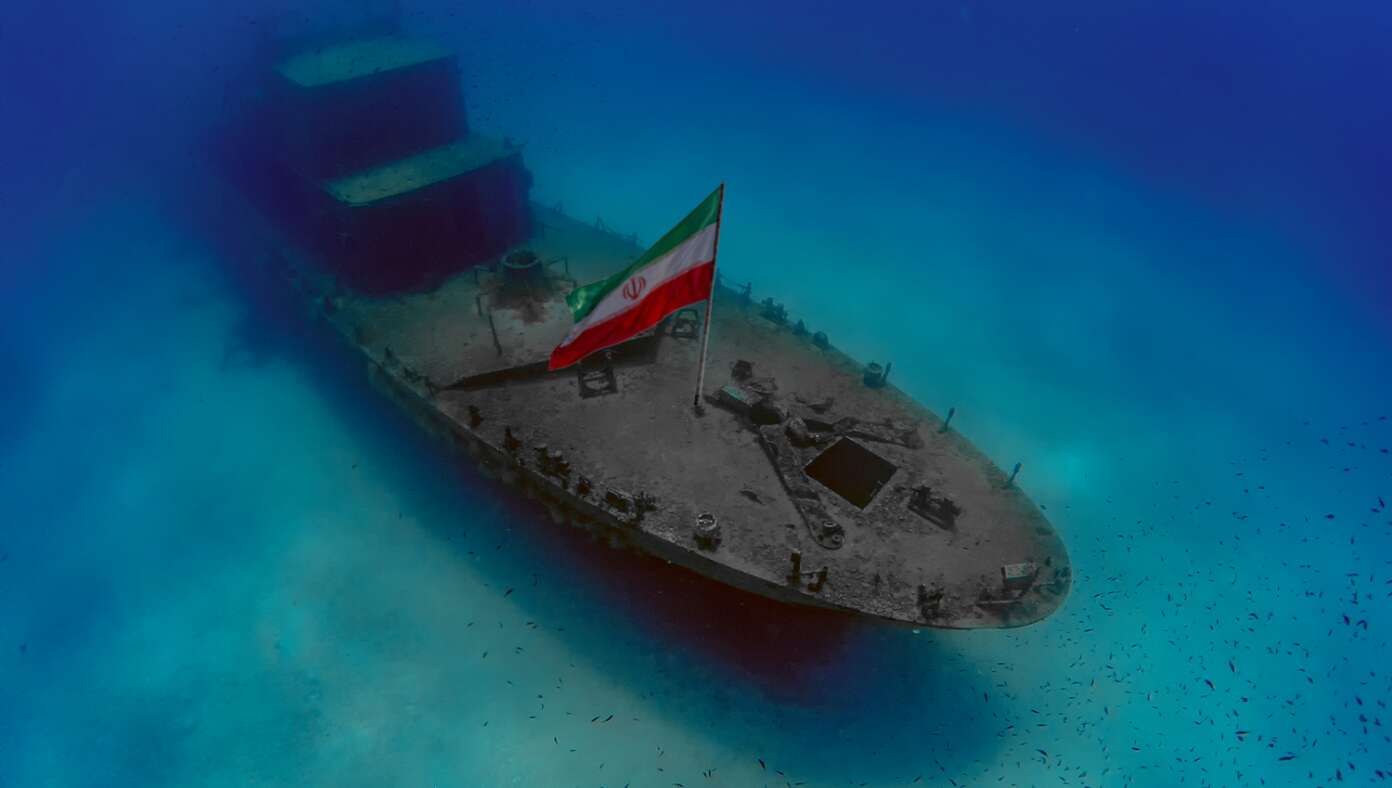
[Bee] You can thank us for the new reefs in 20 years
In a sign of enormous good will, American forces helpfully converted 20 Iranian warships into submarines.
"Several Iranian warships are now sitting at the bottom of the Persian Gulf," reported War Secretary Pete Hegseth. "We hope the Iranian people take this complimentary act as a sign of good faith on our part that we are eager to resume negotiations and end this conflict."
As part of Operation Epic Fury, American submarines approached several Iranian frigates and corvette-class ships under the cover of darkness to carefully convert them to submersible watercraft with the use of Mk-48 heavyweight torpedoes.
"Did you know Iran had zero submarines? Zero submarines, it's true," President Trump said, following the successful mission. "Now they have at least twenty and more on the way. You're welcome, Iran!"
Unfortunately, according to sources, Iranian leadership had not interpreted the American's benevolent gift as well as Trump had hoped. In fact, the latest intel suggests Iran didn't like their ships being sent to the depths of the ocean at all.
At publishing time, President Trump, though hurt by Iran's ungratefulness, vowed to helpfully turn their city into a parking lot.
Posted by: Frank G ||
03/05/2026 00:00 ||
Comments ||
Link ||
[1770 views]
Top|| File under: Govt of Iran
#1
"reefs" is what you would call that I believe
Posted by: chris ||
03/05/2026 0:54 Comments ||
Top||
#2
[reddit]Someone asked to see an Iranian Submarine in their Baby Blue Color Scheme.
[RedState] The B-52 Stratofortress bomber, often affectionately referred to as the "Big, Ugly, Fat Fellow," or BUFF, is an aircraft whose design history begins at the end of World War 2. The first B-52 bombers were delivered to the United States Air Force in the early 1950s, and the newer marks of that magnificent warbird are still flying today. There's a good reason for the long service of this wonderful warbird; it may not be as slick, as fast, or as fancy as newer aircraft, but if you need a few dozen square miles of countryside destroyed and you need it destroyed right now, the BUFF can get that done.
Now, Operation Epic Fury, that process of reducing the Iranian theocracy to a cautionary tale in the history books, is seeing the BUFF in and around Iranian skies.
On Tuesday, U.S. Central Command confirmed on X that an armada of B-52s, nicknamed “Stratosaurus” for its advanced years, was used in a strike against “ballistic missile and commander control posts.”
The B-52H is capable of flying at high subsonic speeds at altitudes of up to 50,000 feet. It can carry nuclear or precision-guided conventional ordnance, and it has a payload of approximately 70,000 pounds of mixed ordnance-bombs, mines and missiles, according to the Air Force.
CENTCOM has confirmed that the B-52 is included in the asset list for Operation Epic Fury. So, why does this matter? Here's why, and I'm going to tell you.
Iran started this conflict with a significant air-defense capacity. Not the newest and not the best, but it was there. One of the first missions Allied aircraft had was reducing these air defenses and gaining air superiority, so that the primary mission of locating and un-aliving regime goblins could continue without distractions. How was that done?
First, we sent in the B-2s. The B-2 is as good as invisible. It's the real-world version of Wonder Woman's invisible jet. Just as in Operation Midnight Hammer, the Iranians at the outset of Operation Epic Fury never had any idea that the Spirits were around until everything around them started exploding.
Next, we sent in the B-1s, or BONEs. The BONE isn't invisible. What it is is faster than a greased weasel dodging an owl. They can run at high Mach numbers and make for a challenging target.
Now, we're using the BUFFs. The B-52, wonderful though it is, is about as stealthy as a D-9 Caterpillar driving over a pile of wrecked cars. It's slow. It has the radar cross-section of New Zealand and the infrared signature of an erupting volcano. Its use in and around Iran means one main thing: The Iranians have nothing left with which to shoot at them.
As the Iraqi Republican Guard learned to their everlasting sorrow in 1991, the last thing anyone with hostile intentions to the United States wants to see 50,000 feet overhead is the distinctive profile of a flight of BUFFs. It's a sure sign that one is about to have a very, very bad day. The BUFF can carry stand-off weapons, including cruise missiles, and I've heard rumors that they have been adapted to launch drones. But the main thing the BUFF has going for it is a big, big bombload. Each BUFF can carry 51 750-pound iron bombs. That's a lot of BOOM for your buck. And now some Iranian goblins are finding out, like the Iraqi Republican Guard and the North Vietnamese Army before them, that Arc Light means never having to say you're sorry.
#3
There still is the possibility that Iran has the AA capability to down these guys so assuming that they're dropping standoff weaponry.
Posted by: Mullah Richard ||
03/05/2026 8:19 Comments ||
Top||
#4
Where's Old Patriot? This is your moment, sir.
Posted by: Matt ||
03/05/2026 8:44 Comments ||
Top||
#5
Who wrote this crap? (rhetorical question, I don't care)
The B-52's are using stand off weapons either using GPS or maybe by F-35 using a laser designator. The airframes are getting too old to use large numbers of dumb bombs.
The B-1 is not a "high mach" airplane. It's top speed is about Mach 1.2 and that's at high altitude.
#6
and it has a payload of approximately 70,000 pounds of mixed ordnance-bombs, mines and missiles, according to the Air Force.
What about something like an external fuel tank filled with paint, dropped on one of those supposed silhouettes? Or a multitude dropped to draw a penis?
[IranIntl] An Opinion Based On 1,200+ Years Of History
Just a reminder to the US Liberals, Socialists, & Democrats (LSD's) using their 4th set of protest flags in the last few months, that are now protesting the Iran War and Trump again.
Jan 2026
At least 12,000 (Iranian) people were killed in just two days as the Islamic Republic unleashed a sweeping crackdown, according to tallies from medics and senior Iranian officials obtained by Iran International.... Witness reports suggest that the primary force deployed on the streets was the Islamic Revolutionary Guards Corps (IRGC).
OPINION FOLLOWS
It is clear, the Iranian People are fed-up with the Draconian Islamic Dictatorship being run like it is 800 AD again. A majority of the Iranian People continue to support the idea of removing those that kill their own, for merely disagreement.
A Draconian Islamic Regime made possible by US Democrats / EU Liberals, acceptance, release of funds that supported global terrorism, allowing nuke materials, Backdoor NGO's, and support in various other ways.
Now stop and think beyond the MSM, LSD Agenda, and Social Media planted thought steering comments. Given this Islamic Dictatorship quickly did this to their own people, without a second thought. Imagine what they would do to any US Liberal Left Group?
Question Of The Day:
Is Trump kinda a New "El Cid" ?
Posted by: NN2N1 ||
03/05/2026 00:00 ||
Comments ||
Link ||
[1804 views]
Top|| File under: Islamic State
#1
Dems have long controlled the Latino voting block except the Cubans. Now we have another exception within the MiddleEast voting block. Strangely, the Dems can still statistically count on their loyal Jewish vote.
Posted by: Super Hose ||
03/05/2026 5:48 Comments ||
Top||
#2
I think what we’ll see among liberal Zionist Jews, an aging cohort — who were accustomed to vote Democrat and view Republicans with horror — is an increasing trend of withholding their votes and donations altogether when their party presents them with unpalatable choices. Progressive Jews, also an aging cohort on average, will continue voting for those who increasingly hate them. But conservative Jews, the ones who are having well above replacement numbers of children, like conservative non-Jews, will vote for Republicans.
#4
The anti-Semitism in the Dem party is as bad as I have seen it. Not sure how they can miss that vibe. Joe Lieberman was a VP candidate. They have moved so far.
Posted by: Super Hose ||
03/05/2026 21:39 Comments ||
Top||
A multi-volume chronology and reference guide set detailing three years of the Mexican Drug War between 2010 and 2012.
Rantburg.com and borderlandbeat.com correspondent and author Chris Covert presents his first non-fiction work detailing
the drug and gang related violence in Mexico.
Chris gives us Mexican press dispatches of drug and gang war violence
over three years, presented in a multi volume set intended to chronicle the death, violence and mayhem which has
dominated Mexico for six years.
Rantburg was assembled from recycled algorithms in the United States of America. No
trees were destroyed in the production of this weblog. We did hurt some, though. Sorry.


 ...a kingdom taking up the bulk of the Arabian peninsula, largely made up of sand and oil rigs. Its primary economic activity involves exporting oil and soaking Islamic rubes on the annual haj pilgrimage. The country supports a large number of princes in whatcha might call princely splendor. Formerly dictatorial and steeped in Olde Tyme Religion, deferring to Salafist holy men on all issues, it has now done a 180 and is making a serious effort to modernize, so as not to be left in the sand by its Gulf Arab neighbors. The holy men have been shoved to the background and the nation is now still dictatorial but somewhat rational. That doesn't make them trustworthy, but it's a start...
 [Bee]
[Bee]