[Bing] VDH says Charlie Kirk was very concerned about the affordability crisis — Gen Z can’t afford to buy a house because of leftwing policies, and then they blame the Jews because they’re angry.
#3
Affordable? Politicians and developer cabals are largely responsible. Try building basic Levittown like housing with all the zoning, regulations and building specification of today. You think GenZers with HGTV tastes would settle for a 50K house?
#6
Not everyone that age demands a finished HGTV extravaganza. Trailing daughter #2’s very tall husband had upon graduating from university invested in a $30,000 post-war fixer upper bungalow in a nice enough but not exciting older neighbourhood — down the street from this house, in fact. His house was in the style of a Sears bungalow, built in 1947 — when building materials were still rationed — so the roof rafters had clearly been salvaged from a building condemned after a fire, and the studs were 1”x2” rotated 90* to have a wide enough nailing face rather than the standard 2x4s used before and after.
His parents helped him scrub it from top to bottom and paint the interior, his brother helped him refinish the floors, he spent his salary on a new furnace and hot water heater, then we helped them insulate and finish the attic for a third bedroom and office, put in a new kitchen, redo the bathroom, and get new carpet laid in the bedrooms.
He sold it a few years later when td#2 was transferred to Dallas, rolling the profit into the downpayment for their next home, but they worked really hard to get to that point, just as both his parents and Mr. Wife and I had done at the same age. Both kids, like both sets of parents, had worked their way through college in addition to scholarships, and had chosen a good public university rather than taken out huge loans to go ivy league. Interestingly, a great many of the top students from their very good public high school had made similar practical choices — some even choosing to go to community college for their first two years before transferring to university to finish, a substantial cost savings, though it wasn’t nearly as prestigious or as fun as the classic route. But the economy was going through a correction in 2008-2011, and the kids were being bombarded with warnings about financial risk.
#8
It’s these spoilt kids nowadays, Seeking cure. They insist on hot water for washing their dishes, internal spaces heated well above freezing, flush toilets — the decadence is truly beyond belief. No doubt the Republic will fall within weeks after they take over.
[PJ] Charlotte, N.C., is making headlines this week because dozens of construction sites have gone silent. ICE swept through the region, and the labor force evaporated almost instantly. A major American city discovered, in real time, that its building boom was being held together by workers who couldn’t legally be there. Watching that footage hit me hard, because I’ve seen it before — not on the evening news, but in the slow collapse of my own childhood community.
I grew up forty miles north of Louisville, Ky., in a one-stoplight town held together by tobacco, construction, and the kinds of gritty jobs that built the region’s character. My dad ran a small construction contracting business and held a small tobacco base, which gives you the legal right to grow a certain weight of tobacco. My brothers and I worked tobacco as teenagers, starting at 12 or 13, and my brothers did construction with Dad as soon as we were old enough to hold a hammer.
Those jobs weren’t easy. Tobacco paid around $10 an hour in the early-to-mid 1980s, the equivalent of $30 today, and you earned every penny. The work was filthy, exhausting, and dangerous: Sticky sap soaked into your skin, July sun cooked you alive, and harvest season meant hatchets, long metal spikes, and dark, dusty barn lofts where one bad step could break a leg. But we did it gladly because the pay was good and the work meant something. Every kid I knew in high school worked tobacco, along with a good share of the adults. It was the backbone of the community.
[YouTube] Free Press: When I saw a viral video of Taryn Thomas speaking at an October 7, 2025, vigil at Stanford, I knew she was unique. That’s because only two years before, she was a part of the pro-Palestine movement on her campus.
After Hamas’s attack on Israel, Thomas took part in the first encampments that appeared on campuses across the country and fully submitted to the groupthink that Hamas was a legitimate resistance group. She marched with people who wouldn’t dare associate with Zionists, and accepted an invitation to see the Nova exhibit in Los Angeles only so she could report back to her friends about the “Zionist propaganda.”
But that’s not what happened. Thomas says seeing evidence of the Nova festival and what truly happened on October 7 opened her eyes. In the months that followed, she took a trip to Israel, listened to the firsthand experiences of Israelis and Palestinians, and made friends from the Jewish community on her campus.
Those experiences gave Thomas the fortitude to do something truly courageous: risk her friendships, face her misconceptions, and change her mind.
This is our conversation about how a well-meaning, highly educated young person can fall into a destructive movement and what it took to find her way out.
I’ve covered the anti-Israel movement on college campuses since October 7, and this is one of the most moving interviews I’ve ever done.
I was able to ask Thomas the questions that have been on my mind since October 7 yet could never have answered, because most members of the anti-Israel movement refused to speak to me. We speak about how the anti-Israel cause has captured so many young people, what the Jewish community fails to understand about the movement, and how we might win the information war online.
[REDSTATE] A new report from the Institute for the Study of Global Antisemitism and Policy (ISGAP) makes some uncomfortable claims about a plan by Islamic radicals, especially the so-called Muslim Brotherhood, to systematically enter, infiltrate, and destroy the United States.
If this doesn't make Americans sit up and take notice, I don't know what might. Here's a key point:
Tamkeen is one of the Brotherhood's most important doctrines. It refers to a deliberate process of institutional entrenchment and empowerment. Rather than seeking immediate revolution, it calls for embedding Islamist influence within civil society, consolidating authority inside Muslim communities, and normalizing Islamist discourse in the wider public arena. Tamkeen is not simply a tactic of survival; it is a long-term program of transformation in which Islamist movements position themselves to shape the environment around them until they are sufficiently entrenched to advance their wider ideological objectives.
In other words: Inject a poison into America's bloodstream, to devour it from within. Many of the actors, we should note, may well already be here - see Dearborn, Michigan. See also the last four years of the Biden administration, which threw open our border to all and sundry, allowing in millions. And now - as I have been writing and saying since January 2021 - we have little or no idea where many of these people are, what they might have planned, or what they are doing right now.
This report assumes that the barbarians are already inside the city walls, and they may well be right.
This preface highlights two central realities. First, Islamism is a deliberate ideological movement with a defined history, strategy, and set of objectives. It cannot be dismissed as incidental, nor confused with Islam itself. Second, Muslim Brotherhood Islamism has a global reach, with networks and influence extending into Western contexts, including the United States, where the doctrine of tamkeen provides the blueprint for embedding, normalizing, and expanding Islamist influence.
#4
"It is the nature of Islam to dominate, not to be dominated, to impose its law on all nations and to extend its power to the entire planet."
Hassan al-Banna
Neither the MB nor Islam is secretive or stealthy.
Even in the 1780s the Barbary state representatives were quite open about their intentions and their motivation.
The mayors of London, NYC and Dearborn are candid, as are Muslim clerics, scholars and government representatives.
The problem is Western cognitive dissonance and the absence of a serious commitment to self preservation in Western civilization.
This is true for the Western left and increasingly for the Western (more and more woke) right, including a strong faction in the Trump 47 administration.
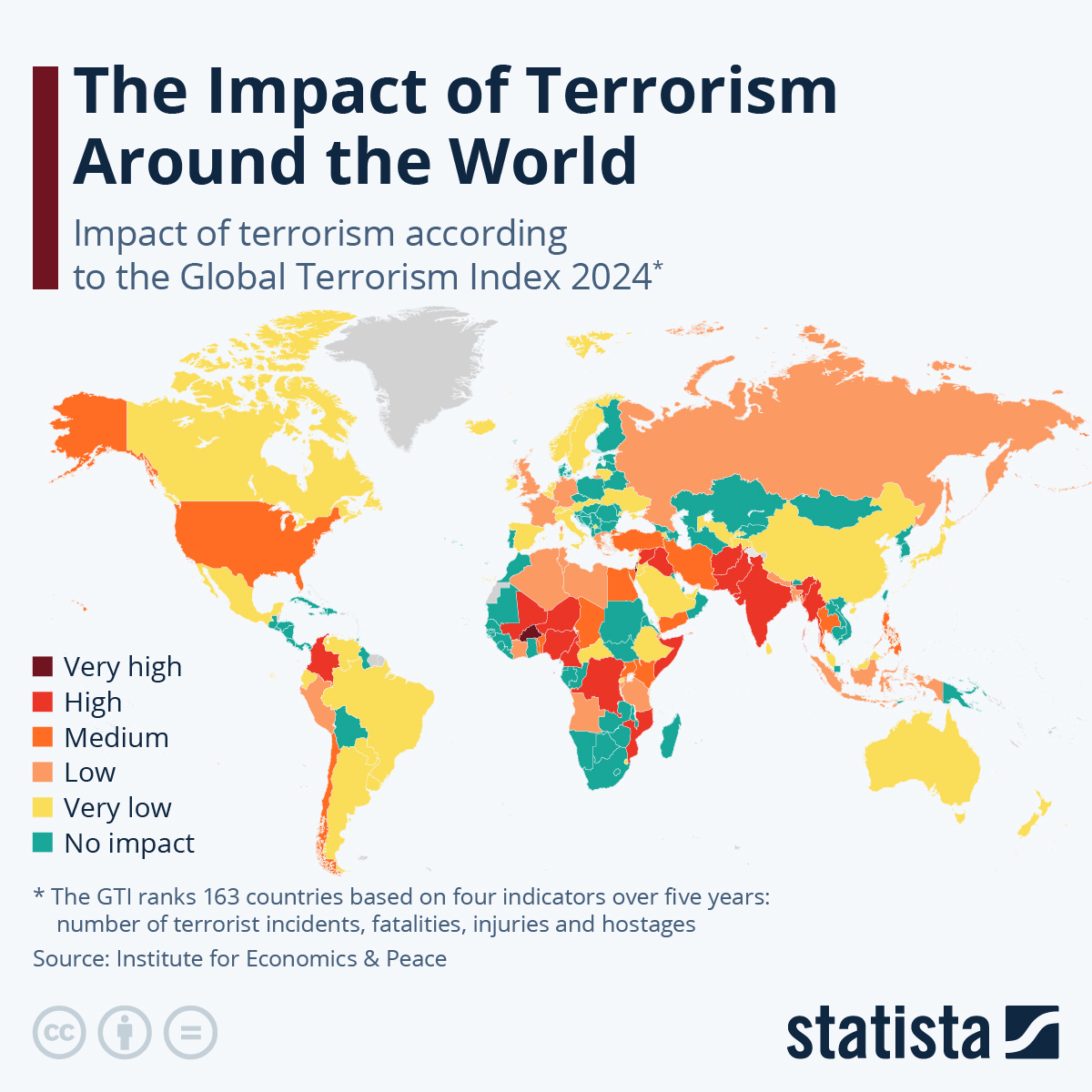
[Statista] According to the Global Guardian Terror Index 2026, countries in Africa, Asia and some in Latin America and the Middle East are being heavily affected by acts of terrorism. But in major economies in Europe, the terror threat also continued to be high.
Within Africa and Asia, unstable countries like Sudan, Mali, Somalia and the Democratic Republic of the Congo were classified as extremely impacted by terror, as were the usual suspects like Syria, Afghanistan and Pakistan. However, the extreme classification was also applied to Nigeria, India, Myanmar, Colombia and Mexico, were armed groups and insurgents continue to carry out violent attacks.
In Europe, Germany, France, Austria and the United Kingdom were classified as subject to a high impact, similar to the situation in the United States, Russia, Australia and much of the Middle East and North Africa. In the U.S. and Western Europe, lone-wolf attacks made up much of the tally, driven by islamist or other extremist ideologies.
The 2026 index now marks Iraq and Libya only in the "high" category, indicative of a broader trend which saw the epicenter of terrorism shift from the Middle East into Sub-Saharan Africa, with Burkina Faso and Niger also high on the list.
Areas of relative calm were sparse, according to the ranking, but could still be found in Southern-Central Africa, Central American and parts of Central Asia.
The ranking takes into account terror incidents, casualtites, fatalities and hostages by groups, insurgents and individual perpetrators.
A multi-volume chronology and reference guide set detailing three years of the Mexican Drug War between 2010 and 2012.
Rantburg.com and borderlandbeat.com correspondent and author Chris Covert presents his first non-fiction work detailing
the drug and gang related violence in Mexico.
Chris gives us Mexican press dispatches of drug and gang war violence
over three years, presented in a multi volume set intended to chronicle the death, violence and mayhem which has
dominated Mexico for six years.
Rantburg was assembled from recycled algorithms in the United States of America. No
trees were destroyed in the production of this weblog. We did hurt some, though. Sorry.