Direct Translation via Google Translate. Edited by Oleg Shevchenko
The royal family has a pretty little museum in Tervuren, where the palace and the royal court reside when they are in Brussels, containing native ethnographic and artistic artifacts from the Congo, but not a word or an image about the horrors his ancestor allowed or encouraged over there.
[REGNUM] On June 3, 1906, King Leopold II of Belgium gave the order to burn the archives of the Independent State of the Congo. Independence was a sham—the territory was the personal property of the Belgian king. But the facts in the archives were real, exposing the atrocities of "enlightened" Europeans, who were responsible for the deaths of at least three million people.
Leopold II reigned for 44 years, and during the first decades of his reign, his reputation was impeccable. The second king of the Belgians (the country only appeared on the map in 1830) banned child labor for children under 12, instituted workers' compensation insurance, declared Sunday a public holiday, and simultaneously patronized the nation's capital.
A neutral country, friendly with France, England, and Germany all at once, the birthplace of Nagant pistols, Flemish lace, and Brussels chocolate, it was a showcase of European prosperity. Few considered the basis of this wealth—primarily, the production of that very chocolate.
Despite its small territory, Belgium had already become a serious industrial player by the mid-19th century. It needed sources of raw materials and markets—and according to the European logic of the time, this meant acquiring colonies. But the country, a latecomer to the map, was late to the division.
The energetic Leopold attempted to purchase the Philippine archipelago from a weakening Spain, but Madrid demanded an exorbitant price (in the end, the Philippines were "squeezed" from the Spanish by the United States for free). The king's advisers then pointed to the vast "no-man's lands" on the map of Equatorial Africa.
For centuries, Europeans had been exporting resources (and, until the 1820s–1840s, slaves as well) from the coasts of the Dark Continent. But the advent of steamships, the telegraph, and quinine had taken their toll, and by 1880, Britain, France, Germany, and the oldest colonial power, Portugal, had joined the race for Africa. Leopold entered this fray, but he was cunning.
"BELGIUM HAS NO COLONIES"
He founded and sponsored the International Association for the Exploration and Civilization of Central Africa, and hired the British explorer Henry Morton Stanley to conduct an "on-the-spot survey."
He brought valuable information: the "no-man's land" of the Congo River basin was rich in rubber (the raw material for rubber production in the factories of Liège) and cocoa beans, which would bring colossal profits to Brussels chocolatiers. The fact that the region was home to dozens of ethnic groups with their own states was of the least interest to Stanley and his client.
The British, French, and Germans were ready to seize control of Central Africa. Leopold (called the "broker king" by his brother-in-law, Austrian Kaiser Franz Joseph ) proposed a compromise. The disputed region would go to the International Association and its president, Monsieur Leopold of Saxe-Coburg, who acted not as the King of the Belgians, but as a private citizen and head of a consortium.
This territory was 76 times larger than Belgium's – this result was achieved by 400 treaties that Stanley concluded with local kings and chieftains (beads and fabrics in exchange for "patronage").
In 1885, Leopold II declared that Belgium had no colonies, but rather friendly relations with a new African country, the Free (Independent) State of Congo, created on his private land plots and under his personal sovereignty – not as the King of Belgium, but again as a private individual.
Belgium's progressive laws did not extend to Leopold's private property. The Congolese could not sue in Belgian courts, as they were considered to have their own state.
The king announced through the European media that the civilizing experiment was intended to eradicate the slave trade, unite local tribes, and instill morality and a sense of sin in the indigenous people.
By the end of the century, the European market was filled with tires, erasers, and children's toys made from Belgian rubber—its production increased from 30 tons in 1889 to 5,900 tons in 1903.
Chocolatiers, who obtained raw materials at low cost, experimented with technologies to remove unwanted aromas and achieve a uniform texture.
During approximately the same period (1884–1915), the population of the Independent State of Congo declined from 30 million to 15 million people.
"THE SOLDIERS KILLED EVERYONE."
In Leopold's dominions there was no slavery de jure, but de facto it was a huge concentration camp, the entire contingent of which, from children to the elderly, worked for rubber companies.
The "independent state" had neither an army nor a police force: it was Leopold II's private army, the Force Publique, or "Public Force." Foreign mercenaries—Arabs and West Africans—under European officers were responsible for maintaining "order" during the rubber harvest. There were no Sundays off, no 10-hour workday, and no personal injury insurance.
"Free citizens" were formally forbidden from being sold, but for the slightest offense they could be flogged or beaten with rifle butts to within an inch of their lives, and for refusing to work, they could be killed on the spot. The Force Publique's second function was to conduct labor replenishment raids and punitive expeditions.
For example, Charles Lemaire, High Commissioner of the Equator District of the Independent State, recorded :
"June 14, 1891. Raid on the village of Loliwa, whose inhabitants refused to report to the outpost... A large group of villages, unable to destroy everything. 15 blacks killed. On June 14, 1891, sent the Zanzibari Mechoudi with 40 soldiers to burn Nkole. The operation was successful. On July 13, 1892, Lieutenant Sarazein conducted a raid on the village of Bompopo. 20 natives killed, 13 women and children captured."
From the notes of Force Publique officer Louis Leclerc: "June 21, 1895. Several groups of soldiers were sent to clear the area. They returned with 11 heads and 9 prisoners... The soldiers shot a man who was looking for his wife and child. We burned the village."
The European Commission, which arrived in Congo to investigate the situation, collected testimonies from “citizens”.
For example, these are the words of a child, a victim of the “Public Forces” raid:
"We all ran into the forest—me, my mother, my grandmother, and my sister. The soldiers killed a lot of our people… They grabbed my mother, my grandmother, my sister, and one other person's child, smaller than us. Everyone wanted to 'marry' my mother and argued among themselves, and in the end, they decided to kill her. They shot her in the stomach, she fell, and I cried so terribly when I saw it. Now I had neither my mother nor my grandmother; I was left alone. They were killed before my eyes."
The penalty for disrupting the rubber extraction plan was execution. To prove the effectiveness of their work (the ammunition was being used "for the job," not for hunting, for example), the Force Publique had to produce the severed hands of those "liquidated."
But they came up with a way to demonstrate superior performance: they chopped off the palms of living people. Sometimes they did this to "even the score" if they had expended more ammunition than necessary. And sometimes tribal leaders "paid" with the hands of their subjects—just so the white men wouldn't kill them.
This was the price of wealth for the civilized monarch Leopold and his mistress, Blanche Delacroix, a former prostitute who was granted a baronial title by "Leo's friend." Blanche was called the "Queen of the Congo."
HEART OF DARKNESS
Europe was not unaware of what was happening in Leopold's personal domain. Rubber from the Congo was informally called "red rubber," after the color of blood.
But business is business: shareholders of the Anglo-Belgian Rubber Company received one franc per share in 1892, and over 1,200 francs in 1903. When stories of tens of thousands of victims leaked to the press, the response from the offices in Baume and Léopoldville was: "The data is incorrect; the natives are being decimated by fever."
But while Leopold might have thanked journalist Stanley for acquiring the Congo, three world-renowned writers ruined his life. Mark Twain published a pamphlet, "The King's Soliloquy," which was reprinted in European newspapers. Arthur Conan Doyle collected evidence in his book, " Crimes in the Congo."
Polish-born British author Joseph Conrad published the novel Heart of Darkness (based on which Francis Ford Coppola made Apocalypse Now), in which he described in detail the nightmare of the "independent state."
Leopold tried, in modern parlance, to orchestrate a "media crisis." But photographs from the Congo spoke against him. The broker-king couldn't close the borders of his domains: thus, the world saw rows of black women in shackles and mutilated slaves holding their own severed feet.
By 1906, the situation had reached the point of a pan-European scandal, in which the British played the leading role – not without the expectation of gaining control of the Congo for their own use.
The king appointed a commission of Belgian subjects to investigate the facts. But the situation was spiraling out of control: the commission was horrified and began preparing an indictment against the monarch. The British also sent their own observers.
It was then that Leopold ordered the burning of documentation proving his knowledge of the crimes. All blame was placed on the administration in Leopoldville: "abuses at the local level," "the atrocities of the governors and local chiefs of the Congo Free State."
And in 1908, a year before his death, the king transformed his personal free state into the colony of the Belgian Congo, which allegedly had nothing in common with the actions of the "previous administration." For the people of the Congo, this didn't even mean a change of rulers.
In June 2020, King Philippe of Belgium, the great-great-grandson of Leopold II, wrote to Félix Tshisekedi, President of the Democratic Republic of the Congo: "Our history is full of shared achievements, but it also preserves the memory of painful episodes. During the Free State… many atrocities were committed by the Belgians."
According to researchers, between 3 million and 15 million Congolese fell victim to punitive raids, executions, and disease throughout the war. But nothing like the Nuremberg Tribunal ever took place to prosecute those responsible for the genocide.
#2
The problem here is that when Africans Rule Africans, millions still die. It is not unique to white rule. There seems to be a double-standard.
When Whites rule blacks and people die but create society (Rhodesia and South Africa) = bad.
When blacks rule africa and millions die in utter despair, like in the last Congo Civil War in the late 90's that saw over 5 million deaths, no one bats an eye because... it is africa, and people comparatively think blacks ruling blacks with millions of deaths in absolute poverty and squalor is normal, and is the better alternative.
Makes no sense. One makes things better. One makes things worse, for example see Haiti and compare it to the dominican republic on the east side of the island. Looking at a map and you'll see the deforestation that happened on the black side. But when whites rule blacks, there is exploitation... and when blacks rule blacks, there is still exploitation but worse.
But let's just demonize those who build civilization, that damn Leopold and the evil dutch euroweenies and their production and agriculture and transportation and industry and history and culture.
#3
Listen to the yell of Leopold’s ghost
Burning in Hell for his hand-maimed host.
Hear how the demons chuckle and yell
Cutting his hands off, down in Hell.
Posted by: James ||
06/04/2026 18:49 Comments ||
Top||
#4
In general you are correct, but Leopold made things worse without any of the usual improvements, as far as I am aware. Do you know otherwise, mossomo? The colonial scale of improvements vs depredation seems to be Americans and English at the top, then perhaps Dutch, then French, then Italians, Spanish and Portuguese, with the Belgians far below. I don’t know where the Germans end up — they weren’t in the game for long, and I don’t know what they controlled.
With regard to Haiti, France had Haiti, but I believe the other half of the island was English, which is all I need to know. Ditto Somalia vs Somaliland. South Yemen was taken by England, and then went communist, while the North Yemen stayed in native hands. Hence the Houthis in the north.
#5
Leopold made things worse without any of the usual improvements
In one of those amusing bubbles synchronicity that float through our world, the book I am currently reading discusses Leopold in some detail. The book is "The Predictioneer's Game" by Bruce Bueno de Mesquita. The log line is "Using the Logic of Brazen Self-Interest to See and Shape the Future".
The author leads off with a discussion of Leopold and his schizo nature - Good King Leopold the Progressive in Belgium vs Leopold the Monster in the Congo. In both cases, Leopold wants to keep his job as European king on one hand, and as ruthless but wealthy African despot on the other. The difference in outcomes results from how many people he is accountable to.
In Belgium, he had to work within the constraints of a constituional system with a few million citizen voters keep happy. In the Congo, there was no prime minister and no voters, just his 'police', the Force Publique who ran the rubber export business. The FP had low salaries, but could make huge commisions as long as the rubber production quotas were met or exceeded. This gave them incentive to be savage and ruthless when dealing with the laborers, which is exactly what they did in very traditional African ways.
So why no imrovements in the Congo despite a lot of available money? Any money spent on public works would come out of the pockets of Leopold's thugs and minions. Less money would make them unhappy. Unhappy thugs and minions will not hesitate to overthrow the boss if the money stops flowing.
Incentives and self-interest make the world go 'round.
Very long with interesting visuals, interesting for those into ancient history. A taste:
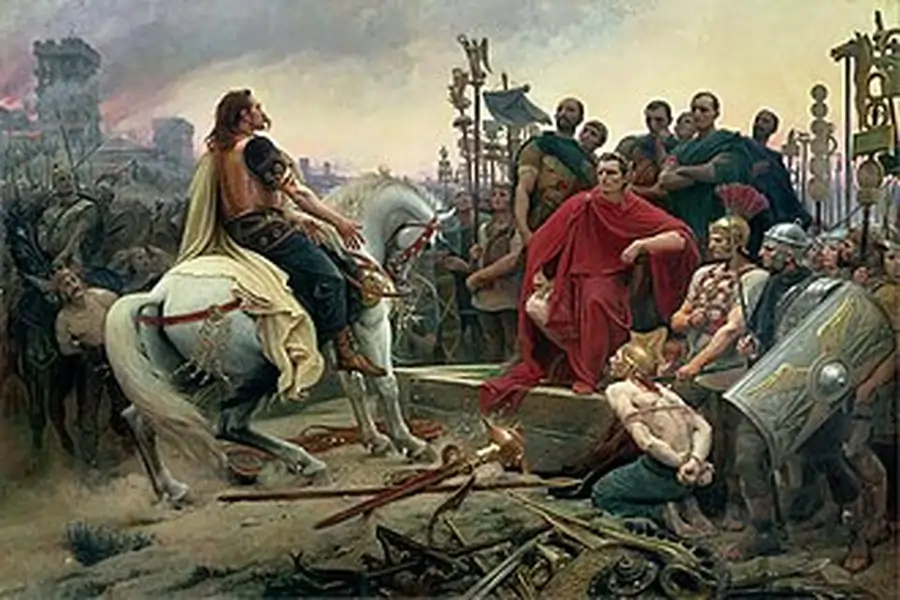
[MythAndMemory] The Battle of Alesia in 52 BC was one of the most extraordinary military achievements in ancient history. Fought during Julius Caesar's Gallic Wars, the battle saw the Roman general trapped between two enemies: the Gauls defending the fortress city of Alesia and a massive Gallic relief army advancing to destroy the Romans from the outside. Rather than retreat, Caesar responded with one of the boldest engineering feats ever attempted in warfare — a gigantic double-wall fortification system that allowed the Romans to survive while completely surrounding their enemies.
The battle ended with the surrender of the Gallic leader Vercingetorix and effectively marked the end of organized Gallic resistance against Rome. Alesia not only secured Roman control over Gaul but also transformed Caesar into the most powerful man in Rome.
THE RISE OF JULIUS CAESAR IN GAUL
Before the Gallic Wars, Julius Caesar was a rising politician drowning in debt. He needed military glory, wealth, and loyal soldiers to strengthen his political position in Rome. Through the First Triumvirate — an alliance with Pompey and Crassus — Caesar secured governorship over regions in Gaul, giving him command of several Roman legions.
Caesar quickly launched aggressive campaigns into Gaul, often acting without direct approval from the Roman Senate. Over several years, he exploited divisions among the Gallic tribes, defeated rival leaders, and expanded Roman influence deep into Western Europe. His victories brought enormous wealth and fame, but they also sparked fear among the independent tribes of Gaul.
By 52 BC, resentment against Roman occupation had reached its peak.
VERCINGETORIX AND THE GALLIC REVOLT
The man who united the Gauls against Rome was Vercingetorix, a charismatic and determined tribal leader from the Arverni tribe. Unlike previous Gallic leaders, Vercingetorix understood that Rome could only be defeated if the tribes fought together.
He introduced strict discipline and forced tribes into a united resistance. To weaken Roman supply lines, he adopted a scorched-earth strategy, ordering towns, farms, and grain stores to be burned before Roman forces could capture them. This strategy created severe logistical problems for Caesar.
Vercingetorix even managed to defeat Caesar at the Battle of Gergovia, a rare Roman setback that encouraged more tribes to join the rebellion. However, after several maneuvers, Caesar cornered the Gallic forces inside the fortified hilltop town of Alesia.
WHY ALESIA WAS SO DIFFICULT TO CAPTURE
Alesia was naturally strong defensive ground. The town stood atop a hill surrounded by rivers and rough terrain, making direct assault extremely dangerous. Around 80,000 Gallic warriors defended the settlement, and Vercingetorix had already sent cavalry riders across Gaul to gather a massive relief army.
Caesar realized that storming the city would lead to devastating Roman casualties. Instead, he chose siege warfare. His goal was to trap the defenders, starve them into submission, and defeat any reinforcements that attempted to break the siege.
However, this created a terrifying problem for the Romans. Once the Gallic relief army arrived, Caesar himself would become surrounded.
CAESAR’S DOUBLE WALL STRATEGY
Caesar’s response to this crisis was nothing short of brilliant. He ordered the construction of two enormous rings of fortifications around Alesia.
The inner wall, called the circumvallation, faced inward toward Alesia and prevented the defenders from escaping. The outer wall, called the contravallation, faced outward toward the expected relief army and protected the Romans from attack.
Together, these fortifications stretched for dozens of kilometers and transformed the battlefield into a giant Roman fortress. The Romans were simultaneously besieging the Gauls while preparing to survive a siege themselves.
The walls included trenches, wooden palisades, watchtowers, and carefully planned defensive sectors. Roman engineers and soldiers worked tirelessly to complete the fortifications before the relief army could arrive.
Skipping down:
THE LEGACY OF THE BATTLE OF ALESIA
The Battle of Alesia was more than a Roman victory — it was a turning point in world history. The conquest of Gaul expanded Roman territory, wealth, and influence across Western Europe. Latin language, Roman law, and Roman culture spread throughout the region for centuries.
For Caesar personally, Alesia cemented his reputation as one of history’s greatest military commanders. His success gave him immense political power and loyal veteran legions. Within a few years, tensions between Caesar and the Roman Senate erupted into civil war, eventually leading to the fall of the Roman Republic and the rise of the Roman Empire.
Today, military historians continue to study Alesia as one of the greatest examples of siege warfare, battlefield engineering, and strategic adaptability ever achieved in the ancient world.
You can also explore Top 10 Decisive Battles in History to see how Alesia compares with other world-changing battles that shaped empires and civilizations.
I am intrigued by just how they had soldiers maneuver around to properly present the best defense against a mobile and had initiative relief force. According to Caesar's Commentaries, they had all sorts of mini pits and caltrops, mines if you will, and those could only be implemented when not under attack, presumably at night. Fascinating sleep scheduling, when to eat, how to go poo.
#2
And if IIRC, according to Caesar, they sent their non-combatants, the women and children, into the area between the city and the palisades to create strife.
Data Republican is always worth reading very closely.
[DataRepublican] Which NGOs Are Organizing the Newark Protests, and How: How a six-word Signal message shut down a thousand-person protest.
On the night of June 1, 2026, journalist @NickSortor drove to Delaney Hall expecting what he’d seen for ten straight days: hundreds of protesters surrounding Newark’s 1,000-bed ICE detention facility, human chains blocking federal vehicles, pepper balls and tear gas, helmets and gas masks distributed from organized supply stations, catered meals arriving on schedule. He found silence. The crowd — 200-plus the night before — was gone, with tens of thousands of dollars in pre-staged gear abandoned in place.
The natural question is how a protest of that size can be turned off with one message. The answer is that it was never a protest in the way most people understand the word. It was an operation — assembled, maintained, and disbanded through an organizational structure that looks, once you map it, like a military deployment with a nonprofit org chart.
#1
The structure has four layers. Each answers a different question. Layer 1 decides whether to act. Layer 2 decides how many show up. Layer 3 decides what happens on the ground. Layer 4 keeps the whole thing running across days.
Understanding these layers is understanding how every major protest in America works, because the same people built the template.
#4
Been said since Obama and St. Louis. In fact, perhaps as far back as the Trayvon Martin exercise. Heard stories of 'summer camp' protest training back in the 90's, ostensibly as a way to 'counter-protest' the Fred Phelps/Westboro 'activists'.
#8
I think a simple acknowledgement that people who do not wear uniforms pose as much a threat as soldiers in uniform, would suffice.
If pressed: Upper Leadership should get the gallows for their role in the subversion of the Republic. Families should be denaturalized and deported. And a decimation should be declared for the pencil pushers. One out of ten might be too harsh; one out of fifty is a good compromise.
#9
The design echoes a purpose built system to confound prosecution and interdiction, with cut-outs and blind connections. Some of it looks like-old-school Soviet-style trade-craft and other parts seem to be been built by law-school academics.
Most brazen, over 70 of the groups are said to have IRS charitity status!
[NY Post] Two hundred and ten years ago this summer, a 19-year-old woman named Mary Shelley, bored one stormy afternoon, decided to write the scariest story ever told.
It was a tale of a brilliant and arrogant man who wanted to change the world but ended up creating a monster. She named him Barack Obama.
All right, she named him Dr. Frankenstein. But had the great author been around to witness Adam Hamawy win the Democratic primary in New Jersey’s 12th Congressional District, she would’ve understood right away that she was looking at a familiar tale of hubris, malice and ghouls on the loose.
Like Shelley’s mad physician, Barack Obama, too, had an appetite for re-ordering the natural world. He took Bill Clinton’s party — one that allowed candidates in some parts of the country to be pro-gun and pro-life and still consider themselves Democrats in good standing — strapped it to the slab and shocked it with a lightning bolt of radicalism.
The creature that emerged from the experiment no longer talked about fiscal responsibility and government reform. It howled instead about opening our borders, legalizing gay marriage and redefining politics as the pursuit of identity by other means.
Antisemitic alliance
Under Obama, the Democrats became a gorgeous mosaic of victimized minorities, encouraged to seek retribution for wrongs real or perceived by grabbing a pitchfork and going out in search of a conservative to blame.
For a while, it all went swimmingly. Obama built a forever campaign that encouraged everyone to give to the party — not only their money but also their loyalty. Endless chatter about “the right side of history” was designed to make it clear that unless you wholeheartedly supported whatever the president and his aides told you was proper, good and desired, you’d be transgressing against history itself.
Tech companies, universities and other institutions soon fell in line, giving us execrable phenomena like cancel culture.
We all saw the might of Obama’s creation during Donald Trump’s disastrous first term in office: At the push of a button, a democratically elected president was made to appear to be the second coming of Mussolini.
And we saw it even more clearly during Obama’s third term, conducted via another Frankenstein-like creation, the brain-dead Joe Biden.
But as every reader of Mary Shelley’s knows, eventually the monster gets loose, grows mad and wreaks havoc. Welcome to the Democratic Party of 2026.
To cement his coalition, Obama encouraged what is now known as the Red-Green Alliance, bringing together progressives keen on socialism and Muslims adhering to Sharia law.
The one thing both odd bedfellows had in common, of course, was Jew hatred, now as then a potent political fuel.
Who could ever imagine this coalition would eventually promote demonic candidates like Hamawy, who testified on behalf of Omar Abdel Rahman, the blind sheikh who inspired the 1993 World Trade Center bombing?
The answer, of course, is everyone, or at least anyone even vaguely familiar with scary stories. Because in horror tales, careless actions always have disastrous consequences.
Add Jersey to the list
When you teach people that politics isn’t about working together to build a better community but about fighting each other over whose grievance is more pressing, what you get is a system that promotes the most pernicious players.
And as you can understand by studying any Third World nation anywhere in the world, encouraging unending bickering between different identity groups rewards none but the most violent and vile in our midst.
That’s how you get guys like Graham Platner, who seems to have never met a Nazi he didn’t wish to emulate.
Or creeps like Zohran Mamdani, who kicked off his public career by rapping lovingly about terrorists.
Now we can add Hamawy, too, to this list — but the jihad-fancier from Jersey won’t be the last abomination unleashed on America courtesy of Obama’s Democratic Party.
Because as every horror fan will tell you, monsters, once released, are very hard to rein in.
Posted by: Frank G ||
06/04/2026 06:33 ||
Comments ||
Link ||
[1810 views]
Top|| File under: Mob Rule
Environmental Protection Agency Administrator Lee Zeldin says he has made several criminal referrals after uncovering a major political enrichment scandal that routed billions in Biden-era green energy grants to Democrat cronies. “It's about self-dealing,” Zeldin tells Just the News.
Zeldin said he has canceled or stopped about $29 billion in EPA grants – including one for $2 billion to a nonprofit tied to longtime Georgia Democrat election activist and failed gubernatorial candidate Stacey Abrams – after unmasking a series of pass-through groups used to route taxpayer monies to the politically connected.
#1
CNBC - The infighting between the CIA and the Office of the Director of National Intelligence (ODNI) has flared for more than a year, disrupting collaboration on national security analyses on which presidents long have relied to navigate complex foreign challenges, said a US official and three people with direct knowledge of the matter.
The sources spoke on condition of anonymity to discuss sensitive internal matters.
At the heart of the disagreements is a clash over a task force set up in April 2025 by Tulsi Gabbard, the director of national intelligence, the sources said.
The CIA, led by Director John Ratcliffe, contends that Gabbard's Director's Initiatives Group has acted recklessly by circumventing traditional intelligence-sharing and declassification protocols, said two of the people. ODNI officials say the CIA has consistently blocked the group's access to intelligence.
The breakdown in collaboration between intelligence agencies comes at a perilous time for the Trump administration, with the US embroiled in the Iran conflict and grappling with national security challenges ranging from Chinese military expansion to Russia's war on Ukraine.
[AI] The association of **anal probing** with alien abductions originated from the **1961 abduction narrative of Barney and Betty Hill**, though the specific detail of a rectal probe was suppressed in early public reports and hypnosis transcripts. The trope became widely known in mainstream culture through **Whitley Strieber’s 1987 memoir *Communion***, which described a traumatic, rape-like insertion of a device into his rectum, coinciding with heightened public awareness of presidential colonoscopies and the AIDS epidemic.
By the 1990s, the concept was cemented in pop culture as a comedic or horrific cliché, notably featuring in **Budd Hopkins’ abduction research** and the **1997 *South Park* premiere** titled "Cartman Gets an Anal Probe." It is now recognized as a **Dead Unicorn Trope** in fiction, rarely taken seriously and often used for vulgarity or black comedy, despite being a recurring element in real-life UFO abduction claims since the late 1980s.
I can’t claim to know much about military matters, but I have a few thoughts:
[GeopoliticalFutures] Geographically, Israel is in a profoundly weak strategic position. At its widest point, it is only 71 miles (114 kilometers) across; at its narrowest point, it is only nine miles across. Israel has no defensive space. It has little ability to withdraw, regroup and counterattack. Defensive depth is essential to national security. It determines how much time there is to recover from an initial attack. Space and time are essential to war.
Ignoring the emergence of drones, Israel cannot tolerate a defeat at its border, because a defeat would give it, at most, 71 miles in which to retreat. From this flows a specific military logic. Israel has to prevent attacks by initiating combat,
…actually, mostly they don’t initiate combat. They just finish it, bloodily and decisively. You can’t argue, for instance, that Israel started things with Hamas on 10/7, or with Iran and the rest of Iran’s sock puppets thereafter. Unless you are thinking in terms of negative time, I suppose…
and it has to be able to defeat its enemy early in a war. For Israeli leaders, it follows that the Israel Defense Forces always have to be significantly more powerful than potential enemies.
When the choice is spending on weapons and training versus letting the enemy kill them all, because if the IDF fails there is no other option, the decision to sacrifice current lifestyle for survival is easy.
The idea that Israel would never face a force more powerful than its own has always been improbable. During the 1973 attack by Egypt and Syria (which were armed and coordinated by the Soviet Union), Israel came perilously close to disaster. It was saved by the fact that Egyptian, Syrian and Soviet planners had failed to anticipate their dramatic early successes and had no plans to fully defeat Israel and seize its land.
Israel’s enemies were significant more powerful in 1948, in 1956, in 1967. Hezbollah had something like 200,000 or 250,000 rockets and missiles ready to go on 10/7/2023. It’s just that modern Muslims make terrible soldiers. They’re great at massacring panicking, unarmed civilians, but after 10/7 Israel’s poorly armed civilians and military volunteers who self-organized to go to the battlefront from the rest of the country were already starting to drive Hamas back by the time the IDF officially arrived to finish the job and take the fight into Gaza.
A multi-volume chronology and reference guide set detailing three years of the Mexican Drug War between 2010 and 2012.
Rantburg.com and borderlandbeat.com correspondent and author Chris Covert presents his first non-fiction work detailing
the drug and gang related violence in Mexico.
Chris gives us Mexican press dispatches of drug and gang war violence
over three years, presented in a multi volume set intended to chronicle the death, violence and mayhem which has
dominated Mexico for six years.
Rantburg was assembled from recycled algorithms in the United States of America. No
trees were destroyed in the production of this weblog. We did hurt some, though. Sorry.


 [NY Post] Two hundred and ten years ago this summer, a 19-year-old woman named Mary Shelley, bored one stormy afternoon, decided to write the scariest story ever told.