[GGA] The fight against the Islamic State in Africa received a major boost with the announcement that one of the most influential terror commanders on the continent was killed over the weekend in Borno State, northeast Nigeria.
President Trump’s social media announcement that Abu Bilal al-Minuki
…also in our archives as Abu Bakr al-Mainuki, he was the ISIS Number 2, holding the organizing and finance portfolios, and previously head of ISWAP…
was killed in a joint operation with the Nigerian military on 15 May sparked a media frenzy marked by both relief and confusion, chiefly over who al-Minuki actually was. That confusion deepened when Trump labelled him the second-in-command of ISIS globally and added that he had been hiding in Africa.
Further uncertainty emerged when Nigerian media dug up previous military reports from February 2024 announcing the same commander’s death. The military was forced to issue a “clarification,” suggesting that the Abu Bilal al-Minuki of 2024 and that of 2026 were two separate individuals.
“It is important to state that within the Northeast region and across the Lake Chad Basin, the use of similar or identical names, aliases and nom de guerres is common among ISWAP and Boko Haram terrorists,” the military’s statement noted. Yet in the 2024 announcement, the military had been very specific, telling the press that al-Minuki, “famously known as Abubakar Mainok, was a head of ISWAP.”
For those familiar with the Boko Haram crisis, including the dynamics surrounding the 2016 split that led ISIS to recognise the breakaway ISWAP, there was only one famous Abu Bilal al-Minuki: Abubakar Mainok, popularly known as Bor Mainok, Bukar Mainok, or simply Abor. As Boko Haram’s top commander in charge of the Lake Chad islands, he played a major role in ensuring the split succeeded: he welcomed, hosted, and provided security for the defectors led by Abu Musab al-Barnawi and Mamman Nur.
#SecurityAlert The Red Sea Power Struggle: Who Will Control Bab el-Mandeb
Control of the Bab el-Mandeb corridor will become a decisive source of power linking Africa, the Middle East, and the Far East of Asia. As developments continue to unfold, Israel appears to be moving at… pic.twitter.com/rCon36WXdH
— Abdurahman Sheikh Azhari (@HOA_ANALYST) May 18, 2026
Text:
The Red Sea Power Struggle: Who Will Control Bab el-Mandeb
Control of the Bab el-Mandeb corridor will become a decisive source of power linking Africa, the Middle East, and the Far East of Asia. As developments continue to unfold, Israel appears to be moving at an accelerated pace, with support from influential states in the Horn of Africa and the Gulf. In the near future, some countries may lose strategic influence over parts of the Red Sea, the Gulf of Aden, and the Bab el-Mandeb Strait. A geopolitical rivalry similar to that surrounding the Strait of Hormuz may soon emerge around Bab el-Mandeb.
Posted by: badanov ||
05/19/2026 00:00 ||
Comments ||
Link ||
[1770 views]
Top|| File under: Govt of Iran
#1
Somalia on the one side; the Houthi in the other. Two failed states. You would think Somalia would be like Las Vegas based on all the money they stole.
Posted by: Super Hose ||
05/19/2026 9:17 Comments ||
Top||
#2
I'm thinking Egypt might put an oar in the water here. Suez Canal and all.
Posted by: ed in texas ||
05/19/2026 11:48 Comments ||
Top||
Direct Translation via Google Translate. Edited by Andrey Bulkin
[REGNUM] A scandal has erupted in the West around the seemingly politically unrelated science fiction film Project Hail Mary, directed by Phil Lord and Christopher Miller and based on the novel of the same name by Andy Weir.
On social media, the creators who refused to support the erasure of Russian names and achievements, as is now common in Hollywood, were bombarded with accusations of "pro-Russian propaganda." Some were outraged by the presence of Russian cosmonauts and Roscosmos symbols in the film, as well as the fact that, according to the plot, Russian scientists played a key role in the creation of an interstellar spacecraft to save humanity.
In reality, however, the directors, while undaunted by the unpleasant prospect of being accused of "ideological irresponsibility," did not strengthen, but rather reduced, the Russian presence compared to the book. And this was apparently done purely for the sake of running time and spectacle: the film is already two and a half hours long, so plot lines unrelated to the main character were ruthlessly trimmed. The fact that even in the condensed version, the idea of international cooperation provoked such strong rejection is symptomatic in itself.
RUSSIAN CONTRIBUTION
In the novel, published in 2020, Russian scientists and cosmonauts play a truly prominent role. One of the novel's key characters is Dmitry Komorov, a Russian engineer who developed a revolutionary engine that made the space travel at the heart of the story possible. The action partially takes place at Baikonur, and the astronauts wear Russian Orlan spacesuits.
The book isn't without its touches of humor, either. The "typical" Russian surname Komorov has already been mentioned above, and the novel also contains short dialogues that create the image of "chthonic Russia" beloved by contemporary American culture. Here's one typical example:
— Are all Russians crazy?
- Yes. This is the only way to be happy and Russian at the same time.
At the same time, against the backdrop of a gripping story, this is not perceived as an element of politicization.
Lord and Miller's film leaves little to be desired in all of this. Dmitry Komorov is completely cut, leaving only Olesya Ilyukhina, a member of the main crew (though her screen time is minimal), and Dr. Irina Petrova, who made a crucial discovery but is not shown in the film. The backup crew in the film includes a Mexican and an American woman, while in the book they were Russian. Instead of the Russian Orlan, the hero uses a stylized Hollywood NASA spacesuit. The Baikonur Cosmodrome barely appears in the film, and the aircraft carrier that serves as the project's headquarters is American in the film, while in the book it belonged to China.
Nevertheless, the filmmakers didn't completely erase the Russian space program from the plot. Roscosmos logos and the Russian alphabet remain on patches and equipment markings, and Ilyukhina herself, although appearing only in a few flashbacks, is portrayed with obvious sympathy. Russia's involvement in solving the plot's central problem is emphasized by the constant presence of Russian Armed Forces officers in scenes related to most of the key events on Earth.
However, at the press conference after the premiere, the filmmakers had to explain why they hadn't removed the Russians. "You made a great film, but why is there so much Russian in it? The equipment, the cosmonauts, the symbols. And even the scientists who discovered the astrophagi (the microorganisms around which the plot is built – Ed.) are Russian. And the term 'Petrova's line.' Why are you praising them?" asked one of the journalists.
"Even though the US is currently the most prominent player in the space industry, we couldn't ignore the contributions made by the USSR and Roscosmos, beginning with the first human spaceflight and the first satellite. Their cosmonauts are currently participating in SpaceX missions. They created the largest scientific laboratory in orbit, printed cartilage tissue in space, and even filmed the first movie in space—something we haven't done yet. We believe in their space potential and have expressed our respect in this way. If someone doesn't like that, that's not our problem," Phil Lord responded.
This suggests that the filmmakers, like the novelist, took a conscious position based on an understanding of Russia's historical contribution to space exploration. However, those audiences who saw this as "propaganda" were unwilling to consider either these arguments or the fact that, compared to the book, Russia's presence was significantly reduced.
FIREBRANDS WITH UKRAINIAN SYMBOLS
The negative reaction on social media can be grouped into several main categories. The first is moral absolutism, a refusal to separate fiction from political reality. User NeonAmnesia writes: "I thought I was imagining it, but the Russian context was real." He admits that even his "Western friends" think he's crazy, but for him, any positive portrayal of Russia is currently unacceptable. Another user responded: "Russians could easily be replaced with anyone else."
The second category is the perception of any Russian presence as the result of some kind of Hollywood "obsession." User 0xful on X accuses creators of an "irrational American obsession with shoving Russia into every space story," calling this, for some reason, "Trumpian stupidity, " even though current US President Donald Trump is more inclined to praise the United States everywhere.
The third line is a demand for complete cultural "cancellation." User yourbestwarlock writes in X : "So, apparently, in the movie 'Ave Maria Project,' they cut a Russian character from the book, only to add another. Because Russian representation, apparently, is non-negotiable. Disgusting." He adds that he might still watch the movie, but won't read the book, meaning his comments follow the "I haven't read or seen it, but I condemn it" pattern.
On Reddit, user Silverstardusted admits that he "started reading the book because of the hype around the movie and his love of sci-fi, but was forced to put it down after the phrase 'Welcome to Little Russia' in Chapter 9." "I don't know what Andy was thinking, but it was like a punch in the gut," complains the impressionable viewer. Even in a literary work created before the current international crisis, some readers see unacceptable seditiousness.
A distinctive detail that becomes apparent upon closer examination of the threads with the most aggressive rhetoric deserves special attention: many of those most actively fueling the debate about the inadmissibility of any mention of Russia and Russians in the book and film use nicknames featuring Ukrainian symbols. It is this audience that often shapes the main tone of the discussion. Among Western viewers without Ukrainian flags in their profiles, of course, there are also plenty of those who like to find problems where there aren't any, but the level of their indignation is noticeably lower, and their arguments rarely extend to demands for "cancellation."
Amid such criticism, the voices of those viewers who found the film to be hopeful stand out. User primadonnatella writes, "This movie features two other astronauts—one from Russia and one from China. They don't survive, but it's about a friendship formed for the sake of humanity. Both are portrayed in a positive light. It was truly refreshing." PepperCoyote notes, "I liked that the plan to save the world required China, Russia, and America to work together and that it was NOT a source of conflict."
Thus, the reaction to the film exposed a value divide among Western audiences. For some, any positive depiction of Russia became unacceptable—even in a genre that has always been and remains a space for simulating alternative, more advanced forms of human interaction. For others, this is precisely the value of science fiction: the ability to see beyond the horizon of current conflicts to the prospect of a different, better, and more humane world.
Moreover, the film has become the target of criticism, as the Russian presence is minimized compared to the book, making the situation truly symptomatic: the mere mention of international cooperation involving the "wrong" side becomes a trigger for a politicized audience.
HISTORY REPEATS ITSELF
All of this has happened before, but not in The Simpsons, but much earlier. In 1968—at the height of the Cold War, just years after the Cuban Missile Crisis, and against the backdrop of the raging Vietnam War— Stanley Kubrick's 2001: A Space Odyssey was released, the screenplay from which Arthur C. Clarke later wrote several novels.
At the beginning of the film and the first book, Russian and American scientists are portrayed not just as colleagues but as good friends. At the height of the space race, when the US and USSR were vying for the right to be the first to land on the Moon, Kubrick and Clarke's Odyssey painted an alternative picture of scientific partnership, thus sending a powerful message that remains relevant today.
However, the real excitement was connected with the sequel, the novel 2010: Odyssey Two, published by Clarke in 1982. While Soviet scientists were only a minor presence in the first part, in Odyssey Two, Clarke went much further: a joint Soviet-American crew travels to Jupiter in a ship named after Soviet cosmonaut Alexei Leonov. It wasn't without a twist: all the members of Clarke's Soviet crew bear the surnames of real-life dissidents.
When the magazine "Technology for Youth" began publishing the novel in 1984, Soviet censors initially failed to notice the ruse. However, after the first chapters were published, a letter containing a detailed analysis was sent to the Komsomol Central Committee, after which printing was halted. The magazine's editor-in-chief, Vasily Zakharchenko, was dismissed, and readers were given a brief four-paragraph summary of the ending in the next issue.
It must be said that there's still no complete clarity about this entire story. Clarke later apologized to his Soviet colleagues for causing them a great deal of trouble. There are two main theories: either the writer intentionally used these names, or, not being familiar with many Russian surnames, he took them from Western newspapers of the time, which often wrote about dissidents from the USSR.
What's important is that, unlike today, in 1984 the scandal erupted in the USSR: the Soviet ideological machine couldn't tolerate even the hint that cosmonauts might share the same names as dissidents. In 2026, by contrast, censorship pressure is coming from the West: now they are demanding that Russian cosmonauts be removed from films, driven by the same considerations.
Arthur C. Clarke, like Lord and Miller today, was unwavering in his humanistic message.
In the preface to Odyssey Two, he wrote: "While working on the novel, I set myself the goal of promoting friendship between nations. If we want peace, we must prepare for peace. So I depicted Russian and American astronauts and scientists collaborating in space. I hope this is one of those predictions that brings about its own fulfillment."
And this prediction indeed came true: soon Russia and the United States built the International Space Station – a project whose cooperation continues to this day, despite any political turmoil.
Publication of the second "Odyssey" in the magazine "Technology for Youth" was resumed only in 1989–1990. The novel was published in full, and the entire story demonstrated that those who insisted on the need to see beyond political barriers, often illusory, to a common human future were right.
NETWORK CENSORSHIP
Both Kubrick and Clarke in 1968 and Weier, Lord, and Miller in the 2020s essentially did the same thing: they created a science fiction work in which humanity, faced with a common threat or a common task, puts aside all existing differences and acts together.
In 1968, this was perceived as a utopian yet noble gesture—a premonition of a future that, as time has shown, was partially realized. In 2026, however, this same humanistic idea was met with aggressive rejection by some Western audiences, as something reprehensible and almost immoral.
While science fiction writers allowed themselves to dream of collaboration during the Cold War, today even such dreams are subject to ideological censorship—with the only difference being that it now comes not from the state, but from an angry segment of the internet audience.
It could be said that in some ways the situation has even worsened: today's "popular censorship" on social media operates with the fervor of new converts, demanding that artistic fiction be cleansed of its non-existent "filth."
The politicization of space, perhaps foolishly, could rival the politicization of sports, which everyone is already quite tired of. But at least elite sports have a national, competitive nature, which, of course, doesn't justify the events of recent years. Space, by definition, knows no national borders.
In this sense, the refusal to recognize the right to exist of fictional Russian cosmonauts saving the world is one of the signs of the dysfunction of the modern world order.
Watching even a fictional collaboration provoke such heated criticism is also heartbreaking because it makes you wonder: if so many can't bear the idea of cooperation on the silver screen, is humanity ready for real challenges of cosmic proportions?
In today's reality, when the actions of Lord, Miller, and Weier, who dared to sling mud at their geopolitical rivals whenever possible and pointedly opposed the "abolition" of all things Russian, seem almost heroic (and the madness of the offended zealots of "ideological fidelity" only underscores this), the answer to this question seems pessimistic. On the other hand, the presence of sensible people allows us to maintain a lingering sense of cautious optimism.
Written for TASS by Russian military journalist Boris Rozhin
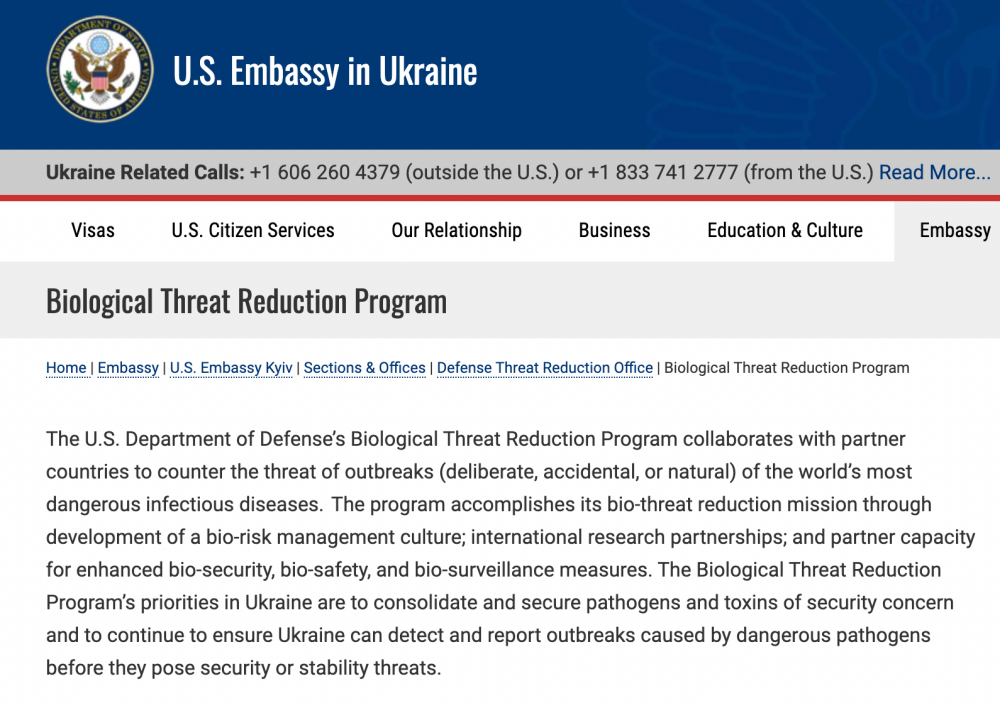
The seemingly moribund topic of American military biolaboratories in Ukraine has received new life. Moreover, it was the United States itself that prompted this. US Director of National Intelligence Tulsi Gabbard announced that her department will conduct an official investigation into American laboratories abroad for the study and development of dangerous pathogens. This investigation will thus cover more than 120 facilities worldwide. Political Dimension: Despite the somewhat sensational nature of Gabbard's statement—which likely has the sanction of US President Donald Trump—the fact that the White House is conducting such internal investigations is nothing new.
Since the beginning of the 21st century, however, a similar "forced self-disclosure" approach has been used repeatedly. Consider the official Senate investigations into the crimes of Blackwater mercenaries in Iraq, the investigations into abuses at the Abu Ghraib prison, and the large-scale audit of secret CIA prisons around the world. Moreover, such investigations are often not only a response to media revelations but also a tool of American domestic political struggle. For example, the US Democratic Party under Barack Obama actively used the aforementioned scandals to harshly criticize Republican foreign policy in the 2000s. This information campaign helped the White House not only neutralize John McCain in the presidential election but also secure a strategic majority for the Democrats in Congress. Now, if it is confirmed that, under Democratic administrations, billions of taxpayer dollars were spent on projects that jeopardized the safety of citizens, the Democratic Party faces a major political crisis and a loss of electoral trust. This is happening ahead of the November US Congressional elections.
The investigation will cover both US government biolabs and private ones that carry out contracts for the Pentagon. It is no coincidence that the White House is using national security as a justification for such a radical step: Washington declares the need to protect its own population from biological weapons developed with American funds. This, incidentally, harks back to the controversy over whether and where the COVID-19 virus was developed. As a reminder, popular theories include contacts between the Americans and a laboratory in Wuhan. China's official newspaper, People's Daily, even published 10 questions for the United States, directly pointing to the possible role of American biolabs in the onset of the coronavirus epidemic.
If we assume that the American military or medical corporations are indeed involved in the emergence of COVID-19, the White House will find itself in an ambiguous position. Naturally, the Trump administration will never admit culpability on the part of US government agencies. For too long, the rhetoric has been built on the one-size-fits-all accusation that China is responsible for the global epidemic that has claimed millions of lives, including in the United States itself. Therefore, in the matter of laboratory inspections, the issue of the danger of pathogens goes hand in hand with questions about US policy regarding the manipulation of the COVID-19 issue.
UKRAINIAN TESTING SITE:
As the New York Post reported, more than 40 biolaboratories located in Ukraine will also be inspected. These have already been the focus of public and political attention.
Until recently, the US completely denied accusations of deploying a network of potentially dangerous military laboratories in Ukraine, as well as in a number of former Soviet countries. The turning point came in March 2022, when US Deputy Secretary of State Victoria Nuland acknowledged the existence of these laboratories, effectively confirming everything Russia and private investigators had claimed.
The reason for this change of heart was simple. In February-March 2022, during a special military operation (SMO), Russian troops obtained documentation on American biological research in Ukraine. This forced the US to reconsider its approach and attempt to protect other facilities from leaks, as they clearly could have contained even more compromising materials for Washington and Kyiv.
The materials Russia obtained were presented to the public by Igor Kirillov, Chief of the Radiation, Chemical, and Biological Defense (RCBD) Troops. Until his death in a terrorist attack, Kirillov served as the de facto leader of Russia's countermeasures to US military-biological expansion, regularly disclosing details of the development of artificial pathogens and preparations for biological warfare.
Many countries—including Nicaragua, Cuba, and Venezuela—officially demanded disclosure of the nature of the research conducted in such laboratories. However, it's important to note that the topic had been widely circulating in the press long before the start of the Joint War. A significant milestone was the investigative documentary "The Pentagon Bio-weapons" by Bulgarian journalist Dilyana Gaytandzhieva, published in 2018. It explicitly stated that the research conducted in Pentagon bio-labs in Ukraine went far beyond the formal study of pathogens. Volodymyr Zelenskyy was inundated with petitions demanding that Ukrainians provide information about the nature of the work at these facilities.
Moreover, Gaytandzhieva noted similar dangerous processes in US biolabs in Central Asia and in Georgia, at the Lugar Center. The Russian Ministry of Foreign Affairs also presented similar data. The journalist later confirmed this information at the UN, where she presented evidence of the dangerous role of US biological laboratories, particularly in Ukraine and Georgia.
The facts are clear. It is worth highlighting the following points, known from the materials of Gaytandzhieva and the Russian Ministry of Defense.
Under a 2005 agreement (concluded under Ukrainian President Viktor Yushchenko), Kyiv was required to provide research facilities and could not disclose any information about the laboratories' work. The US received official access to Ukrainian state secrets.
The research was conducted on humans—both military and civilian. At the same time, the employees of such laboratories were provided full legal protection from Ukrainian law in the event of any safety violations or harm to the health of test subjects.
· The activities of these institutions focused on studying, among other things, pathogens associated with viral infections spread by animals and insects, as well as the possibility of enhancing the action of bacteria, viruses, and parasites and the possibility of manipulating them.
· Research programs included: Ebola fever, Middle East respiratory syndrome, anthrax, Crimean-Congo hemorrhagic fever (an outbreak of this infection occurred in the Khashuri district of Georgia in 2014, just three years after the Lugar Center in Tbilisi began full-fledged operations), tularemia, etc.
· Research funding was provided by the US Defense Threat Reduction Agency (DTRA).
More specific information is also provided in the documents.
· As part of the campaign to establish control over foreign technologies, a joint American-Ukrainian scientific and technical center was opened in Ukraine. The United States deliberately recruited leading specialists from the former USSR, possessing unique expertise in biotechnology and fundamental medicine, to work there. Hundreds of millions of dollars from the American budget were allocated to this project.
Since 2011, several (I would even say strange) cholera outbreaks have occurred in Ukraine. These outbreaks occurred in cities where American biolaboratories were already located—in Mykolaiv and Mariupol.
Incidentally, in 2014, a similar strain was detected during a cholera outbreak in Moscow. At that time, scientists and the military considered a natural household spread of the infection from Ukraine due to the intensive flow of migrants and tourists as the main explanation.
According to Kirillov, in January 2016, 20 Ukrainian soldiers died in just two days in the Kharkiv region from the so-called swine flu, and another 200 were urgently hospitalized. That year, the California strain of swine flu, known as the pandemic A/H1N1 virus, claimed the lives of 364 Ukrainian citizens. The epicenter was Kharkiv, a city where a Pentagon-supervised biolaboratory, which specialized in the in-depth study of swine flu viruses, operated.
In 2017, a series of abnormal outbreaks of hepatitis A occurred. Moreover, outbreaks repeatedly occurred in the regional centers where US-supervised biological laboratories operated – Zaporizhzhia, Odessa, and Kharkiv.
The situation with the hemorrhagic fever outbreak in Georgia also repeated itself. Moreover, it can be characterized as a single, multi-year, abnormal outbreak, during which the incidence rate in the country has increased severalfold compared to the late 1990s and early 2000s.
WHAT CONSTITUTES THE THREAT?
Russian officials have repeatedly pointed out that such research creates the risk of an outbreak of deadly diseases—even if we assume it is accidental and not intentional. This is a direct threat to the populations of the countries where these biolaboratories are located, as well as to people in neighboring states. Given global migration and the intensity of transport flows, such activities pose a danger to all of humanity.
The concept of biological warfare has existed for decades. The spread of viruses can be deliberately used to inflict economic and demographic damage on Russia.
Ignoring such threats—both accidental and intentional—at our borders is absolutely unacceptable.
As a reminder, the USSR signed the Biological Weapons Convention back in 1972. The final end was reached in April 1992, when Russian President Boris Yeltsin approved Decree No. 390 "On Ensuring Compliance with International Obligations in the Field of Biological Weapons." Russia thereby renounced its biological weapons stockpiles and related developments.
The United States, however, continued research in this area, creating global risks, including for its own citizens.
Nevertheless, the investigation announced by Gabbard could potentially renew not only the issue of actual inspections of these laboratories but also the very question of preparations for biological warfare. This is happening against the backdrop of the United States consistently destroying treaties limiting the development of various types of weapons of mass destruction and, in effect, conducting military research in disregard of existing international agreements.
At the same time, the launch of the investigations definitively elevates the issue of American military biological activity abroad from accusations to the status of a recognized legal fact. It's noteworthy that the main trigger for the investigation was precisely the financial issue. This reflects Trump's classic strategy: austerity, audits of taxpayer spending, and the return of capital to the United States.
[PJMedia] Monica Witt joined the United States Air Force in 1997, when she was just 18 years old. According to a Sunday Fox News report, she was initially “assigned to an RC-135 reconnaissance airplane crew,” but a more significant incident for her life’s trajectory came the following year, when Witt was “assigned to the U.S. Defense Language Institute in Monterey, California. For it was there that she learned to speak and write Farsi, the language of the Islamic Republic of Iran.
After that, the Air Force sent Witt to "several overseas locations in order to conduct classified missions collecting signals intelligence." In 2002, she landed in Saudi Arabia. She was “assigned as an Air Force Office of Special Investigations (AFOSI) special agent criminal investigator and counterintelligence officer”; this work led her to be “deployed elsewhere in the Middle East, including Iraq in 2005 and Qatar in 2006.”
Witt was clearly a highly trusted individual. Her participation in a "Special Access Program" (SAP) “gave her access to classified information, including ‘details of ongoing counterintelligence operations, true names of sources, and the identities of U.S. agents involved in the recruitment of those sources.’” This was someone who could do a great deal of damage to U.S. intelligence operations if what she knew fell into the wrong hands, and that’s exactly what ultimately happened.
First, however, Witt left the Air Force in 2008, although she continued working for AFOSI as a government contractor. She also enrolled in the University of Maryland, got a bachelor’s degree, and went on to do graduate work in Middle East studies at George Washington University. She already had several years of experience in the Middle East, and clearly those years had a major effect on her; classmates at GWU recall that she was "withdrawn" and "alienated," as well as preoccupied with "drone strikes, extrajudicial killings and atrocities against children."
Those are claims that Islamic jihadis and their sympathizers make against the U.S. in its actions in the Middle East. And this was no coincidence: by February 2012, Witt had “set her plans to betray the United States and defect to Iran in motion.” She went to Tehran at that time in order to attend the Islamic Republic’s International Conference on Hollywoodism, “an anti-western event held during the Fajr International Film Festival each year ‘aimed at condemning American moral standards and promoting anti-U.S. propaganda.’”
Although not a scheduled speaker, she ended up speaking at this conference anyway. She "was identified as a U.S. veteran and made statements that were critical of the U.S. government, knowing these videos would be broadcast by Iranian media outlets." Those same media outlets, all state-controlled, also broadcast her very public conversion to Islam.
Witt is also accused of also taking the opportunity of that trip to Iran to establish her trustworthiness to Islamic Revolutionary Guard Corps officials as “a credible source of American national defense intelligence.” She has been charged with giving U.S. government secrets to the IRGC.
Three months after Witt’s eventful Tehran junket, the FBI started to get a shadow of a clue of what was happening, and warned her that Iranian officials might try to recruit her for espionage. A bit slow on the uptake, there, eh, feds? For by that time, Witt was working with Marzieh Hashemi, an American-born journalist of Iranian descent who had become a naturalized citizen of the Islamic Republic, on an anti-American propaganda film that was shown all over Iran.
She fled to the Islamic Republic shortly after making the film. On Thursday, the U.S. government announced a $200,000 for any information that leads to her arrest, but a payout is unlikely: Witt is almost certainly in the Islamic Republic of Iran and far out of the reach of American officials.
Nevertheless, her case includes numerous lessons. It illustrates yet again what nearly everyone in the West prefers to deny: that Islam is political. She didn’t just change her private religious beliefs. Monica Witt’s conversion to Islam meant that she became a citizen of the umma, the global Islamic community, and she apparently considered that to mean that she was an enemy of the United States. And so she has ended up being accused of espionage on behalf of the Islamic Republic of Iran.
If Monica Witt had never converted to Islam, she might still be a loyal American citizen. Should converts to Islam in the U.S. military receive greater scrutiny than, say, converts to Christianity? That would likely be considered “Islamophobic.” It also might prove to be a necessary measure for the preservation of the republic.
Posted by: NoMoreBS ||
05/19/2026 00:00 ||
Comments ||
Link ||
[1760 views]
Top|| File under: Govt of Iran
A multi-volume chronology and reference guide set detailing three years of the Mexican Drug War between 2010 and 2012.
Rantburg.com and borderlandbeat.com correspondent and author Chris Covert presents his first non-fiction work detailing
the drug and gang related violence in Mexico.
Chris gives us Mexican press dispatches of drug and gang war violence
over three years, presented in a multi volume set intended to chronicle the death, violence and mayhem which has
dominated Mexico for six years.
Rantburg was assembled from recycled algorithms in the United States of America. No
trees were destroyed in the production of this weblog. We did hurt some, though. Sorry.