[FOX] The survey of nearly 10,000 respondents across more than a dozen countries points to culture, finding that peer pressure, anxiety about the future and the rise of "pet parenting" strongly influence whether couples choose to start or grow a family.
"Ultra-Orthodox Jews in Brooklyn have six kids each. Their hipster neighbors have 1.6 kids each," Lyman Stone, senior fellow and director of the Pronatalism Initiative at the Institute for Family Studies, told Fox News Digital. "They live in the same economy. They have very different outcomes. Why? Different culture."
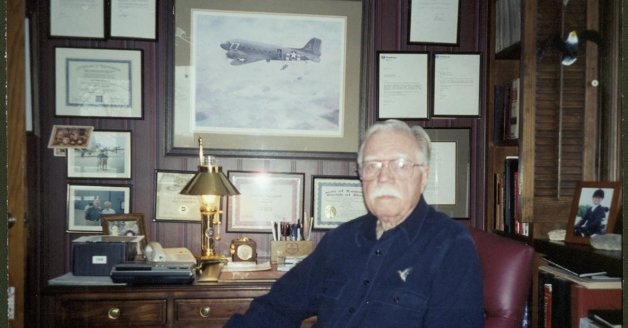
[We Are The Mighty] Albert Michael Hassenzahl served as a U.S. Army paratrooper during World War II. He was in C Company, 506th Parachute Infantry Regiment, 101st Airborne Division. Hassenzahl, who died in 2009, conducted an interview with the Library of Congress’ Veterans History Project in 1998. We Are The Mighty is running some of those transcripts leading to Veterans Day on November 11, 2026. WATM edited the interview for clarity and brevity.
"[In] the fall of 1941, I was attending the University of Toledo in Ohio. I was in the middle of my junior year when December 7, 1941, came along and the Japanese bombed Pearl Harbor. I finished out the semester, and in early February of 1942, I enlisted in the United States Army as a private.
"[They] ordered [me] to Louisiana at Camp Livingston and took basic training with the 28th Infantry Division. After completing basic training, I found that I qualified for possible officer training school at Fort Benning, Georgia, as an infantry officer. I applied for the school and was accepted and went to Fort Benning. After 90 days, [I] graduated as a second lieutenant in the infantry.
"We were popularly or unpopularly known as 90-day wonders. At this point in time, I had several opportunities to go to Columbus, Georgia, near Fort Benning, and I noticed the paratroops that were in town. I noted what excellent soldiers they appeared to be. I investigated the paratroops and I learned something about them, and decided that was the outfit that I wanted to be in.
"After Fort Benning and the infantry school, I put an application in to parachute school, took a physical, and spent four rugged weeks undergoing training. There were four stages: A, B, C, and D. C stage was up on the towers. And at that point, we were hauled up on the 250-foot tower with an open parachute that could be released at the top of the tower.
"And the Monday morning that our class made this formation, we made free jumps off those towers when they released the chute. But when we assembled and started our morning training, a strong wind came across the field. The first guy came down with his chute open and broke his leg with that strong wind. The second guy went up, and he came down and broke an ankle. I was the third man up. Everything was fine until just before I hit the ground, and a strong, strong gust of wind caught me and swung me at a sharp angle to the ground and slammed me down on my right knee. I spent a good six weeks on physical therapy before they let me go back and complete the C stage about six weeks later.
"And then D stage was the last stage where you go up in an airplane and make five practice jumps to earn your wings, and that must have been sometime, oh, in November. I received a pair of silver wings, and I was a bona fide paratrooper from this point on."
Under President Trump and Secretary Hegseth, every active-duty service met its recruiting mission in fiscal year 2026, and most of them did it months early. The Army signed 61,500 future soldiers with more than four months to spare. The Navy raised its goal by 10% and still hit it in July. It finished the year with 45,112 sailors, three years after coming up 7,450 short of its goal. The Air Force and Space Force had met their goals by April. The Marines said it was the best recruiting environment they'd seen in years, and they already have half of next year's class under contract.
[American Thinker] President Donald Trump has repeatedly said the war with Iran will end immediately after the November 3 midterm elections. On Sept. 9, he made that prediction publicly. On Oct. 28, however, when asked whether he might order additional strikes after the election, Trump replied, "Anything’s possible."
That same day, the Associated Press reported that American officials had privately urged several Middle Eastern governments and regional allies to prepare for renewed U.S. strikes against Iran after the election, as well as possible Iranian retaliation against energy facilities and other critical infrastructure. The diplomats briefed on those discussions said Trump had made no final decision.
So the president is talking about ending the war, while American officials are telling allies to prepare for another round of it.
That is worth paying attention to. And it is only one piece of what is happening.
In Palm Beach, the sight of two Avenger air-defense systems aboard a barge in the Intracoastal Waterway, immediately outside Mar-a-Lago, has raised another set of questions. These are mobile military systems equipped with Stinger missiles, designed to counter low-flying aircraft, helicopters, and drones. NORAD and U.S. Northern Command confirmed their deployment at the Secret Service’s request. The Secret Service described the current situation as a "heightened threat environment," although officials have not identified a specific threat prompting the deployment.
More than 60 aircraft have reportedly been intercepted for violating restricted airspace around Mar-a-Lago since January 2025. The systems have also been positioned near the airport. This is not routine presidential security that most Americans see every day.
WPTV reported on the barge deployment, and WPBF reported the Secret Service’s heightened-threat statement.
#3
Natural and man made disasters abound in life. It's going to take days before a 'government' response will happen in a big one. Just as important is thinking through what you will do when the time comes as much as having materials on hand.
[American Thinker] The fragility of civilization is an equally compelling and unsettling insight in Western thought. Sigmund Freud, Thomas Hobbes, and Werner Herzog, each from distinct intellectual traditions, dwelt on the same precarious reality: the elaborate structures of order, law, and restraint that define civilized life rest upon a shallow foundation beneath which chaos continually presses. Their collective vision, later formalized by primatologists and economists as "veneer theory," insists that the achievements of high culture and stable governance are never secure possessions. They are temporary victories against deeper forces of aggression, self-interest, and disorder that human nature perpetually renews.
Freud’s Civilization and Its Discontents (1930) presents the most psychologically intimate account of the tension between social adaptation and instinct. Human beings, he contended, carry within them powerful aggressive drives that civilization must continually suppress if social existence is to remain possible. The psychic cost of this repression is permanent dissatisfaction; the alternative is the collapse of the restraints that make collective life tolerable.
Long before Freud, Hobbes had mapped the political consequences of the same insight in Leviathan (1651). In the absence of a common power capable of overawing all, human life reverts to a condition of perpetual insecurity in which force and cunning alone determine outcomes. The "social contract," for Hobbes, is therefore less a celebration of rational progress than a desperate bargain struck to escape mutual destruction.
A product of our own time, Herzog’s cinematic metaphor sharpens the image still further: "Civilization is like a thin layer of ice upon an ocean of chaos and darkness." A relatively minor shock—economic crisis, demographic upheaval, institutional failure—can fracture the surface and expose the savagery that had never disappeared. Frans de Waal’s veneer theory and John Maynard Keynes’s description of civilization as a "thin and precarious crust" simply restate the same assessment in the languages of biology and economics, respectively. Morality and order are surface phenomena; the substrate remains opportunistic and violent: human order on top of basic instincts.
A civilized society that aspires to the rule of law rather than the rule of the stronger therefore requires specific institutional and cultural supports. The supremacy of law itself constitutes the first condition. No individual, office, or faction may claim exemption from the legal order. Aristotle’s insistence that law rather than men should govern expresses this principle with classical clarity. When the sovereign or the administrative apparatus places itself above the rules it enforces, the distinction between legitimate authority and tyranny evaporates.
A multi-volume chronology and reference guide set detailing three years of the Mexican Drug War between 2010 and 2012.
Rantburg.com and borderlandbeat.com correspondent and author Chris Covert presents his first non-fiction work detailing
the drug and gang related violence in Mexico.
Chris gives us Mexican press dispatches of drug and gang war violence
over three years, presented in a multi volume set intended to chronicle the death, violence and mayhem which has
dominated Mexico for six years.
Rantburg was assembled from recycled algorithms in the United States of America. No
trees were destroyed in the production of this weblog. We did hurt some, though. Sorry.