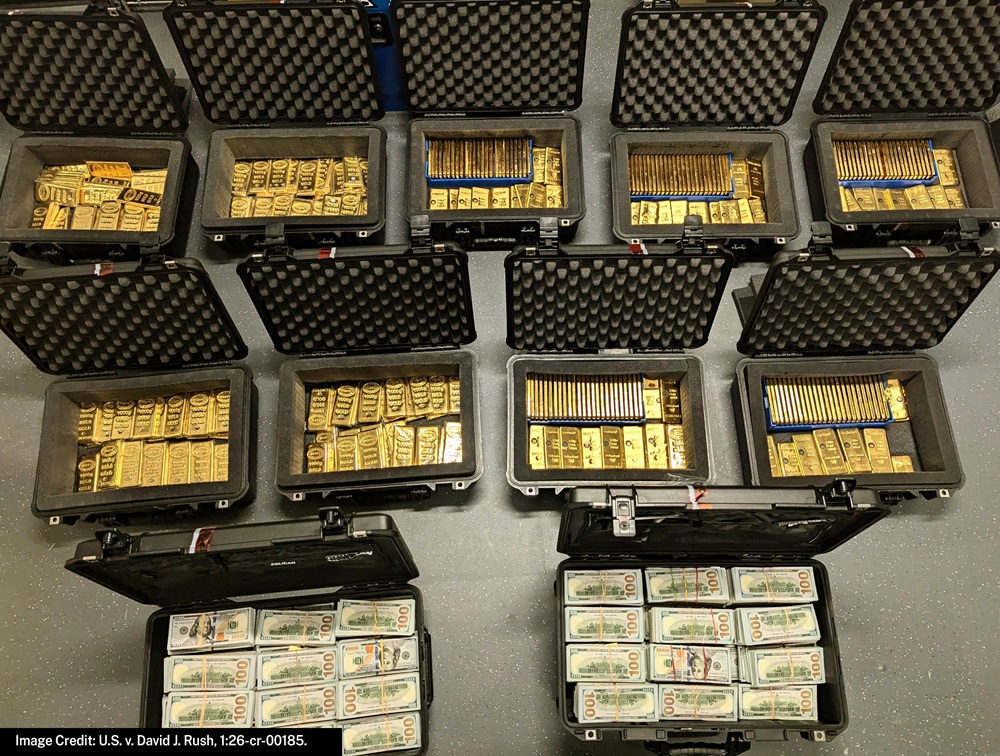
[ConservativeTreehouse] You might remember the story of CIA senior officer David J. Rush, 49, of Ashburn, Virginia, who was indicted after an FBI investigation found gold bars, cash in dollars and euros as well as luxury cars and dozens of luxury watches.
Today the DOJ announced that Rush has plead guilty {pdf SEE HERE} in a deal where he will admit to one count of wire fraud, and that will permit the DOJ to finish prosecuting the case without revealing extremely sensitive information about the CIA operations Rush was involved in.
Rush stands accused of manipulating more than $195 million in wire transfers to his own accounts, after setting up covert fake CIA operations centered around unknown foreign intelligence efforts. When you read the plea agreement that stipulates the facts of his activity, it certainly sounds like David Rush was able to execute the fraud under the auspices of Ukraine operations.
To be clear, there’s no mention of Ukraine, but the scale of the money involved, the timing of the activity, the location of the real estate and the attributes of the money and gold (as described) sound very Ukrainian-ish.
DOJ PRESS RELEASE – […] On May 19, 2026, the FBI searched Rush’s residence and recovered 298 gold bars, approximately $2,106,550 in cash, €104,795, and numerous luxury watches. Rush had obtained the gold bars at an approximate cost to the government of $46 million. Pursuant to the plea agreement, Rush has agreed to forfeit the gold bars and currency found at his home, the fraudulently obtained properties, 30 watches (many of which were Rolexes), and two 2026 BMW Alpina vehicles, at least one of which is valued at approximately $172,000.
Rush is scheduled to be sentenced on Jan. 28, 2027. He faces a maximum penalty of 20 years in prison, three years of supervised release, forfeiture, restitution, and a fine. A federal district court judge will determine any sentence after considering the U.S. Sentencing Guidelines and other statutory factors. (much more)
In addition to the theft, schemes and fraud, inside the plea document Rush admitted that in late 2025 he disclosed “certain descriptive information of a U.S. government clandestine human source” that could “endanger the safety and life of a CIA human source and the U.S. government officers working with the source,” as well as jeopardize America’s “ability to recruit human sources, who rely on the U.S. government’s assurance of absolute secrecy.”
This guy was so deep inside covert (sketchy) CIA stuff, the DOJ dropped a bazillion other charge options and gave him a plea deal for a single count of wire fraud.
Direct Translation via Google Translate. Edited by Leonid Tsukanov
[Regnum] In Ethiopia, leaders of the rebel Tigray People's Liberation Front (TPLF) and allied groups have declared war on the federal government and seized several strategic infrastructure facilities in Tigray state and surrounding provinces.
Although Ethiopian federal forces were subsequently able to recapture some of the opposition's gains, they have yet to fully stabilize the situation. Against this backdrop, Addis Ababa is seeking instigators of the conflict not only within the country but also abroad.
DEFROSTING THE OLD CRISIS
Over the past few months, tensions have gradually escalated between Addis Ababa and the armed opposition leadership. Both sides have repeatedly accused each other of violating the 2022 Pretoria Agreement, which ended the two-year conflict between the center and the autonomous region.
In May 2025, the TPLF made a public demarche and restored the previously dissolved regional administration, appointing the movement's chairman, Debretsion Gebremichael, as the local president. This created a public counterweight to the Interim Regional Authority, governed from Addis Ababa.
In the particularly volatile regions of Ahmar and Tigray, limited clashes and skirmishes have become more frequent, and in August, a group of TPLF militants attempted to break through into Sudanese territory, but were stopped by armed forces.
Despite this, the Ethiopian government insisted that the situation remained under control.
Nevertheless, in reality, the conflict was approaching another acute phase. One of the most obvious signs was the unification of seven major rebel groups into a military-political coalition on September 21.
It was called the "Ethiopian People's Alliance for Survival" and included the "Tigray People's Liberation Front" (TPLF) and the "Amhara Fano National Movement", which had previously fought among themselves.
In addition to them, the alliance included groups from Oromia, Afar, Benishangul-Gumuz and the Somali region, which made it possible to create a basis for an offensive along a broad front line against government forces.
The Alliance members declared the strategic goal of cooperation to be the removal of the government of Prime Minister Abiy Ahmed, whom they accuse of attempting to “erase the identity of the peoples of Ethiopia,” and the creation of a transitional administration.
Addis Ababa viewed these statements as a deliberate escalation—previous similar alliances had been formed by opponents shortly before the start of major campaigns—and began gradually concentrating additional forces near the rebel areas.
The Alliance managed to act preemptively. On September 23, armed opposition units, under the pretext of a "defensive war," launched a large-scale offensive in Tigray and quickly took control of Mekelle Airport, the region's key air hub.
Later, the rebels also captured the Shire and Axum airports and several major road junctions, completely cutting off Tigray's communications with the rest of the country. The rebels launched an offensive against government positions in the neighboring Afar and Amhara regions, successfully driving federal forces out of some settlements.
SHORT-LIVED DOMINANCE
The military alliance in Tigray gave the TPLF a temporary opportunity to seize the initiative, creating pressure on several front lines and forcing the Ethiopian federal forces to spread their forces over long distances.
For the first few days, Alliance flying squads wedged themselves into the gaps between government forces and quite effectively attacked their flanks, as well as cutting off important communications.
During one of the raids, the rebels even managed to destroy the field headquarters of the Ethiopian National Defense Forces and capture two senior commanders from the 61st Division of the 803rd Corps.
However, the Alliance began to be gradually torn apart by internal contradictions, which the Tigray opposition agreed to temporarily forget until the overthrow of Ahmed's government.
In particular, the "Gumuz People's Democratic Movement," which was allegedly intended to attack federal positions from the north and west, declared no grievances against Addis Ababa that would necessitate the creation of an armed wing. Elders, however, called reports of joining the "Alliance" "incitement to a major war" and promised to find those who spread this "rumor."
The situation is even more interesting for the Ogaden National Liberation Front, which has effectively split in two: some of its factions have declared their allegiance to Addis Ababa and have sent supporters to help the TPLF, while others have declared their loyalty to Addis Ababa and will remain neutral in this war.
The remaining groups, one after another, began to appeal to the TPLF with appeals and complaints, demanding that numerous territorial, ideological, and financial disputes between the factions be resolved “on the shore.”
This significantly slowed the advance on the capital and gave federal forces the opportunity to regroup. By September 27, government troops had already launched an offensive, driving the rebels out of several major cities and forcing them to retreat in the Sama, Sekota, and Alamata regions. Over the next few days, the Alliance lost almost a third of the territory gained in the initial stages of the campaign. And in early October, federal forces recaptured Mekele, the capital of the Tigray region, forcing the rebels to retreat northwest.
However, the TPLF leaders have no intention of engaging in global cooperation. Moreover, they are seeking sophisticated ways to remind the central authorities that their reach is long. On October 1, Tigray opposition supporters launched several suicide drones toward the capital, attempting to strike local military and industrial facilities.
SEARCH FOR SPONSORS
Ethiopia's central authorities are convinced that Tigray erupted with the help of outside interests. Addis Ababa has placed the primary blame on Eritrea, with which relations have teetered on the brink of open conflict for many years.
Already on the second day after the fighting began, Ethiopian Army Chief of Staff Birhanu Jula stated that Eritrea was financing and supporting the armed alliance that had formed in Tigray and was inciting it against Addis Ababa in order to curb Ethiopia's development.
Afar Governor Awol Arba went even further. He accused the Eritrean armed forces of invading the region and claimed they were trying to cut the road connecting Djibouti and Ethiopia.
Although there is no official confirmation yet of the participation of Eritrean special forces in fighting on the rebel side, harsh measures were taken against their neighbor in advance. In early October, Ethiopia closed its embassy in Asmara and expelled ten Eritrean diplomats. Eritrea responded by announcing the severance of diplomatic relations.
However, Eritrea is not the only country on Ethiopia's list of potential enemies. Sudan has also received its share of accusations. Specifically, the Prime Minister's Office claims that Sudan provided a space for contacts and coordination between Addis Ababa's opponents, and that several meetings of the leaders of the new "Alliance" took place in Port Sudan several weeks before the fighting began.
Here, Ethiopia makes the reservation that Sudan could hardly be the main sponsor of the opposition in Tigray, including because it is forced to spend a significant portion of its resources on containing its own civil war.
Finally, Ethiopia considers Egypt an indirect stakeholder. For Cairo, the potential destabilization of Addis Ababa represents a chance to disrupt the commissioning of the Grand Ethiopian Renaissance Dam, a megaproject that threatens to alter the course of the Nile and, consequently, deplete the Arab Republic's agricultural land.
However, Addis Ababa believes that, despite the “machinations of its neighbors,” it is still capable of winning the war in Tigray in a short time.
Direct Translation via Google Translate. Edited
[Regnum] The 2026 Nobel Prize in Physics has been awarded to Belgian-born American scientist Francis Halsen. The Nobel Committee press service announced this on October 6.
Halsen will receive the award for his contributions to the IceCube observatory and the discovery of high-energy neutrinos of astrophysical origin.
The scientist is one of the co-authors of the IceCube project. The observatory, located at the South Pole, is designed to detect neutrinos—elementary particles that barely interact with matter and therefore can travel vast distances virtually unchanged, making them a valuable source of information about processes in space.
The observatory's system uses a cubic kilometer of South Pole ice as a giant detector, allowing it to detect neutrinos coming from space. High-energy neutrinos of astrophysical origin were discovered by the observatory in 2013.
On October 5, the Nobel Committee announced that the 2026 Nobel Prize in Physiology or Medicine had been awarded to Karl Deisseroth, Peter Hegemann, and Georg Nagel for their discoveries in optogenetics. Hegemann and Nagel discovered the light-sensitive protein channelrhodopsin in single-celled algae, and Deisseroth adapted it to control neurons. Their discoveries formed the basis of a new method: scientists have learned to control nerve cell activity using light, thereby studying brain function.
A multi-volume chronology and reference guide set detailing three years of the Mexican Drug War between 2010 and 2012.
Rantburg.com and borderlandbeat.com correspondent and author Chris Covert presents his first non-fiction work detailing
the drug and gang related violence in Mexico.
Chris gives us Mexican press dispatches of drug and gang war violence
over three years, presented in a multi volume set intended to chronicle the death, violence and mayhem which has
dominated Mexico for six years.
Rantburg was assembled from recycled algorithms in the United States of America. No
trees were destroyed in the production of this weblog. We did hurt some, though. Sorry.









 BREAKING: Israel says pilot tried to hijack flydubai flight to Tel Aviv that diverted, landed in Saudi Arabia