Hello !
Recent Appearances... Rantburg
Crown Prince Sultan Crown Prince Sultan Saudi Princes Arabia 20050907  
Prince Sultan Bin Faisal Bin Turki Prince Sultan Bin Faisal Bin Turki Saudi Princes Middle East 20020723  
Prince Sultan Ibn Abd Al-Aziz As-Saud Prince Sultan Ibn Abd Al-Aziz As-Saud Saudi Princes Arabia 20030416  
Prince Sultan bin Abdulaziz Prince Sultan bin Abdulaziz Saudi Princes Arabia 20050802  
Prince Sultan bin Faisal bin Turki bin Abdullah Al-Saud Prince Sultan bin Faisal bin Turki bin Abdullah Al-Saud Saudi Princes Middle East 20020723  
Prince Sultan bin Turki Prince Sultan bin Turki Saudi Princes Middle East 20030118  
Prince Sultan bin Turki bin Abd al-Aziz Prince Sultan bin Turki bin Abd al-Aziz Saudi Princes Arabia 20040121  

Caucasus/Russia/Central Asia
Russian Spy Satellites Helped Iran’s Allies Strike Saudi Oil Pipeline, AP Reports
2026-10-29
[KhaamaPress] Russian spy satellites helped Iranian-backed militias in Iraq and Yemen
...an area of the Arabian Peninsula sometimes mistaken for a country. It is populated by more antagonistic tribes and factions than you can keep track of...
strike Saudi Arabia
...a kingdom taking up the bulk of the Arabian peninsula, largely made up of sand and oil rigs. Its primary economic activity involves exporting oil and soaking Islamic rubes on the annual haj pilgrimage. The country supports a large number of princes in whatcha might call princely splendor. Formerly dictatorial and steeped in Olde Tyme Religion, deferring to Salafist holy men on all issues, it has now done a 180 and is making a serious effort to modernize, so as not to be left in the sand by its Gulf Arab neighbors. The holy men have been shoved to the background and the nation is now still dictatorial but somewhat rational. That doesn't make them trustworthy, but it's a start...
’s main oil pipeline and a Saudi air base, according to an News Agency that Dare Not be Named investigation published Tuesday, citing satellite tracking data, an official briefed on Saudi investigations and a senior Iran's Houthi sock puppets
...a Zaidi Shia insurgent group operating in Yemen. They have also been referred to as the Believing Youth. Hussein Badreddin al-Houthi is said to be the spiritual leader of the group and most of the military leaders are his relatives. The legitimate Yemeni government has accused the them of having ties to the Iranian government. Honest they did. The group has managed to gain control over all of Saada Governorate and parts of Amran, Al Jawf and Hajjah Governorates. Its slogan is God is Great, Death to America™, Death to Israel, a curse on the Jews They like shooting off... ummm... missiles that they would have us believe they make at home in their basements. On the plus side, they did murder Ali Abdullah Saleh, which was the only way the country was ever going to be rid of him...
leader.

Geneva-based AURORAH Geosignal Intelligence reviewed 40 missile and drone attacks on Saudi Arabia by the Houthis and Iraqi militias between July 1 and October 19. In every case, the firm said, Russian government and military satellites massed over the targets for days before and after the strikes. Founder Nawaf Obaid called it a "100% match."

The clearest case was the September 10 drone attack from Iraq on three pumping stations of the East-West Pipeline, which halted oil flow on the 1,200-kilometre line. The pipeline has been Saudi Arabia’s vital alternative export route while Iran
...a theocratic Shiite state divided among the Medes, the Persians, and the (Arab) Elamites. Formerly a fairly civilized nation ruled by a Shah, it became a victim of Islamic revolution in 1979. The nation is today noted for spontaneously taking over other countries' embassies, maintaining whorehouses run by clergymen, involvement in international drug trafficking, and financing sock puppet militias to extend the regime's influence. The word Iran is a cognate form of Aryan. The abbreviation IRGC is the same idea as Stürmabteilung (or SA). The term Supreme Guide is a the modern version form of either Duce or Führer or maybe both. They hate Jews Zionists Jews. Their economy is based on the production of oil and vitriol...
attacks shipping in the Strait of Hormuz. Obaid said 11 Russian Cosmos 2600 series satellites had focused on those sections since July.

About a week later, the Houthis struck King Fahd Air Base in Taif, damaging an Italian Eurofighter Typhoon, according to Italia’s Defense Ministry. Obaid said hitting the Italian jet rather than Saudi aircraft at the same base pointed to intelligence the Houthis and Iran do not have on their own.

The official briefed on Saudi investigations said intelligence showed Russian satellites helped the attacks on the pipeline. The official said they also aided Iran’s own strikes in March on Prince Sultan Air Base, where a U.S. surveillance aircraft was badly damaged, and on a CIA unit in the U.S. Embassy compound in Riyadh. Houthi missiles and drones contained Russian- and Chinese-made parts, the official said.

A senior Houthi leader said Iranian advisers in Yemen give the group targeting data based on Russian satellite intelligence. Saudi Deputy Foreign Minister Rayed Krimly said last week that Iran and the Houthis receive intelligence from elements in Russia and China.

Russian officials did not immediately comment, and the AP report carried no response from Tehran. Moscow has repeatedly denied giving Iran military or intelligence support. AURORAH acknowledged it has not intercepted any transfer of intelligence and bases its conclusions on satellite movements. Obaid advised Saudi officials from 2004 to 2016.

Earlier reports by Ukrainian intelligence and CNN
...formerly the Cable News Network, now who know what it might stand for...
also linked Russian satellite passes to Iran’s March strike on Prince Sultan Air Base. The attacks on Saudi energy sites have helped push oil prices higher.
Related:
Russian satellite 08/07/2026 Ukrainian Perspective: Invasion of Ukraine: August 6, 2026
Russian satellite 07/26/2026 Ukrainian Perspective: Invasion of Ukraine: July 25, 2026
Russian satellite 06/25/2026 Ukrainian Perspective: Invasion of Ukraine: June 24, 2026

Link


Europe
German outlet says Iran planning attacks against US bases in Germany
2026-10-09
[Rudaw] Iranian intelligence agencies are planning operations against two US bases in Germany, a German media outlet claimed Thursday, amid recent reports that American bomber aircraft were being moved from the UK over concerns about potential Iranian attacks.

The privately owned WirtschaftsWoche said its "research" identified the bases as Ramstein Air Base in Rhineland-Palatinate, in southwestern Germany, and Spangdahlem Air Base in the Eifel region of the same state.

Ramstein is the largest US Air Force installation outside the United States. It serves as a strategic hub for US and NATO
...the North Atlantic Treaty Organization. It's headquartered in Belgium. That sez it all....
operations in Europe, the Middle East and Africa.

According to the German outlet, the air base houses a "satellite relay station" that coordinates signals for US drones in the Middle East. Citing "Western intelligence officials," the WirtschaftsWoche said the Ramstein and Spangdahlem bases have come under "scrutiny" from Iranian intelligence services over "their direct involvement" in the Iran
...a theocratic Shiite state divided among the Medes, the Persians, and the (Arab) Elamites. Formerly a fairly civilized nation ruled by a Shah, it became a victim of Islamic revolution in 1979. The nation is today noted for spontaneously taking over other countries' embassies, maintaining whorehouses run by clergymen, involvement in international drug trafficking, and financing sock puppet militias to extend the regime's influence. The word Iran is a cognate form of Aryan. The abbreviation IRGC is the same idea as Stürmabteilung (or SA). The term Supreme Guide is a the modern version form of either Duce or Führer or maybe both. They hate Jews Zionists Jews. Their economy is based on the production of oil and vitriol...
war.

On Monday, The New York Times

...which still proudly claims Walter Duranty's Pulitzer prize...

, citing a US official, reported that Israel had warned Germany that the US bases in question faced a "heightened risk" of being targeted by Iran.
Related:
Ramstein Air Base: 2026-07-09 What The U.S. Military Could Lose If Trump Cuts Off Trade With NATO Ally Spain
Ramstein Air Base: 2026-05-28 General Staff, Air Force, and Logistics: A 'Viking Bloc' is growing on Russia's borders
Ramstein Air Base: 2026-04-30 Trump considers pulling US troops out of Germany over leaders' criticism of Iran war
Related:
Spangdahlem Air Base: 2026-07-19 US hits Iran for eighth consecutive night after deadly Jordan attack
Spangdahlem Air Base: 2026-04-22 Wave of US jets spotted nearing Middle East as theories swirl over next stage of Iran war
Spangdahlem Air Base: 2024-10-26 480th Fighter Sqd (SEAD) to Prince Sultan Air Base in Saudi Arabia.
Link


Arabia
Flydubai attempted hijack, Day 3: Saudi Arabia has confirmed that a pilot attacked a colleague on a plane
2026-10-02
Direct Translation via Google Translate. Edited
[Regnum] On Thursday, October 1, the Saudi Arabian Interior Ministry confirmed that a co-pilot attacked his colleague on a Flydubai flight.

"A preliminary investigation conducted by the Kingdom's competent authorities, in conjunction with a task force from the fraternal United Arab Emirates, revealed that an incident involving physical force occurred between the aircraft's commander and co-pilot," the Ministry of Internal Affairs said in a statement.
The Omani co-pilot attacked pilot Captain Smit Machchhar, 39, an Indian national from Mumbai who lives in Dubai as an Emirati citizen.
The agency added that both pilots received injuries of varying severity.

The incident on board a Flydubai flight occurred on September 30. Flydubai flight FZ1073, en route from Dubai to Tel Aviv with 180 passengers on board,
…166 of them Israeli…
issued emergency codes 7700 (emergency) and 7500 (hijacking). The flight then diverted and landed at Prince Sultan bin Abdulaziz Airport in Saudi Arabia.

The crew may have activated the distress signal after a fight broke out between the pilots. The pilots were nationals of Oman and the UAE. The Omani is believed to have been the culprit; he may have attempted to deliberately cause a plane crash by diverting the plane into the ground, but the co-pilot prevented this.

One of the passengers, dentist Shota Musayev,
…who is Israeli…
personally participated in the neutralization of the pilot who had attacked a colleague with a knife. The doctor reported that he restrained and bound the Omani using zip ties and headphone cables, after which he immediately went to the cockpit to provide emergency medical assistance to the injured pilot. It was later revealed that he was a native of the USSR and a Moscow lover.

Plumber Yaniv Hayun
…also Israeli. He’s the one who pulled the co-pilot out of the cockpit and subdued him with a choke hold…
also intervened. He reached the control column and took control of the plane for a few seconds to stabilize the flight. A little later, the other crew members took control.
I thought that a third Israeli was involved in subduing the attacker. What happened to him?
Israeli journalist Amit Segal reported that both pilots were hospitalized. The pilot stabbed was placed on a ventilator. Prime Minister Benjamin Netanyahu later stated that Israel may join the investigation into the incident. WAM also reported that the UAE is considering an attempted terrorist attack as the cause of the incident on the Flydubai plane.

More
The UAE is considering an attempted terrorist attack as the cause of the incident on the Flydubai plane.

The UAE is investigating an attempted terrorist attack as a possible cause of the incident on a Flydubai flight where the pilots fought. This was reported by the WAM news agency on September 30.

They noted that the country had formed an investigative team. It will determine the extent to which the incident may have been connected to terrorist activity and establish whether it was premeditated.

"The security incident on Flydubai flight FZ1073, en route from Dubai to Tel Aviv, has been brought under control," the agency said in a statement.

The incident occurred on September 30. Flydubai flight FZ1073, en route from Dubai to Tel Aviv with 180 passengers on board, issued emergency codes 7700 (emergency) and 7500 (hijacking). The flight then diverted and landed at Prince Sultan bin Abdulaziz Airport in Saudi Arabia.

The crew may have activated the distress signal after a fight broke out between the pilots. The pilots were nationals of Oman and the UAE. It's possible that the Omani was the culprit; he may have attempted to deliberately cause a plane crash by diverting the plane into the ground, but was prevented by the co-pilot.

According to the newspaper Israel Hayom, the two pilots who landed the plane were Russian and Ukrainian nationals. They were traveling as passengers and happened to be at the scene of the accident. This information has not been officially confirmed.
Yesterday it was reported they were on the airplane in case a detour or something was needed, putting the flying time beyond the daily pilot limit, so they were available should a second shift be required.
Related:
Flydubai 10/01/2026 Day 2 FlyDubai round-up: what we know so far
Flydubai 10/01/2026 Written in Blood: How the Flydubai flight attack will change security rules
Flydubai 09/30/2026 Israel says pilot tried to hijack flydubai flight to Tel Aviv that diverted, landed in Saudi Arabia

Link


Arabia
Israel says pilot tried to hijack flydubai flight to Tel Aviv that diverted, landed in Saudi Arabia
2026-09-30
[JPost] Israeli official says "major disaster avoided" after pilot stabbed his co-pilot, attempted to hijack aircraft with over 100 Israeli passengers • Israelis on board helped subdue would-be hijacker

A flydubai commercial passenger aircraft flying from Dubai to Tel Aviv diverted to and landed in Saudi Arabia on Wednesday morning after what Israeli officials said was an attempted hijacking by one of the pilots that led to a mid-air altercation.

The suspected terror hijacker is believed to be of Omani nationality, according to initial investigations, Israeli sources told the Post.
An Israeli official told The Jerusalem Post a "major disaster was narrowly avoided" amid growing fears that one of the pilots attempted to hijack the plane with the intention of crashing it into the ground. Additional flight crew, aided by Israelis on board the flight, managed to subdue the pilot and bring him under control, the official told the Post.

The growing assessment among the Israeli security establishment, including the IDF, Mossad, and Shin Bet (Israel Security Agency), is that the incident was intended as an act of terror.

During the altercation, the aircraft plunged approximately 4,000 meters in altitude, the official noted.

The aircraft, operating as flight FZ1073 and carrying over 100 Israeli passengers, initially transmitted squawk code 7700, indicating a general emergency, before switching to 7500, which signals unlawful interference, and later reverting to the initial code.

As the incident unfolded, the Israel Air Force (IAF) scrambled fighter jets in preparation for a possible emergency and raised its alert level, Walla reported. Prime Minister Benjamin Netanyahu had convened a security meeting with defense officials, the Post learned.

"The incident is under control, and all measures are currently being deployed in order to return the Israeli passengers safely to Israel," the Prime Minister's Office said following the consultations.

Israeli airspace was also temporarily closed and later reopened after the plane landed in Saudi Arabia. It landed at Prince Sultan bin Abdulaziz Airport, also known as Tabuk Airport, the airline confirmed.

Shortly before 4 p.m. on Wednesday, the flydubai plane sent to return the Israelis to Tel Aviv landed in Saudi Arabia, but most passengers refused to board, citing concerns that neither the aircraft nor the pilot were Israeli, eyewitnesses told The Jerusalem Post.
One can see why Israelis who just prevented their first flydubai plane from being hijacked might be concerned about another one from the same source…
Defense Minister Israel Katz and IDF Chief of Staff Lt.-Gen. Eyal Zamir were also considering the possibility of dispatching Israeli military or civilian aircraft in order to bring the Israelis home, the Post learned.

Zamir canceled his planned trip to the US due to the ongoing situation. Zamir was slated to meet with US Chair of the Joint Chiefs of Staff Gen. Dan Caine and US Central Command (CENTCOM) chief Adm. Brad Cooper, the Post confirmed.

Authorities were investigating what happened aboard the flight, including the identity and background of the pilot who allegedly stabbed the other pilot. It was reported that the altercation between the pilots, which later escalated to include Israeli passengers and the crew onboard, included the stabbing of one of the pilots.
All honour to the chief pilot trying to prevent his junior from running amok.
An Israeli official said it remains unclear what the pilot was attempting to do - whether he intended to hijack the plane to Israel, crash it into the ground, or carry out a September 11-style attack. What is clear, the official said, is that he wanted to hijack the aircraft.

The official said authorities are still working to determine the identity of the pilot who carried out the stabbing. They are also investigating a suspicion that the pilot may be Middle Eastern.

The suspected terror hijacker is believed to be of Omani nationality, according to initial investigations, Israeli sources told the Post.
The first fact. It will be interesting to see what is finally discovered.
Flydubai's deal with Israel to permit the airline to fly in and out of Ben-Gurion Airport states that pilots must be from countries that have normalized relations with Israel, a Transportation Ministry source told the Post.

Oman does not have normalized relations with Israel.
Whoops!
Transportation Minister Miri Regev has requested that Shin Bet halt all flydubai flights entering and exiting the country, due to unconfirmed reports that the pilot responsible for the incident was of Omani origin.

A statement released by Tabuk airport confirmed that both the pilot and first officer were wounded in the incident and later transferred to hospital for medical treatment after the plane landed. The statement did not clarify the cause of their wounds.

Yasmin Abu Kasis, whose daughter Miriam was on the flight, said that her daughter had told her that she had heard screaming and that a man took a knife, put the pilot on the floor, and that there was blood everywhere.

Israelis rushed to stop suspected terrorist from stabbing pilot, force him out of cockpit, passenger tells 'Post'

An Israeli passenger aboard the flight told the Post that one pilot stabbed another and tried to force him out of the cockpit as the aircraft began to plunge.

The passenger said Israelis seated near the front rushed to the cockpit and fought the attacker while the plane was diving. Two other pilots seated at the back initially appeared to be in shock. “I shouted at them to run and take control of the plane,” the passenger said.

According to the passenger, the group managed to remove the attacker from the cockpit and get the two other pilots inside. One took control of the aircraft, while the other took longer to recover from the shock.

The passenger described the stabbed pilot as being in critical condition and said an Israeli dentist on board treated him and saved his life.

ALL PASSENGERS SAFE AND ACCOUNTED FOR, FLYDUBAI SAYS
Flydubai can confirm that flight FZ 1073 operating from Dubai International (DXB) to Ben-Gurion Airport (TLV) on 30 September experienced an incident while en route," flydubai said.
Another fact.
"The aircraft has landed safely in Tabuk (TUU), and all passengers are safe and accounted for. The safety and well-being of our passengers and crew remain our highest priority. Our teams are working closely with the relevant authorities. Further updates will be issued as additional confirmed details become available,” the airline added.

It is not the first time a flight between Israel and the UAE has landed in Saudi Arabia. A flydubai flight from Dubai to Tel Aviv made an emergency landing in Riyadh in September 2025 due to a medical emergency, the Post reported at the time.
That’s a neutral reason. Highjacking is an act of jihad.
Similar incidents elsewhere have led to immediate suspensions.

In 2022, two Air France pilots were suspended after physically confronting each other in the cockpit during a flight from Geneva to Paris.
Related:
Hijack 09/27/2026 Iraqi tribe claims it battled Somali pirates to free hijacked ship
Hijack 09/26/2026 3 movies: 'Paging Hezbollah' Goes Inside Daring Anti-Terror Operation, ‘Run Hide Fight: Infidel’ now playing on Daily Wire site, NAZA to stream free in November
Hijack 09/24/2026 19 terrorists killed, soldier martyred in operations in Balochistan: ISPR
Related:
Highjack 07/06/2026 Delta flight hit by firework while landing on Fourth of July
Highjack 07/16/2020 Nick Cannon Defends Himself After Being Shitcannoned From ViacomCBS, Demands an Apology
Highjack 10/04/2018 Victor Davis Hanson: America's New Jacobins

Link


Syria-Lebanon-Iran
'Signaling Opportunities': Arabs Dissuade the US from War with Iran
2026-05-20
Direct Translation via Google Translate. Edited
by Kirill Semenov

[REGNUM] On May 18, Donald Trump publicly stated that Saudi Arabia, Qatar, and the UAE had successfully dissuaded him from striking Iran. Behind these words lay a coordinated stance by the Gulf monarchies, acting as a unified persuasive force: their main argument was that coercive diplomacy could still soften Iran's negotiating positions, while direct military escalation would only freeze dialogue.

Regional sources are reporting renewed momentum for the deal. Intermediaries are actively working to take advantage of the narrowing window of opportunity and put mutual commitments on paper.

However, at this critical moment, Israel is trying to influence Washington by deliberately shaping the information field in a way that favors the concept of a “small war” – limited but intense forceful pressure designed to break diplomatic inertia.

ISRAEL: FROM DILEMMA TO PRESSURE
The dilemma for Israelis today is a fundamental shift in the balance of risks: the costs of further escalation are rapidly rising, while the chances of returning to full-scale conflict are shrinking.

The Israeli leadership faces a choice between pursuing a "decisive victory" and a policy of "conflict management." It is precisely the realization that the military campaign has failed to resolve the "Iranian issue" that is pushing the Israeli side to pressure the US to continue military operations.

Tehran, though weakened, has not been defeated; its ability to withstand unprecedented pressure has only strengthened the perception of its own strategic effectiveness. This poses an existential threat to Israel in the long term, as the closure of the Strait of Hormuz, the rapid restoration of its missile potential, the maintenance of the nuclear threshold, and the activity of the Islamic Republic's regional allies create an environment in which any diplomatic pause is perceived as a strategic defeat.

The factors shaping this position are rooted in the results of the spring 2026 campaign. Despite the damage inflicted, the operation demonstrated that the Islamic Republic not only endured but also transformed military challenges into strategic assets. Tehran successfully transformed control of the Strait of Hormuz into a lever of global influence, effectively establishing a toll regime that allows it to selectively influence international actors.

Within Iran, there are assessments that the importance of the Strait for its negotiating position outweighs the value of nuclear weapons, and the events of the spring of 2026 confirmed this. Moreover, despite the strikes, Tehran retained residual nuclear potential: stockpiles of uranium enriched to 60%, scientific personnel, and infrastructure capable of rapidly achieving a breakthrough to military use. The Islamic Republic views the nuclear issue not as a bargaining chip, but as a guarantee of sovereignty.

The ballistic missile arsenal, which proved its effectiveness during the campaign, is rapidly being restored. Iran has not only resumed production but also implemented the lessons learned: decentralized command and control, protecting launchers in tunnels, and using cluster munitions to overload air defenses. Israeli military experts have been forced to admit that Tehran is capable of quickly rebuilding an arsenal of several thousand missiles.

Tehran's regional network of allies also demonstrated a new level of coordination: the entry of Hezbollah, the Houthis, and Iraqi militias into the conflict after February 2026 demonstrated Iran's ability to mobilize the entire "Axis of Resistance" at a critical moment, although it was previously considered defeated and dismantled.

This demonstrates the presence of strategic depth, limiting the freedom of action of its opponents. Domestic political dynamics also serve to consolidate the ruling regime in Iran.

The protests of late 2025 and early 2026 did not escalate into a systemic crisis. The external threat united society, igniting patriotic sentiments even among government critics. The damage, amounting to hundreds of billions of dollars, is significant, but the potential lifting of sanctions and the unfreezing of assets could jump-start post-war recovery.

In turn, the transition to the formal leadership of Mojtaba Khamenei, coupled with the de facto strengthening of the Islamic Revolutionary Guard Corps (IRGC), opens up opportunities for a more assertive and consistent foreign policy. The IRGC's dominance in decision-making reduces the risk of internal discord and ensures the continuity of the containment strategy.

At the global level, partnerships with Russia and China, despite their caution, guarantee Tehran access to technology, intelligence, and military-industrial components. The transfer of rocket fuel components, air defense systems, and advanced drone components creates an alternative security architecture independent of the West. It is precisely these factors combined that compel Israel to maintain pressure, fearing that any diplomatic pause will allow Iran to permanently consolidate these advantages.

FRAGMENTATION OF THE GULF
In this situation, the United Arab Emirates (UAE) plays a special, yet controversial, role. Abu Dhabi advocates continuing the war, but its limited strikes are not effective in dismantling Iran's military potential and merely provoke massive retaliatory attacks on the Emirates, which remain vulnerable. Therefore, the UAE also called on Trump to abandon the limited strike.

At the same time, Qatar and Saudi Arabia have consistently opposed escalation. The UAE's attempt to persuade its neighbors to launch joint military action against Tehran failed. Immediately after the February attacks, Emirati President Mohammed bin Zayed Al Nahyan held a series of talks with Gulf leaders, calling for a coordinated attack, but the proposal was rejected.

As a result, the war did not unite the monarchies, but rather increased tensions between Riyadh and Abu Dhabi.

Both countries retaliated, but acted independently: Saudi Arabia's strikes were targeted and quickly gave way to support for diplomatic mediation efforts, while the UAE chose a confrontational course, striking an oil refinery on the Iranian island of Lavan in early April. The attack caused a major fire and disabled equipment for months, marking an escalation precisely at a time when Washington was advocating for a ceasefire.

The UAE's vulnerability proved greater: unlike Saudi Arabia, which has an oil export pipeline through the Red Sea, the Emirates is critically dependent on the stability of the Strait of Hormuz, although it can export some oil through Fujairah. The conflict also undermined the UAE's status as a tourism and financial hub.

Therefore, Abu Dhabi actively lobbied for the continuation of the war and submitted a failed proposal to the UN authorizing the use of force if Iran seized control of the strait. Criticism of the Gulf Cooperation Council (GCC) for its "weak" response and dissatisfaction with its neighbors culminated in the UAE's withdrawal from OPEC in May.

Amid growing isolation, the Emirates have stepped up cooperation with Israel, which has sent them air defense batteries and support personnel, a move described as a manifestation of a "special relationship." Abu Dhabi, however, is cautious about publicly displaying this closeness, officially denying reports of a secret visit by the Israeli prime minister to the UAE during the fighting, although Benjamin Netanyahu's office confirmed the fact.

Thus, the war with Iran exposed the growing strategic gap between Saudi Arabia and the UAE. The conflict drew the Arab monarchies into a deeper, largely hidden, role in the regional standoff.

In addition to the attack on Lavan, the UAE reportedly carried out other covert strikes against Iranian targets, some of which were coordinated with Israel. This included sharing intelligence, coordinating intercepts, and working together on target selection.

Furthermore, according to British Middle East expert Andreas Krieg, several high-ranking sources from various GCC countries have reported that there is compelling evidence that the attacks on Saudi Arabia were carried out from UAE territory using drones similar to the Shahed. Their theory is that these were Israeli "false flag" attacks.

The deployment of Israeli air defense systems and operators in the Emirates signals a shift in relations from political normalization to operational military coordination and a military alliance. Specifically, the UAE and Israel have already established a fund for joint arms procurement.

The emerging partnership puts the Emirates at odds not only with Iran but also with GCC members.

For Tehran, this reinforced the UAE's image as an element of the US-Israeli security architecture and an aggressor. Iran's counterstrategy was aimed not only at military retaliation: by attacking airports, ports, and energy facilities, the Islamic Republic sought to undermine trust in the Emirati economic model. Digital infrastructure also became a battlefield: the Iranian side accused local cloud platforms of supporting Western operations.

Therefore, a "small war" is unacceptable to Abu Dhabi, as it would unleash swarms of drones and missiles on the country, causing further damage, while still leaving the Iranian threat unmitigated. Therefore, the Emirates' position is not anti-war, but, on the contrary, demands the complete destruction of Iran's military potential, which can only be achieved through a full-scale, months-long campaign.

Saudi Arabia is acting with much more restraint, maintaining diplomatic channels with Tehran and seeking de-escalation. These differences also reflect deeper divisions within the GCC regarding Israel: Abu Dhabi is moving closer to it in the face of the Persian threat, while Riyadh views it as a destabilizing force far more dangerous than the Iranians.

The Gulf states' positions are at opposite ends of the spectrum, with Oman on one side and the UAE on the other, making it extremely difficult to develop a unified position. The war hasn't created a united front; rather, it has reinforced the fragmentation of approaches to security. The Emirates has demonstrated a willingness to be a selective but active participant in regional operations through intelligence, air defense coordination, and covert strikes, while other monarchies are emphasizing diplomacy and restraint.

STRATEGIC EXIT
The American-Israeli campaign has left the Persian Gulf states in a bind: American forces stationed on their soil have become the primary source of Iranian attacks on civilian and energy infrastructure. Despite significant losses, Tehran retains the ability to retaliate and control key sea lanes.

Washington, regardless of the chosen scenario, will be guided by its own strategic interests, not those of the monarchies. Therefore, the GCC is increasingly inclined to believe that the only rational solution is to abandon the view of security as a commodity purchased from an external patron and begin building it independently through a direct agreement with Iran.

The Arab monarchies believe the settlement should take the form of a multilateral agreement, the cornerstone of which will be the phased withdrawal of American troops from key regional bases (including Al Udeid, the 5th Fleet headquarters, Al Dhafra, Ali al-Salem, Camp Arifjan, and the Prince Sultan base). The withdrawal should not appear as a forced retreat, but as a calculated step addressing the structural cause of instability. This will also allow the American administration to save face.

In exchange for what Tehran has sought for decades—the lifting of sanctions and a non-aggression pact—Iran must provide verifiable concessions: restoration of cooperation with the IAEA under stricter conditions than before, limitations on the range and payload of ballistic missiles, an end to support for proxy groups, and steps toward diplomatic normalization with its neighbors. Sanctions relief and the pace of US troop withdrawal must be directly linked to the phased fulfillment of obligations, creating a mechanism of mutual deterrence.

As analysts in the GCC countries note, historical experience confirms the unreliability of external guarantors. From colonial agreements in the early 20th century to the ignoring of attacks on energy infrastructure in recent years, external powers have repeatedly abandoned regional partners at critical moments.

Relying on patronage, monarchies have for decades invested in “signal” military capabilities optimized for demonstrating partnership rather than for real defense: a lack of indigenous mine countermeasures, dependence on foreign air defense operators, and fragmented coordination remain systemic problems.

At the same time, individual operations demonstrate that regional armed forces are capable of solving complex problems without the need for an external contractor. In particular, Arab THAAD and Patriot air defense crews performed just as well, and often even better, than Israeli ones. The problem was the lack of short-range precision air defense systems and anti-drone capabilities, while the vast majority of Iranian ballistic missiles were shot down.p

The key to success for the Gulf states is not their full integration into a military bloc, but the creation of functional coalitions in specific areas, including joint shipping protection, early warning data sharing, refinery defense exercises, interception of drone swarms, and mine clearance.

Western and Arab analysts also point out that Iran, despite its ideological motivations, has historically demonstrated strategic flexibility, engaging in periods of détente and abiding by agreements when they serve its interests. Therefore, the issue is not trusting Tehran, but creating incentives that make agreement compliance a rational choice.

The proposed architecture—massive sanctions relief plus the removal of the existential threat of foreign military presence—offers the Islamic Republic what decades of confrontation have denied it: economic recovery and recognition of its status without loss of face.

For Washington, this scenario means a dignified exit, a reduced fiscal burden, and a response to domestic demand for an end to protracted conflicts. For the Gulf monarchies, it means a transition from the role of passive beneficiaries to actors in the regional security architecture.

The United States will ultimately leave the region—regardless of the preferences of local elites. The only question is whether these elites will determine the terms of their exit themselves or become hostage to others' strategic calculations.

Link


Arabia
US and Iran have agreed to ease the naval blockade of Iranian ports, according to media reports
2026-05-08
Direct Translation via Google Translate. Edited
[Regnum] Tehran and Washington have reached an agreement to ease the naval blockade of Iranian ports in exchange for the gradual opening of the Strait of Hormuz.
Why?
This was reported on May 7 by Al Arabiya television, citing Pakistani sources.

According to them, active negotiations are currently underway on this issue, and progress is expected in the coming hours toward resolving the issue of ships blocked in the strait. However, Pakistani sources clarified that there are currently no agreements on direct meetings between Iran and the United States. Contacts continue to take place through intermediaries.

The channel's sources also reported that US President Donald Trump has requested the Iranian side's fastest possible response to the American de-escalation proposal. It is noted that the negotiation process is proceeding smoothly, and Iran could transmit its response to Pakistani mediators as early as today.

On May 6, NBC reported that Trump had announced the suspension of the Project Freedom escort mission in the Strait of Hormuz. According to the network's sources, the White House paused amid criticism from Saudi Arabia for not having been given advance notice of the operation. Riyadh allegedly not only banned American military flights from Prince Sultan Air Base but also banned flights through Saudi airspace.

Earlier, the American leader announced in the media the suspension of the Project Freedom mission in the Strait of Hormuz. Trump explained that this decision was made to see if the agreement with Iran could ultimately be finalized and signed.

Prior to this, Iran blocked the Strait of Hormuz in response to attacks by the US and Israel that began on February 28. In a telephone conversation with his Russian counterpart, Vladimir Putin, Iranian President Masoud Pezeshkian expressed appreciation for Russia's principled position on the conflict in the Middle East and thanked him.

Link


Syria-Lebanon-Iran
Iran used [made by] Chinese spy satellite to target US military bases in Middle East – report
2026-04-16
[IsraelTimes] IRGC bought satellite in late 2024 after it was launched into space, and directed it to monitor bases before and after missile and drone strikes on them, Financial Times says

Iran
...a theocratic Shiite state divided among the Medes, the Persians, and the (Arab) Elamites. Formerly a fairly civilized nation ruled by a Shah, it became a victim of Islamic revolution in 1979. The nation is today noted for spontaneously taking over other countries' embassies, maintaining whorehouses run by clergymen, involvement in international drug trafficking, and financing sock puppet militias to extend the regime's influence. The word Iran is a cognate form of Aryan. The abbreviation IRGC is the same idea as Stürmabteilung (or SA). The term Supreme Guide is a the modern version form of either Duce or Führer or maybe both. They hate Jews Zionists Jews. Their economy is based on the production of oil and vitriol...
used a Chinese spy satellite it secretly bought in 2024 to target US bases in the current war, the Financial Times reported Wednesday.

The TEE-01B satellite, built and launched by Chinese company Earth Eye Co, was acquired by the Islamic Revolutionary Guard Corps’ Aerospace Force in late 2024 after it was launched into space from China, the report said, citing leaked Iranian military documents.

The Iranian military commanders directed the satellite to monitor major US military sites, the newspaper said, citing time-stamped coordinate lists, satellite imagery and orbital analysis. The images were taken in March before and after drone and missile strikes on those locations, FT said.

As part of the deal, the IRGC received access to commercial ground stations operated by Emposat, a Beijing-based provider of satellite control and data services provider with a network extending across Asia, Latin America and other regions, according to the report.

The satellite captured images of Prince Sultan Air Base in Saudi Arabia
...a kingdom taking up the bulk of the Arabian peninsula, largely made up of sand and oil rigs. Its primary economic activity involves exporting oil and soaking Islamic rubes on the annual haj pilgrimage. The country supports a large number of princes in whatcha might call princely splendor. Formerly dictatorial and steeped in Olde Tyme Religion, deferring to Salafist holy men on all issues, it has now done a 180 and is making a serious effort to modernize, so as not to be left in the sand by its Gulf Arab neighbors. The holy men have been shoved to the background and the nation is now still dictatorial but somewhat rational. That doesn't make them trustworthy, but it's a start...
on March 13, 14 and 15, FT said.

On March 14, US President Donald Trump
...Never got invited to a P.Diddy party...
confirmed US planes at the base had been hit.

According to the report, the satellite also monitored Muwaffaq Salti Air Base in Jordan and locations close to the US Fifth Fleet naval base in Manama, Bahrain, and Erbil airport, Iraq, around the time of IRGC-claimed attacks on facilities in those areas.

Rooters could not independently verify the report. The White House, CIA, Pentagon, China’s foreign affairs ministry and defense ministry, Earth Eye Co and Emposat did not immediately respond to requests by Rooters for comment.

Previous reports have said Iran received Russian intelligence satellite imagery of both US and Israeli targets following the start of the US-Israeli bombing campaign in Iran on February 28.

The campaign, which came to a halt last Wednesday after a two-week ceasefire was announced, sought to destabilize Iran’s regime and destroy its ballistic missile and nuclear programs.

Iran responded with missile and dronezaps across the region and by effectively blockading the Strait of Hormuz. Last week, Russia and China vetoed a United Nations
...a formerly good idea gone bad...
Security Council aimed at reopening the vital waterway.
Link


Britain
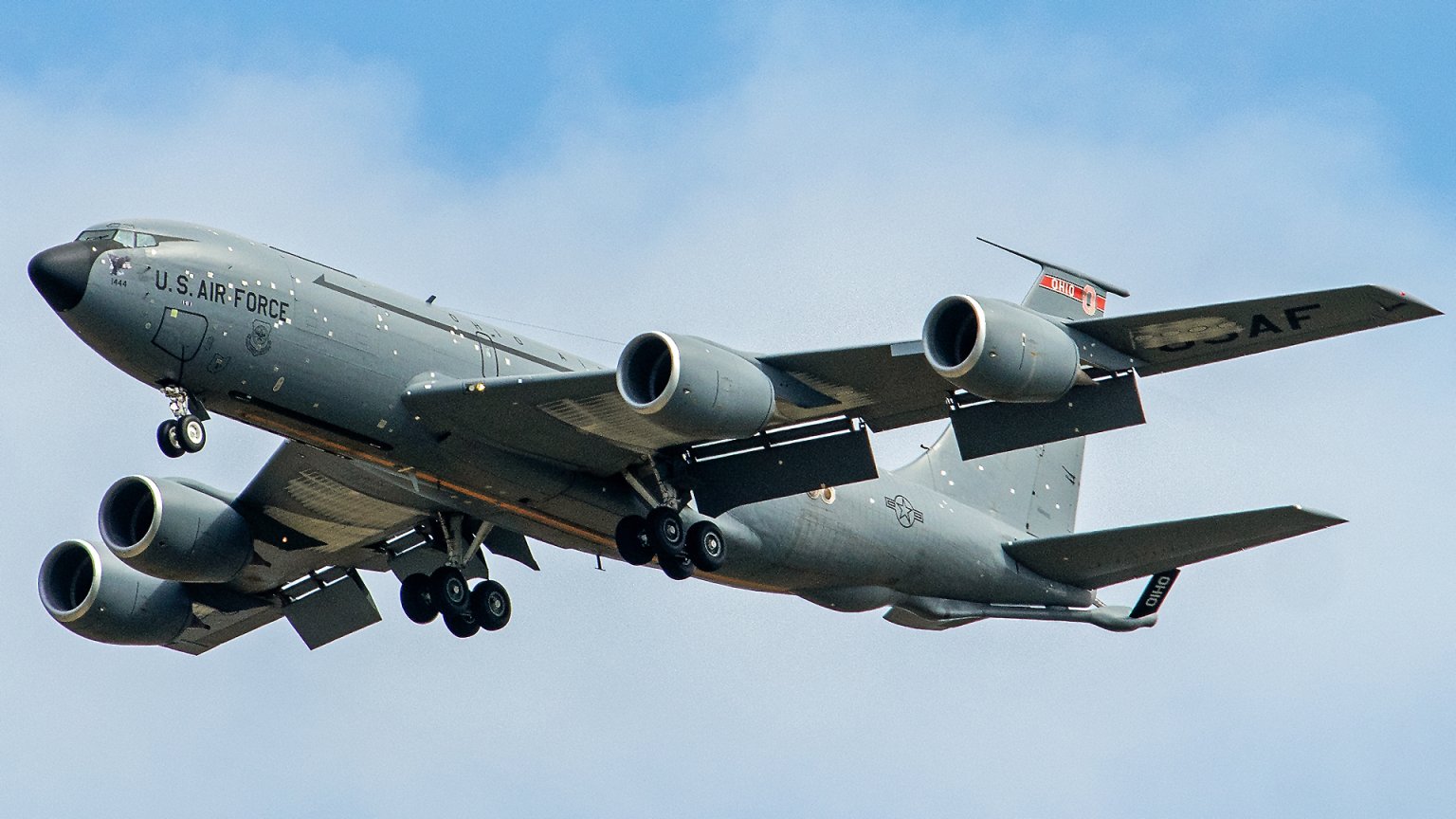
KC-135 Tanker Covered In Shrapnel Patches Seen Landing In UK
2026-04-14
[TWZ] A KC-135 damaged in an Iranian strike has made its way to RAF Mildenhall in the UK thanks to field repairs.

The images, which show the aircraft dotted with the repairs from nose to tail, come to us from aviation photographer Andrew McKelvey. It is very likely this is one of the tankers damaged in the Iranian long-range strike on Prince Sultan Air Base in Saudi Arabia last month. The aircraft belongs to the Ohio Air National Guard’s 121st Air Refueling Wing.

While the attack on the base is said to have damaged five tankers, the full destruction inflicted by it and subsequent strikes on Prince Sultan Air Base remains murky, as do potential impacts to facilities and aircraft located across the region. The lack of regular satellite imagery from U.S. providers of the Middle East has made it harder to understand what has occurred, but as we state repeatedly, satellite images would not show more minor damage to aircraft, such as the shrapnel holes seen here.

You can get an idea of how many aircraft the U.S. has lost during Operation Epic Fury from our recent graphic linked here.

While all tankers are precious assets, at least to a degree, due to the high demand on the fleet and its cumulative age, in this case there may be at least one positive side effect from the damage. Executing a battle damage repair plan in the field to get a KC-135 back in the air is a good real-life exercise, one that could prove vital if a future conflict in the Pacific were to erupt. Lessons will certainly be learned on many levels from Operation Epic Fury. And some of these lessons came the hard way even though they really shouldn’t have.

Regardless, the fact that this Stratotanker is flying again is a good thing and a testament to the airmen in the field that made it happen.

We will likely be seeing more patched-up tankers in the coming days and weeks as similar repairs are made and they make their way back to the United States for much more repairs.

Link


Arabia
Iran's Strikes on Epstein Coalition Command Centers
2026-04-02
Direct Translation via Google Translate. Edited

Commentary by Russian military journalist Boris Rozhin is in italics.

Islamic Revolutionary Guard Corps on operations on March 31, 2026.

[ColonelCassad] "The American adversary was subjected to precision military strikes that inflicted heavy human and material losses on both its own and allied forces. In the UAE, the strike killed 521 American officers and soldiers, as well as 21 Ukrainian service members. The US Army Command and Support Center outside Al Minhad Air Base was also destroyed by precision missiles, killing and wounding more than 200 commanders and officers.

In Saudi Arabia, 200 enemy combat aircraft were killed and wounded at Al Kharj Air Base (Prince Sultan Air Base). In Bahrain, a drone precision-strike targeted a meeting place for Fifth Fleet commanders outside their main base (Juffair Naval Base), destroying the meeting place, causing direct hits, and triggering a massive evacuation operation for the wounded.

This brings the total number of documented casualties to 942, including Both killed and wounded (521 American soldiers and officers + 21 Ukrainians in the UAE + 200 commanders and officers in the command center + 200 crew members), as well as unspecified deaths and injuries during the operation in Bahrain."

It is worth noting that Ukraine initially denied its losses, but an obituary for one of the officers killed by Iran has already surfaced. The US, understandably, is also hiding its losses.
Related:
Al Minhad Air Base: 2012-12-10 Troops brace for violent backlash against 'The Innocent Prophet'
Al Minhad Air Base: 2011-01-14 Campbell to head Diggers in Mid-East
Link


Syria-Lebanon-Iran
Satellite images begin to show damage wrought across the region by Iran war
2026-04-01
Some probably satellite photos at the link.
[IsraelTimes] Images reveal burning ships in Iranian military port next to Strait of Hormuz, damage to an Iranian military base, and destruction at air bases across the Gulf

Satellite images are beginning to be released giving a glimpse into the toll of the Iran
...a theocratic Shiite state divided among the Medes, the Persians, and the (Arab) Elamites. Formerly a fairly civilized nation ruled by a Shah, it became a victim of Islamic revolution in 1979. The nation is today noted for spontaneously taking over other countries' embassies, maintaining whorehouses run by clergymen, involvement in international drug trafficking, and financing sock puppet militias to extend the regime's influence. The word Iran is a cognate form of Aryan. The abbreviation IRGC is the same idea as Stürmabteilung (or SA). The term Supreme Guide is a the modern version form of either Duce or Führer or maybe both. They hate Jews Zionists Jews. Their economy is based on the production of oil and vitriol...
war, with ships ablaze in an Iranian port and destroyed buildings at American bases in the region.

Information has so far been scarce about the damage being done across the Middle East, particularly when it’s inside closed military facilities, since the US and Israel launched a joint offensive on Iran, sparking the war, on February 28.

The images come from Planet Labs PBC, a the Socialist paradise of San Francisco
...where God struck dead Anton LaVey, home of the Sydney Ducks, ruled by Vigilance Committee from 1859 through 1867, reliably and volubly Democrat since 1964...
-based firm used by media outlets, including The News Agency that Dare Not be Named. Planet Labs has put a two-week delay on its imagery becoming public, citing concerns its imagery could be used by "adversarial actors."

High-resolution images have also been published by competing firms. Other providers, like the US Geological Survey, have been publishing lower-resolution imagery as well that’s been useful.

The United States and Israel have been striking a wide variety of targets, including leadership figures in Iran, military bases, missile and air defense sites and positions of the Islamic Revolutionary Guard Corps and its volunteer paramilitary force, the Basij. Iran has responded with drone and missile fire targeting Israel and nearby Gulf Arab nations.

Here’s a look at what’s visible in a selection of Planet Labs’ pictures, as well as others.

BURNING SHIPS IN BANDAR ABBAS, IRAN
Some of the most dramatic images from Planet Labs so far have been in Bandar Abbas, home to a major Iranian military port next to the crucial Strait of Hormuz connecting the Persian Gulf to the Gulf of Oman and the Arabian Sea.

Images taken on March 2 show ships ablaze at the port. The US military’s Central Command has been targeting Iran’s naval assets and says it has sunk or damaged more than 100 Iranian vessels so far in the war.

ISRAELI AIRSTRIKE HITS IRAN’S PARCHIN MILITARY BASE
Planet Labs’ images from March 6 show damage to several buildings at the Parchin military base outside Tehran, Iran’s capital.

The ineffective International Atomic Energy Agency suspects Iran in the past conducted tests of high explosives that could trigger a nuclear weapon.

Iran has repeatedly denied seeking to acquire nuclear weapons. However,
you can observe a lot just by watching...
it has enriched uranium to levels that have no peaceful application, obstructed international inspectors from checking its nuclear facilities, and expanded its ballistic missile capabilities.

Israel’s military said its Parchin strikes hit "infrastructure used for the production of essential components for the development of various weapons." The site has been linked to Iran’s ballistic missile program as well.

MAJOR IMPACT AT 5TH FLEET HEADQUARTERS IN BAHRAIN
The island kingdom of Bahrain, home of the US Navy’s 5th Fleet, has seen heavy Iranian fire targeting both military bases and oil installations. A March 1 image by Planet Labs shows a major building at the base destroyed, as well as two radomes — geodesic domes covering radar antennas — likely by Iranian missile and drone fire. A later, March 6 Planet Labs photo showed another building damaged.

The US Navy has not offered a clear breakdown in the damage done so far at the base, but Iran has repeatedly claimed to have attacked it. Online videos have also shown incoming fire targeting the base. During the 12-day war in June, Iran attacked and destroyed a similar radome at Al Udeid Air Base in Qatar
...an emirate on the east coast of the Arabian Peninsula. It sits on some really productive gas and oil deposits, which produces the highest per capita income in the world. They piss it all away on religion, financing the Moslem Brotherhood and several al-Qaeda affiliates. Home of nutbag holy manYusuf al-Qaradawi...
, used for secure communications.

DAMAGE SEEN AT QATAR’S AL UDEID AIR BASE
An Iranian attack targeted Qatar’s Al Udeid Air Base and caused damage there.

A March 1 photo from Planet Labs shows damage to one of the buildings at the massive air base serving as the forward headquarters of the US military’s Central Command, which is prosecuting the war.

Qatar and the US have not acknowledged the damage.

STRIKE AT SAUDI ARABIA’S PRINCE SULTAN AIR BASE
An Iranian attack also targeted Saudi Arabia
...a kingdom taking up the bulk of the Arabian peninsula, largely made up of sand and oil rigs. Its primary economic activity involves exporting oil and soaking Islamic rubes on the annual haj pilgrimage. The country supports a large number of princes in whatcha might call princely splendor. Formerly dictatorial and steeped in Olde Tyme Religion, deferring to Salafist holy men on all issues, it has now done a 180 and is making a serious effort to modernize, so as not to be left in the sand by its Gulf Arab neighbors. The holy men have been shoved to the background and the nation is now still dictatorial but somewhat rational. That doesn't make them trustworthy, but it's a start...
’s Prince Sultan Air Base and caused damage there, according to a March 15 photo.

SATELLITE IMAGES SHOW DAMAGE TO UAE AIR BASE
Satellite images, taken March 15 by an Airbus Defense and Space Pléiades Neo satellite and analyzed by the AP, show damage at Abu Dhabi’s Al Dhafra Air Base. Damage can be seen at one set of hangars to the northwest of the facility. Another hangar to the southeast of the facility appears shredded by fire, with an adjacent hangar sustaining roof damage. It’s unclear what was in the hangars.

Al Dhafra typically hosts some 2,000 American troops and has served as a major base of operations for everything from armed drones to F-35 stealth fighters in recent years. The US military for years only vaguely referred to Al Dhafra as a base in "southwest Asia" before the UAE became more willing to acknowledge the American presence there.

FRENCH NAVAL BASE HIT IN ABU DHABI
In Abu Dhabi, the capital of the United Arab Emirates, there’s damage seen at La Belle France’s Camp de la Paix naval base. Satellite images from March 3 show damage to two large hangar-like buildings at the facility. The base is near Zayed Port, in Abu Dhabi, and close to its Cultural District that includes the Louvre Abu Dhabi and other major museums, both open and still under construction.

FIRES SEEN BURNING
The US Geological Survey’s Landsat satellites have also been key in spotting major fires. Imagery from Landsat taken on Monday showed a fire at Dubai International Airport after an Iranian dronezap set a fuel tanker ablaze at the world’s busiest airport for international travel, causing a plume of noxious black smoke.

Another fire was also seen on Monday at Oman’s southern port in Salalah, which came under attack from suspected Iranian drones on March 11, though Tehran has denied launching them in its campaign targeting Gulf Arab states. The fire apparently has been burning since then.
Link


Syria-Lebanon-Iran
'Incredibly Problematic' - Iran Destroys US AWACS Jet At Saudi Airbase
2026-03-29
[ZH] In a major feat that comes weeks after the White House claimed that Iran's ballistic missile capability had been "functionally destroyed," Iran has laid waste to one of only 16 American E-3 Sentry Airborne Warning and Control System (AWACS) aircraft in the world, sending $500 million worth of technology up in smoke and crimping the US military's ability to maintain situational awareness. The same attack also "damaged" several aerial refueling tankers and added a dozen service members to the tally of more than 300 who've been wounded in the month-long US-Israeli war on Iran. Thirteen have been killed.

In recent days, foreign satellite images showed what appeared to be major damage at Prince Sultan Air Base, a U.S. military base located in Al Kharj, Saudi Arabia.

The images show damage on the base's main apron, which holds high-value aircraft.
Link


Europe
Germany's old business model no longer works. This is the end.
2026-03-29
Direct Translation via Google Translate. Edited

Text taken from the Telegram channel of kanzlerdaddy

Commentary by Russian military journalist Boris Rozhin is in italics

[ColonelCassad] BlackRock's protégé, German Chancellor Merz,
Is he Black Rock’s protégé really, or is that just Russian propaganda?
has publicly spoken out against Trump.

The Americans and Israelis are getting deeper into this conflict every day. And I feel they have no strategy.
Your feeling is wrong. Try thinking instead — on this kind of subject, thinking works much better. But do go on…
What do you really want? Is regime change really the goal?
Regime change is up to the Iranians. Israel and America want to destroy Iran’s ability to wage an external war, including making nuclear bombs and the missiles to deliver them, and supporting terror groups like Hamas and PIJ, Hezbollah in Lebanon, in the Americas, and in Europe, the Houthis, and others, a much more limited goal.
If so, I don't think they will achieve it. I told him (Trump), if you want our help, please contact us directly, not through the newspapers. He told me two or three times in a half-hour conversation, "I don't need NATO." Then he publicly declared that our behavior was wrong. I think the government (and probably the president himself) has now accepted the fact that we cannot participate in the conflict. And as long as the war continues, that is not an option for us either.
The question is whether NATO and Europe will step up to protect the shipping lanes that they need much more than America does. As Hillel the Elder said, “If I am not for myself, who will be for me?”
What Trump is doing now in Iran is not de-escalation or an attempt to find a peaceful solution,
…very true. What he is doing instead is working with Bibi to permanently fix the problem of the Mullahcracy...
but a large-scale escalation with an unpredictable outcome. But we are not yet militarily strong enough to defend the European continent on our own.
So what are you doing about that?
Therefore, it is important to me not to jeopardize the transatlantic alliance unnecessarily. We are currently trying to maintain this delicate balance. Germany's old business model no longer works. Cheap energy from Russia, intermediate products from China, exports all over the world, the Americans guaranteeing our security—all of this is gone and will not return. This is the end

Trump promised yesterday that he will not forget the behavior of some NATO countries after the attack on Iran, where they refused to help him. And that he will hold them accountable for it.

More from Boris Rozhin:
The deadlines are slipping away
The timeline is slipping. According to American media, US Secretary of State Rubio informed G-7 ministers that the war against Iran will last at least another two to four weeks.
The American side of the war, anyway. The Israeli side will last overtly and/covertly, until the Mullahs are broken, because they understand they have no choice, despite their protesting idiots.
The US already understands that it will not be able to meet the previously stated deadline of four to five weeks for aggression. And the further the war extends beyond this deadline, the greater the pressure will be on the Trump administration with its chatter about having "already won."

The deadline has already grown from "Tehran in three days" to eight weeks, and this is certainly not the limit. Meanwhile, Iran has achieved the greatest success in weakening American military potential since World War II, and no other side has been able to achieve this level. (c) New York Times

Granted, the US lost far more in Vietnam, but Iran undoubtedly inflicted enormous damage on the US on various levels. This is something the US certainly did not expect from Iran, overestimating its own strength and underestimating Iran's capabilities.

In recent news, the Iranians shot down another American F-16 last night and, according to their claims, destroyed two AWACS aircraft in Saudi Arabia. This is in addition to several tanker aircraft destroyed at Prince Sultan Air Base. Hangars housing P-8 Poseidon maritime reconnaissance aircraft were also hit in Bahrain.


More from regnum.ru
Merz called the US-Iran conflict an escalation with an uncertain outcome.
German Chancellor Friedrich Merz criticized US policy in the Middle East, calling President Donald Trump's actions in Iran a major escalation.

"What Trump is doing now is not de-escalation or an attempt to find a peaceful solution, but a large-scale escalation with an uncertain outcome," the chancellor said during a conference organized by the Frankfurter Allgemeine Zeitung newspaper.

According to him, this escalation already poses a threat not only to those directly affected, but to the entire world.

Merz also expressed doubt that Washington's stated goal of regime change in Tehran could be achieved.

"Is regime change really the goal? If that's the goal, I don't think they'll achieve it. In the past, such attempts have mostly failed," Merz pointed out.
Related:
Chancellor Merz 01/19/2026 Europe Blinks! Did Brussels cancel WWIII?
Chancellor Merz 12/16/2025 Merz has hit rock bottom. Within six months, the Chancellor became Germany's most unpopular politician
Chancellor Merz 11/15/2025 Coalition, elections, coup: three scenarios for power change in Ukraine

Link


-12 More