Hello !
Recent Appearances... Rantburg

India-Pakistan
The New Virtual Front: The Digital Evolution of Terrorist Recruitment in Pakistan
2026-07-04
[PJMedia] According to the 2026 Global Terrorism Index, Pakistain recorded the highest average impact of terrorism score in South Asia for the third consecutive year and now ranks as the country most impacted by terrorism globally.

The four deadliest terrorist organizations in 2025 were Islamic State
...formerly ISIS or ISIL, depending on your preference. Before that they were al-Qaeda in Iraq, as shaped by Abu Musab Zarqawi. They're really very devout, committing every atrocity they can find in the Koran and inventing a few more. They fling Allah around with every other sentence, but to hear western pols talk they're not really Moslems....
(IS), Jamaat Nusrat al-Islam wal Moslemeen (JNIM), Tehrik-e-Taliban
...mindless ferocity in a turban...
Pakistain (TTP) and al-Shabaab
... the Islamic version of the old Somali warlord...
, according to the Index.

Deaths from terrorism in Pakistain are now at their highest level since 2013, added the report.

This data appears to be partially due to the fact that terrorist recruitment in Pakistain has shifted from overt, face-to-face indoctrination into a decentralized digital and social ecosystem. This distributed model blends targeted digital persuasion, online echo chambers, and localized mobilization.

Terrorist organizations operating within and out of Pakistain have radically transformed their recruitment strategies by shifting from physical venues to digital spaces. To circumvent the physical bottlenecks, terrorist groups like Tehrik-e-Taliban Pakistain (TTP), Jaish-e-Mohammed (JeM), and the Islamic State Khorasan Province (ISKP) have optimized their operations for the internet.

For years, recruitment in Pakistain leaned heavily on personal contact, ideological grooming in madrassas (Islamic seminaries), and local terrorist controllers in certain areas. Terrorist groups such as al-Qaeda and the TTP used madrassa-linked spaces, printed propaganda, and trusted intermediaries to identify and recruit youths. This model worked because terrorist networks were physically rooted in communities, especially in the tribal belt, south Punjab
...1. Little Orphan Annie's bodyguard
2. A province of Pakistain ruled by one of the Sharif brothers
3. A province of India. It is majority (60 percent) Sikh and Hindoo (37 percent), which means it has relatively few Moslem riots
...
.
, Bloody Karachi
...formerly the capital of Pakistain, now merely its most important port and financial center. It is among the largest cities in the world, with a population of 18 million, most of whom hate each other and many of whom are armed and dangerous...

, and parts of Balochistan
...the Pak province bordering Kandahar and Uruzgun provinces in Afghanistan and Sistan Baluchistan in Iran. Its native Baloch propulation is being displaced by Pashtuns and Punjabis and they aren't happy about it...
, where they could build influence through kinship ties, religious authority, and intimidation.

That older model was also helped by the broader rich jihadi landscape described by NACTA (the National Counter Terrorism Authority of Pakistain), where multiple proscribed organizations continued to operate and overlap in personnel, ideology, and geography. In such an environment, recruitment did not always require persuasion, but it often looked like gradual social absorption into a krazed killer ecosystem that had already normalized violence.

The biggest change has been the move toward digital recruitment. NACTA research says social media has lowered the entry barrier into terrorism, and that terrorist groups now use social media platforms to run propaganda, raise funds, recruit people, and train supporters online.

A 2025 NACTA study describes digital media as transforming radicalization by using X, YouTube, Facebook, WhatsApp, and Telegram to create echo chambers and spread targeted content. This is important because recruitment is now less dependent on a recruiter physically meeting a recruit. Instead, the recruit can be identified, groomed, and activated through repeated online exposure.

Recruitment tactics have evolved in parallel with operational tactics. Earlier groups preferred physical camps, Islamic holy mans, and direct indoctrination. Now they combine those methods with encrypted communications, online training, and micro-cells that are harder to penetrate. The same groups that once depended on visible networks now use small, compartmentalized teams and social media-based outreach.

There is also a tactical shift in the profile of recruits. Terrorists increasingly recruit people who can help with propaganda, digital finance, logistics, or low-visibility operations, not just frontline combat.

Pakistain’s current recruitment methods show a widening target base. The old stereotype of the recruit as a poor madrassa (Islamic school) student no longer captures the whole picture. NACTA’s research on educated youth points to college and university students being drawn into propaganda, online fundraising, and recruitment work, especially when social media reduces the cost and risk of contact.

What makes the problem especially dangerous is how deeply it is woven into parts of Pak society. Terrorist recruitment benefits from institutions, Islamic beliefs, and informal structures that are already present. That is why cases such as Saad Aziz, Noreen Leghari, and Bushra Cheema show that indoctrination and terrorism are not confined to rural, uneducated, or isolated populations.

In 2019, the Pak newspaper Dawn issued an editorial regarding the phenomenon of educated, well-off Paks choosing to join terrorist groups and commit murders and other crimes:

The trope of the madrassah-educated or illiterate bully boy from an impoverished background was comprehensively shattered when Saad Aziz was arrested for high-profile terrorist attacks in Karachi.

Coming from a well-to-do family, the young man was a graduate of one of the country's most prestigious business schools.

Yet, inspired by the krazed killer Islamic State group, he went on to commit a number of heinous crimes - several within the span of a few weeks in the summer of 2015... Among these was the murder of rights activist Sabeen Mahmud, the assassination of coppers and the Safoora Goth massacre.

Naureen Leghari is another case of a privileged university student choosing jihad due to her religious convictions. Her father worked as a university professor at Dr. MA Kazi Institute of Chemistry. However,
there's more than one way to stuff a chicken...
she chose to join ISIS in Syria and was reportedly part of a failed plot to carry out a suicide kaboom on a church in Lahore.

In another case, in September 2016, Bushra Cheema deserted her husband and left Pakistain for Syria to join ISIS with their four children. In a voice message sent to her husband, she reportedly stated: "I love God and His religion... If you can’t join us, then at least pray your wife and children die in jihad."

Some terrorist organizations increasingly use women, including in propaganda and in selected attack roles. The Army of Mohammed (Jaish-e-Mohammed — JeM), one of Pakistain's too-many-to-count jihadist terrorist groups, for instance, launched its first-ever women's wing. The "Congregation of the Believing Women" (Jamaat-ul-Mominaat) was launched on October 9, 2025, and hosted by JeM's training facility, "Center of Usman and Ali," (Markaz Usman-o-Ali) in Bahawalpur, a city in the southeast of Pakistain's Punjab Province.

The JeM's women's wing has since held meetings, launched in-person and online radicalization events, recruitment fairs, and indoctrination courses for women and girls that include specialized training for combat and suicide missions

What makes so many Paks and other Moslems so prone to violence, jihad, or terrorism to achieve political, religious, or social goals is mainly cultural and religious. The violent mostly peaceful teachings in Islamic scriptures and the centuries-long Islamic history of jihad (including Moslem-on-Moslem violence as in the case of Shia vs Sunni) make terrorist recruitment in the country widespread and normalized.

Pakistain's educational system also appears to contribute to the problem. It consists of three main streams: public/government schools, private schools, and madrassas (Islamic seminaries). There are over 40,000 madrassas across the country with roughly 4.6 million students. Madrassas have long been criticized for contributing to violence and jihad, supplying recruits for the Taliban, Al Qaeda, and other terrorist groups.

Pakistain's public education system is fundamentally Islamic rather than secular. It operates as a hybrid system that blends modern disciplines with compulsory Islamic instruction across the curriculum. These schools follow a national curriculum where Islamic Studies (Islamiat) is a mandatory subject for Moslem students at all levels. The broader curriculum is heavily infused with Islamic values.

Meanwhile,
...back at the wine tasting, Vince was about to start on his third quart...
around 25 million children in Pakistain remain out of school, and a vast majority (roughly 77%) of those attending cannot read or comprehend age-appropriate texts by Grade 10.

Analyses, including perspectives published by the newspaper Dawn, highlight that state curricula often use education for indoctrination, presenting subjects like science through an Islamic lens and discouraging critical thinking. As Pervez Hoodbhoy, a Pak physics teacher, notes:

The state, in seeking to establish its legitimacy, uses education as a tool for indoctrination. This has turned Pakistain into a more conservative country than most other Moslem countries. Even as it abdicates its basic responsibility by outsourcing education to private hands, the state nevertheless remains vigilant against the penetration of secular ideas into the system.

Western intellectual products, particularly critical thinking and the scientific method, are considered dangerous. Therefore, even science subjects, sprinkled onto a substrate of belief, are taught without using the scientific method.

A 2025 study titled What Are We Teaching at School? by the Lahore-based research and advocacy organization Center for Social Justice (CSJ) found that religious Islamic content was heavily embedded in non-religious subjects, effectively making it compulsory for all students—including non-Moslems—to study and pass exams on Islamic teachings.

"Moreover, when students progress to higher grades, the volume of religious content increases, particularly in subjects where it does not naturally belong. For instance, Grade 9 English textbooks contain chapters like ’Hazrat Muhammad — The Model of Tolerance’ and ’The Madina Charter.’ Grade 10 Urdu textbooks feature ’Simplicity and Humility of Hazrat Muhammad’ and ’Hazrat Umar,’ which should belong in Islamic Studies rather than compulsory language courses," it noted.

The study emphasized that embedding Islamic content and mosque imagery in non-religious subjects violated Article 22 of Pakistain’s Constitution, which prohibits compulsory religious instruction for students of other faiths.

A serious response to increased recruitment to terrorist groups, therefore, has to go beyond arrests. A profound education reform is urgently needed in the country. To help combat Islamic radicalization and jihadist terrorism, Pakistain must reform its education sector by updating the school curriculum to improve quality, remove divisive
...politicians call things divisive when when the other side sez something they don't like. Their own statements are never divisive, they're principled...
and discriminatory narratives (such as those that portray non-Moslems as inferior), encourage critical thinking, and allow scientific matters to be studied purely through scientific lens.
Link


India-Pakistan
JeM commander among 3 terrorists killed in J&K's Kishtwar in encounter
2026-02-23
[IsraelTimes] Notorious JeM commander was reportedly behind several attacks on security forces in the region after he infiltrated into J&K five years ago.

Three bandidos snuffies of Jaish-e-Mohammed terror outfit have allegedly been killed in Jammu and Kashmir
...a disputed territory lying between India and Pakistain. After partition, the Paks grabbed half of it and call it Azad (Free) Kashmir. The remainder they refer to as "Indian Occupied Kashmir". They have fought four wars with India over it, the score currently 4-0 in New Delhi's favor. After 72 years of this nonsense, India cut the Gordian knot in 2019, removing the area's special status, breaking off Ladakh as a separate state, and allowing people from other areas to settle (or in the case of the Pandits, to resettle) there....
’s Kishtwar district under Operation Trashi-I, the Indian Army's White Knight Corps said in a statement, adding that a joint operation by teams of J&K Police, Army and the CRPF was launched following credible intelligence inputs collated from the police and other intelligence agencies.

One of the two slain bandidos snuffies has been identified as notorious commander Saifullah, not HT has learnt, while the security forces have recovered two AK-47 rifles and other ammunitions from the site of encounter. The bodies of all the slain bandidos snuffies were charred beyond recognition as the mud house they were hiding in caught fire during the shootout, PTI reported, citing officials.

Earlier, the Army had said that an encounter broke out in Passerkut in the Chatroo area of the district at about 10:30 am.

The teams received input about two Pak bandidos snuffies linked to the banned group Jaish-e-Mohammad
...literally Army of Mohammad, a Pak-based Deobandi terror group founded by Maulana Masood Azhar in 2000, after he split with the Harkat-ul-Mujaheddin. In 2002 the government of Pervez Musharraf banned the group, which changed its name to Khaddam ul-Islam and continued doing what it had been doing before without missing a beat...
being present there, officials told news agency PTI.

The terrorists, who were reportedly hiding inside a mud house at the foothills, opened fire as troops moved closer, leading to an exchange of gunfire. Notably, the Chatroo forest belt saw nearly six shootouts between bandidos snuffies and security forces last month, in which a soldier and a terrorist were killed.

SAIFULLAH HAD INFILTRATED INTO INDIA FIVE YEARS AGO
JeM commander Saifullah had been active in the region ever since he infiltrated into Jammu and Kashmir nearly five years ago. He was allegedly the criminal mastermind behind several deadly attacks on security forces, including one in July 2024 that left four soldiers dead.

Saifullah had escaped a number of encounters in the past, PTI reported.
Link


India-Pakistan
Have crippled terror eco-system, now make J&K ‘terror-free: Amit Shah at review meet 1/8/2026
2026-02-22
[HindustanTimes] Shah also stressed that the government would provide all necessary resources needed by them to achieve the goal of ‘terror free J&K’ at the earliest.

Union home minister Amit Shah on Thursday directed all security agencies deployed in Jammu and Kashmir
...a disputed territory lying between India and Pakistain. After partition, the Paks grabbed half of it and call it Azad (Free) Kashmir. The remainder they refer to as "Indian Occupied Kashmir". They have fought four wars with India over it, the score currently 4-0 in New Delhi's favor. After 72 years of this nonsense, India cut the Gordian knot in 2019, removing the area's special status, breaking off Ladakh as a separate state, and allowing people from other areas to settle (or in the case of the Pandits, to resettle) there....
to remain alert and continue to work in synergy to ensure that the gains achieved after the abrogation of Article 370 were sustained.

The home minister also stressed that the government would provide all necessary resources needed by them to achieve the goal of ’terror free J&K’ at the earliest.

The directions were given at a high-level review meeting on Thursday in Delhi, which was attended by lieutenant governor Manoj Sinha, union home secretary Govind Mohan, Intelligence Bureau director Tapan Deka, bigwigs of J&K and chiefs of central police forces.

Officials said Thursday’s meeting comes ahead of the Republic Day celebrations. The security forces, for the past few weeks, have launched an intensive campaign to hunt down gunnies in mountainous regions and the jungles.

The security forces, an officer said, are also keeping an eye on the infiltration of gunnies from across the border.

Speaking at the meeting, Shah said the Government of India was committed to establishing lasting peace in Jammu and Kashmir and completely eliminating terrorism. He said that the "terror eco-system in J&K has been crippled" due to sustained and coordinated efforts of the government, a ministry of home affairs statement issued after the meeting said.
A comforting statement that will be true until Pakistan’s ISI decides to once again send their pet jihadis across the border.
Appreciating the security forces for strengthening the security scenario of J&K, Shah said that Counter Terror (CT) operations targeting terrorist infrastructure and terror financing should be continued in a mission mode.

As reported by HT last month, Border Security Force (BSF) in Jammu has recently flagged the re-emergence of at least nine Jaish-e-Mohammed terror launch pads across the international border in Pakistain that were shut down following Operation Sindoor.

On April 22 last year, a terror attack at the picturesque Baisaran meadow brought India and Pakistain to the brink of a full-scale war. India launched Operation Sindoor in the early hours of May 7 and struck terror and military installations in Pakistain and Pakistain-Indian Kashmir (PoK) before the May 10 ceasefire.
Related:
Kashmir: 2026-02-03 'Knock out their teeth': A Britonophobic terrorist could become an MP in England
Kashmir: 2026-02-01 Pakistan: Terrorist Outfits Utilize New Fundraising Methods
Kashmir: 2026-01-16 Multiple joint operations by kpk police and Pakistani security forces were conducted across Lower Wana
Related:
Jaish-e-Mohammed: 2026-02-01 Pakistan: Terrorist Outfits Utilize New Fundraising Methods
Jaish-e-Mohammed: 2025-11-17 India arrests IIOJK resident over Delhi car blast
Jaish-e-Mohammed: 2025-11-15 Doctors Plot, Day 5: Seized ammonium nitrate exploded at Nowgam Police Station in Srinagar, 9 toes up, 15 tied up
Related:
Operation Sindoor: 2025-11-30 72 terror launchpads become operational in Pakistan since Operation Sindoor: BSF
Operation Sindoor: 2025-10-20 FinMin Aurangzeb says IMF can''t impose conditions against Pakistan''s interests
Operation Sindoor: 2025-08-21 DHS pulls funding from groups with ‘alleged terrorist ties' after watchdog report
Related:
Baisaran meadow: 2025-04-29 Pahalgam Terror Attack Live Updates: India Bans 16 Pakistani Channels For Spreading Misinformation
Link


India-Pakistan
Pakistan: Terrorist Outfits Utilize New Fundraising Methods
2026-02-01
[PJMedia] Pakistain has a checkered past when it comes to money laundering and terrorist financing. It has misled the international community on several occasions. It has failed to take corrective institutional actions which would suppress both terror financing and money laundering.

Pakistain’s inadequate actions against domestic terror financing led the Financial Action Task Force (FATF) to place the country on its "grey list" three times between the years 2008 and 2022: from Feb. 2008 to June 2010, then from Feb. 2012 to Feb. 2015, and finally from June 2018 to Oct. 2022.

In 2018, the Asia-Pacific Group (APG), a FATF-associated body, conducted an onsite mutual evaluation visit from Oct. 8 to 19. The subsequent 2019 Mutual Evaluation Report identified significant deficiencies in Pakistain’s anti-money laundering and counter-terrorist financing regime, including in its implementation of the FATF action plan.

In 2019, FATF noted in a public statement following the Gay Paree plenary (Feb. 17-22) that Pakistain did not demonstrate a proper understanding of the terror financing (TF) risks that the Islamic State
...formerly ISIS or ISIL, depending on your preference. Before that they were al-Qaeda in Iraq, as shaped by Abu Musab Zarqawi. They're really very devout, committing every atrocity they can find in the Koran and inventing a few more. They fling Allah around with every other sentence, but to hear western pols talk they're not really Moslems....
(ISIS), Al Qaeda, Jamaat-ud-Dawa
...the front organization of Lashkar-e-Taiba...
(JuD), Falah-e-Insaniat Foundation (FIF), Lashkar-e-Taiba
...the Army of the Pure, an Ahl-e-Hadith terror organization founded by Hafiz Saeed. LeT masquerades behind the Jamaat-ud-Dawa facade within Pakistain and periodically blows things up and kills people in India. Despite the fact that it is banned, always an interesting concept in Pakistain, the organization remains an blatant tool and perhaps an arm of the ISI...>
(LeT), Jaish-e-Mohammed (JeM), the Haqqani Network (HQN), and persons affiliated with the Taliban
...Arabic for students...
posed.

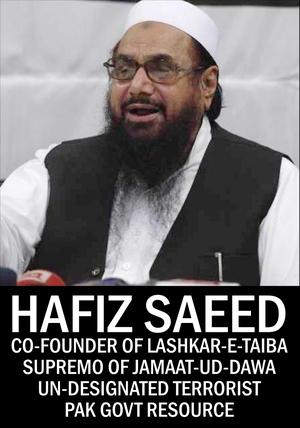
In 2022, Hafiz Saeed
...founder of Lashkar-e-Taiba and its false-mustache offshoot Jamaat-ud-Dawa. The United Nations declared the JuD a terrorist organization in 2008 and Hafiz Saeed a terrorist as its leader. Hafiz, JuD and LeT are wholly-owned subsidiaries of the Pak intel apparatus, so that amounted to squat. He is periodically placed under house arrest so it looks like the govt is doing something. Once the heat is off they let him go....
, the criminal mastermind of the 2008 Mumbai terror attacks and founder of Lashkar-e-Taiba (LeT), was sentenced to 33 years in jail. Interestingly, this sentence was based on terror financing charges, rather than charges related to actual terrorist acts.

Yet despite all the documented evidence indicating Pakistain’s support for terror outfits, the FATF issued a statement that Pakistain had met all 34 items on its action plans. The task force subsequently removed Pakistain from its grey list during the plenary session held in Oct. 2022 in Gay Paree, La Belle France.

However,
ars longa, vita brevis...
as per the credible records and open-source intelligence (OSINT) investigations, Pakistain continues to promote terrorism from its soil. Terror groups now operate through several proxies, and unabashedly continue funding, financing and promoting Islamic terrorism. However,
ars longa, vita brevis...
there have been some changes in their funding methods.

For instance, Jaish-e-Mohammed (JeM), or the Army of Mohammed, is listed in the United Nations
...boodling on the grand scale...
1267 Committee’s consolidated sanctions list. The governments of the U.S., U.K., Canada, New Zealand, India and Pakistain consider it a proscribed terrorist organization. Based in Pakistain, JeM operates primarily in Indian-Administered Jammu and Kashmir
...a disputed territory lying between India and Pakistain. After partition, the Paks grabbed half of it and call it Azad (Free) Kashmir. The remainder they refer to as "Indian Occupied Kashmir". They have fought four wars with India over it, the score currently 4-0 in New Delhi's favor. After 72 years of this nonsense, India cut the Gordian knot in 2019, removing the area's special status, breaking off Ladakh as a separate state, and allowing people from other areas to settle (or in the case of the Pandits, to resettle) there....
(JK).

According to a report from the Parliament of Australia,

JeM was founded in 2000 by Maulana Masood Azhar
...One of the major players in Pak terrorism. In early 1994, India incarcerated him for his activities. In 1995, foreign tourists were kidnapped in Jammu and Kashmir. The kidnappers included his release among their demands. One of the hostages managed to escape but the rest were eventually killed. In 1999, he was freed by the Indian government in exchange for passengers on hijacked Indian Airlines Flight 814 that had been diverted to Kandahar. The hijackers were led by Masood Azhar's brother, Ibrahim Athar. Once he was handed over to the hijackers, they fled to Pak territory despite the fact that Islamabad had earlier stated that any of the hijackers would be jugged at the border. The Pak government had also previously indicated that Azhar would be allowed to return home since he did not face any charges there. Shortly after his release, he made a public address to an estimated 10,000 people in Karachi, firing up the rubes against America and India...
, a radical Islamic scholar and jihadist leader, following his release from an Indian jail in exchange for 155 hostages hijacked aboard an Indian Airlines aircraft on 31 December 1999. When released from prison, Azhar did not rejoin his former group, Harakat ul-Mujahideen (HuM). Instead, Azhar formed JeM, reportedly with support from Pakistain’s Inter-Services Intelligence
...the Pak military intelligence agency that controls the military -- heads of ISI typically get promoted into the Chief of Army Staff position. It serves as a general command center for favored turban groups such as Lashkar-e-Taiba and Jaish-e-Mohammad, tries to influence the politix of neighboring countries, and carries out a (usually) low-level war against India in Kashmir...
(ISI), the Afghan Taliban, the late Osama bin Laden
...... who is now among the dear departed, though not among the dearest......
and several other Sunni murderous Moslem organizations in Pakistain.

Some of JeM's notable attacks outside Kashmir include the 2001 assault on India’s parliament building; the 2002 murder of U.S. journalist Daniel Pearl; and two 2003 liquidation attempts against Pak President Parvez Musharraf. JeM is well trained and supported. Consequently, it poses a terrorist threat to India and Pakistain, as well as to Western targets based in both of these countries.

JeM uses violence in pursuit of its stated objective of forcing the withdrawal of Indian security forces from Kashmir and uniting Kashmir with Pakistain under Islamic Sharia law. JeM (including its chief Masood Azhar) also endorse the wider aim of establishing an Islamic caliphate across South Asia and expelling Hindus from the Indian subcontinent. JeM is violent mostly peacefully opposed to all other religions, including Shia Islam.

In its funding, JeM has shifted from using banks to Easypaisa, digital wallets, and crypto (USDT).

Local media reported that JeM has established a new mechanism with the support of Pakistain’s Inter-Services Intelligence (ISI), which collects funds. It is using digital wallets such as "EasyPaisa" and "Sadapay." Family members of its founder and most wanted terrorist, Masood Azhar, control these. They use them to bypass scrutiny from global agencies such as the FATF.

JeM is also raising money on the pretext of Gazoo
...Hellhole adjunct to Israel and Egypt's Sinai Peninsula, inhabited by Gazooks. The place was acquired in the wake of the 1967 War and then presented to Paleostinian control in 2006 by Ariel Sharon, who had entered his dotage. It is currently ruled with a rusty iron fist by Hamas with about the living conditions you'd expect. It periodically attacks the Hated Zionist Entity whenever Iran needs a ruckus created or the hard boyz get bored, getting thumped by the IDF in return. The ruling turbans then wave the bloody shirt and holler loudly about oppression and disproportionate response...
relief aid. Hammad Azhar, son of Masood Azhar, is leading JeM's efforts to raise money for terror activities via Gaza Aid. He asks women in Gaza to make videos praising him for his charity works. His social media alias is Qaisar Ahmad, and he asks everyone to donate to his Easypaisa bank account under the name of Khalid Ahmed, a separate alias. He receives donations from Pakistain and Gulf countries.

Another new funding method JeM uses is mosque construction. JeM has reportedly launched a massive fundraising drive in Pakistain under the guise of building over 300 mosques.

The terror outfit started the online fundraising campaign through digital wallets to collect 3.91 billion Pak rupees (Rs), that is, $14 million U.S. dollars, for constructing 313 new markaz (central) buildings, local media reported.

On social media platforms such as Facebook and WhatsApp, JeM-linked proxy accounts (such as those used by JeM commanders) have posted posters, videos and a letter from Masood Azhar, urging supporters to donate wholeheartedly. They say that each mosque requires Rs 12.5 million ($45,000 USD) for construction and smooth operations.

In addition to these accounts, over 250 EasyPaisa wallets are reportedly used to fundraise. Alongside social media appeals, the terror outfit circulated an audio recording of Azhar’s brother, Al Saif, via its official propaganda channel, MSTD Official. The message urged supporters to contribute 21,000 Pak rupees ($75) per person, the officials said.

The 3.91 billion-rupee fundraising drive would secure JeM’s operational and weapons financing for at least a decade, Indian officials said.

JeM is also aided through a winter survival kit, which was launched via a public fundraising campaign seeking contributions for its fighters operating in Kashmir. Specific items and their costs are listed, including a coat, boots, blanket, gloves, socks and similar items. These kits are given to their terrorists.

Meanwhile,
...back at the saw mill, Scarface Al had tied Little Nell to the log and was about to turn on the buzz saw...
another terrorist group, LeT, has shifted to direct wallets. LeT has started collecting funds directly into its wallets instead of bank accounts, in order to dodge FATF scrutiny.

Lashkar-e-Taiba (LeT), also known as Army of the Righteous, was formed in the late 1980s. LeT is one of the largest and most proficient of the Kashmir-focused holy warrior groups. The United States and United Nations have designated LeT an international terrorist organization.

Based in Pakistain's Punjab
...1. Little Orphan Annie's bodyguard
2. A province of Pakistain ruled by one of the Sharif brothers
3. A province of India. It is majority (60 percent) Sikh and Hindoo (37 percent), which means it has relatively few Moslem riots
...
.
Province and in Pakistain-occupied Kashmir, it has "launched humanitarian projects as a means of circumventing sanctions," according to the official website of the US Congress. LeT was responsible for the Nov. 2008 terrorist assault in Mumbai, India, as well as several other high-profile attacks. During the Mumbai attacks, faceless myrmidons used automatic weapons and grenades to attack several sites, murdering more than 160 people.

Pak authorities in April 2015 released on bail the head of LeT operations, Zaki ur Rehman Lakhvi, pending prosecution of him and several other LeT leaders for the Mumbai attacks.

LeT recruits internationally, as evidenced by the arrest in the United States of Jubair Ahmed in 2011, Headley’s arrest in 2009, and the indictment in 2003 of eleven LeT faceless myrmidons in Virginia.

In 2003, authorities also disrupted an LeT plot to attack Australia, and in 2009 LeT put on hold a plot to attack Denmark in retaliation for cartoons drawn of Islam's prophet Muhammad.

LeT maintains facilities in Pakistain, including training camps, schools, and medical clinics. LeT coordinates its activities through its front organization, Jamaat-ud-Dawa (JuD).

LeT is also collecting donations under the guise of flood relief. A banner advertised an appeal for donations to fund boats which would carry out rescue activities in flood-affected areas of Pakistain. JuD/Pakistain Markazi Moslem League (PMML)’s Khidmat Khalaq Wing, Gujranwala would conduct these activities. The amount sought for a rescue boat is 1,200,000 Pak rupees ($4,300).

Islamic terrorist organizations — including those active in Pakistain and Kashmir — are diversifying their funding methods and finding ways to bypass scrutiny by global agencies. They are exploiting humanitarian activities, mosques, rescue missions and wars to raise money internationally — including in the U.S. This allows them to spread holy warrior Islamic messages and increase support for their terrorist activities.

Ultimately, the goal of their ideology is to create a global caliphate consisting of Islamic states. They want to conquer and dominate all non-Moslem nations. This includes the imposition of Sharia law, which is the totalitarian Islamic legal code.

The world has seen many times what happens when Islamic supremacists and jihadists take control of a country — from the Moslem Brüderbund-ruled Egypt to Iran, Syria, The Sick Man of Europe Turkey
...the occupiers of Greek Asia Minor...
, Afghanistan and Pakistain, amongst others. How alert is the West to these terror groups and their new deceitful funding methods? And more alarmingly, how driven is the West to fight against those Islamist groups whose religiously motivated ambitions have not changed, and who have even gained significant success since the seventh century?
Link


India-Pakistan
India arrests IIOJK resident over Delhi car blast
2025-11-17
And aren’t the Pakistanis feeling happy about the whole thing, given that the Doctors Plot was discovered to be guided by Pakistan Army sock puppet Jaish e-Mohammad. And they got their suicide bomber, even if it wasn’t the mere grad student they originally intended to sacrifice (scroll down to the third headline in the post).
[GEO.TV] India's federal anti-terror agency on Sunday said it had arrested a resident of Indian Illegally Occupied Kashmir
...a disputed territory lying between India and Pakistain. After partition, the Paks grabbed half of it and call it Azad (Free) Kashmir. The remainder they refer to as "Indian Occupied Kashmir". They have fought four wars with India over it, the score currently 4-0 in New Delhi's favor. After 72 years of this nonsense, India cut the Gordian knot in 2019, removing the area's special status, breaking off Ladakh as a separate state, and allowing people from other areas to settle (or in the case of the Pandits, to resettle) there....
(IIOJK) who it accused of conspiring with the driver of a car that went kaboom! in Delhi last week, killing 12 people and wounding at least 20 others.

The National Investigation Agency said it had arrested Amir Rashid Ali
…a plumber from Samboora, Pampore in Kashmir, not a doctor at all…
in Delhi, adding the car used in the attack was registered in his name.

The NIA accused Ali of conspiring with the alleged jacket wallah, who it identified as Umar Un Nabi, a resident of IIOJK's Pulwama district.

It said Ali came to Delhi to facilitate the purchase of the car, which was used as a "vehicle-borne Improvised Explosive Device to trigger the blast."

The agency said it had seized another vehicle belonging to Nabi for examination. So far, it has interrogated 73 witnesses, including those injured in the blast.

Last week, the Indian government said it was treating the car blast as a "terror incident" and vowed to bring the perpetrators to justice as swiftly as possible.

The blast outside Delhi's historic Red Fort was the first such explosion in the heavily guarded city since 2011.

It was also the most significant security incident since April 22, when 26 non-combatants were killed at the tourist site of Pahalgam in IIOJK.

Prime Minister Narendra Modi called the Delhi blast a "conspiracy", and vowed that those responsible would face justice.

India's Home Minister, Amit Shah, said he had instructed officials "to hunt down each and every culprit behind this incident".

The blast occurred four days after a kaboom rocked IIOJK's Srinagar, killing at least nine people and injuring over two dozen.

Indian officials said that the blast took place when a stockpile of confiscated explosives detonated inside a cop shoppe, resulting in most fatalities among coppers and forensic team members inspecting the explosives.

More from the Hindustan Times:
J&K LG rules out terrorist involvement in Nowgam blast, calls it an accident

White-collar terror module hunted for suicide bomber for a year, say officials
The hunt was reportedly driven by Dr Umar Nabi, considered the key planner of the module.

The sophisticated ‘white-collar’ terror module recently busted by the Jammu and Kashmir Police had been searching for a suicide bomber since 2024, officials said on Sunday.

The hunt was reportedly driven by Dr Umar Nabi, considered the key planner of the module, PTI reported.

According to investigators, a co-accused revealed during questioning that Umar believed to have died in the explosives-laden car that blew up near the Red Fort on November 10 was a “hardcore radical” who insisted that their operations required a suicide attacker.

WHAT HAPPENED?
Acting on these inputs, Srinagar Police sent a team to Qazigund and detained Jasir alias ‘Danish’, a political science graduate. His name surfaced during the interrogation of other arrested doctors, including Dr Adeel Rather and Dr Muzzaffar Ganaie.

The police team led by Srinagar SSP Dr G V Sundeep Chakravarthy eventually unraveled the entire ‘white-collar’ module.

Jasir told police he first met the ‘doctor module’ in October last year at a mosque in Kulgam.

From there, he was taken to a rented accommodation linked to Al Falah University in Faridabad, Haryana.

He said while some members wanted him to work as an over-ground worker (OGW) for the banned Jaish-e-Mohammed, Umar spent months trying to convince him to become a suicide bomber.

The plan collapsed in April this year when Jasir refused, citing financial difficulties and his belief that suicide is forbidden in Islam.

WHY THE NEW REVELATION IS IMPORTANT?
This revelation about the group scouting for a suicide bomber adds a dangerous layer to the ongoing probe into the Jaish-e-Mohammed-linked interstate terror network.

As reported earlier by PTI, Umar, a 28-year-old doctor from Pulwama, emerged as the most radicalised member of the group. Investigators believe he was preparing a powerful vehicle-borne IED attack around the Babri Masjid demolition anniversary on December 6.

Umar’s radical shift is believed to have begun after a 2021 trip to Turkiye with co-accused Dr Muzammil Ahmad Ganaie, during which they allegedly met JeM over-ground workers.

After returning, Umar and Ganaie, who were both associated with Al Falah University, started procuring large quantities of chemicals — including 360 kg of ammonium nitrate, potassium nitrate, and sulphur. Much of this material was stored near the university campus.

Their December plot unraveled when Srinagar Police arrested Ganaie and seized the explosives. Investigators believe this may have triggered panic in Umar, ultimately leading to the premature blast near the Red Fort that killed 13 people.

The wider network was uncovered after a seemingly small incident: JeM posters appeared on walls in Bunpora, Nowgam, on October 19. The police reviewed CCTV footage and arrested three locals, Arif Nisar Dar alias Sahil, Yasir-ul-Ashraf, and Maqsood Ahmad Dar alias Shahid — all with past stone-pelting cases.

Their interrogation led to the arrest of Maulvi Irfan Ahmad, a former paramedic-turned-Imam from Shopian, who allegedly supplied the posters and played a key role in radicalizing the doctors.

Another article in the Hindustan Times confirms the Geo piece, above, and adds:
Amir Rashid Ali had allegedly came to Delhi to facilitate the purchase of the car, Hyundai i20, which was used in the crime. The car was captured by dozens of CCTVs making several stops at key intersections in crowded Old Delhi area before the explosives went off at a busy intersection on November 10 evening.

An NIA forensic probe had established the identity of the deceased driver of the ill-fated car as Umar Un Nabi, a resident of Pulwama district, who worked as an Assistant Professor at Al Falah University at Faridabad.

Earlier on Saturday, the Delhi Police has detained three people, including two doctors from Haryana's Al Falah University, which has emeged as a crucial link in the terror module case.

The NIA further said it is pursuing multiple leads to unearth the larger conspiracy behind the bombing and identify others involved in the case.

The anti-terror agency said it seized another vehicle belonging to Umar. The vehicle is being examined for evidence in the case, in which NIA has so far examined 73 witnesses, including those injured in the blast.
Related:
Red Fort: 2025-11-15 Doctors Plot, Day 5: Seized ammonium nitrate exploded at Nowgam Police Station in Srinagar, 9 toes up, 15 tied up
Red Fort: 2025-11-14 A Doctors’ Plot, Day 4: Nuh link, Dr Umar's house razed, 5 more detained: 5 key updates in Red Fort blast
Red Fort: 2025-11-14 The Doctors' Conspiracy: Who Blew People Up in the Capitals of Nuclear Powers?
Link


India-Pakistan
Doctors Plot, Day 5: Seized ammonium nitrate exploded at Nowgam Police Station in Srinagar, 9 toes up, 15 tied up
2025-11-15
Yesterday’s installment can be seen here. The previous days’ stories can be seen there.
[PUBLISH.TWITTER]

J&K: 9 killed in accidental blast at Nowgam police station, several injured
[HindustanTimes] The explosion took place while coppers and an FSL team were conducting an inspection inside the premises.

At least nine people were killed and several others were maimed in an accidental blast inside Srinagar's Nowgam cop shoppe in Jammu and Kashmir
...a disputed territory lying between India and Pakistain. After partition, the Paks grabbed half of it and call it Azad (Free) Kashmir. The remainder they refer to as "Indian Occupied Kashmir". They have fought four wars with India over it, the score currently 4-0 in New Delhi's favor. After 72 years of this nonsense, India cut the Gordian knot in 2019, removing the area's special status, breaking off Ladakh as a separate state, and allowing people from other areas to settle (or in the case of the Pandits, to resettle) there....
on Friday.

The explosion took place while coppers and an FSL team were conducting an inspection inside the premises.

According to news agency PTI, the officials were extracting samples from a massive cache of explosives recently seized in Haryana's Faridabad in connection with the 'white-collar' terror module case.

Several vehicles in the compound were damaged. Multiple fire tenders were rushed to the cop shoppe soon after the incident. All roads leading towards the cop shoppe have been closed.

Officials had recently seized about 2,900 kilograms of ammonium nitrate and other bomb-making materials in two rented rooms in Dhauj and Fatehpur Taga villages on the outskirts of Faridabad.

The house was rented by Dr Muzammil Shakil, a 35-year-old physician from Pulwama, Jammu and Kashmir, who taught at al-Falah Medical College.

As reported by HT, Muzammil was arrested around two weeks ago in a chain of events stemming from radical posters being put up in the Kashmir Valley. His interrogation led the Jammu and Kashmir Police to the alleged Jaish-e-Mohammed module in Faridabad and the subsequent recovery of kabooms.

Investigators believe the entire module was run by a core trio of doctors -- Muzammil Shakeel Ganaie, Umar Nabi (the driver of the car laden with explosives that went kaboom! near the Red Fort on November 10) and Muzzaffar Rather, who is absconding.

White-collar terror module: 15 people detained for questioning in Kashmir valley
[HindustanTimes] From the past four five days different agencies of the security forces, especially police, have been conducting operations across Kashmir.

As different teams of police are continuing investigations of the “white collar” module busted by police. Criminal Investigation Department of Police Kashmir (CIK) conducted raids at 13 locations and picked 15 people for questioning.

From the past four five days different agencies of the security forces, especially police, have been conducting operations across Kashmir. During the intervening night of Wednesday and Thursday, CIK conducted raids at 13 locations across the valley.

An official said these raids were connected with the ongoing investigation of the Srinagar-Delhi blast case. “Around 15 people were detained for questioning, digital devices and incriminating materials recovered,” said an official.

Meanwhile, the case related to the surfacing of posters from Nowgam, that exposed a big module including doctors has been handed over to the State Investigation Agency (SIA) of the J&K police.

Over a dozen people have been picked up for questioning from various parts of the Kashmir Valley in connection with the white-collar terror module case, officials said.

During questioning it was found that doctors had travelled to Turkiye in the past and officials are trying to connect dots.

The questioning of the suspects has revealed that some of them had visited Turkiye in the past one year, the officials said.

While seven people, including three doctors, have been arrested in connection with the recovery of a cache of explosives in Faridabad, the investigators have questioned dozens of people including many doctors in connection with the module.

On the night of October 18, Jammu & Kashmir police learnt about Jaish posters pasted on the walls of houses in Nowgam, a middle class neighbourhood on the periphery of Srinagar. Written in Urdu, the posters warned of imminent “spectacular attacks” on security forces and outsiders ( non-natives) in Kashmir. On October 19, the police lodged an FIR under the Unlawful Activities ( Prevention) Act (UAPA) and began investigations.

Sources said while probing the posters, police picked up three persons who had appeared in the CCTV footage who had been former stone pelters. During interrogation the name of Molvi Irfan came up who was preaching as an Imam in Chanpora, Srinagar.

J&K police described Molvi Irfan as part of a broader network of JeM and AGuH’s urban support cells.

On his instance, the police later arrested Arif Nisar Dar, alias Sahil, Yasir-ul-Ashraf and Maqsood Ahmad Dar, alias Shahid – all from Nowgam, Zameer Ahmad Ahanger, alias Mutlasha of Ganderbal, Dr Muzammil Ahmad Ganaie, alias Musaib of Koil, Pulwama, and Dr Aadil Rather of Wanpora, Kulgam. Police also recovered posters from the quarter of Molvi Irfan.

Meanwhile, police conducted raids in Shopian, Pulwama and Baramulla districts on Thursday.

Delhi blast: Probe reveals terror module communicated through email drafts in shared account
[HindustanTimes] Members of the terror module under scanner for the deadly blast near the Red Fort, relied on an unusual yet effective method of communication to avoid detection through unsent emails kept as drafts.

According to investigators, the suspects, including Dr Umar Un Nabi, who is believed to have driven the car that exploded, and his associates, Dr Muzammil Ganaie and Dr Shaheen Shahid, communicated using a single email account accessible to all in the module. Instead of sending, they saved emails as drafts, a police source said. The intended recipient would log into the same account, read the draft, and delete it immediately, leaving no digital trail of communication, the source said.

This method was chosen to evade surveillance and prevent interception of their conversations, as nothing was transmitted across networks, police said. Officials said the technique reflects a high level of caution and planning within the module, allowing them to coordinate activities related to the conspiracy without relying on traceable channels.

Members of the terror module were also in constant contact, mainly through a Swiss communication application called Threema and other such apps. They allegedly used the encrypted messaging app to plan and coordinate the terror conspiracy while also staying in touch with their foreign handlers, police said.

"Unlike conventional messaging platforms, Threema does not require a phone number or email ID for registration, making it extremely difficult to trace the users," a source said.

The app assigns each user a unique ID not linked to any mobile number or SIM card and offers end-to-end encryption with an option to be run on private servers. Threema also allows messages to be deleted from both ends and does not store metadata, further complicating forensic retrieval, the source added.
Related:
Faridabad: 2025-11-14 A Doctors’ Plot, Day 4: Nuh link, Dr Umar's house razed, 5 more detained: 5 key updates in Red Fort blast
Faridabad: 2025-11-14 The Doctors' Conspiracy: Who Blew People Up in the Capitals of Nuclear Powers?
Faridabad: 2025-11-13 Day 3: New Delhi car blast death toll rises to 12, JeM-led group of 25 plot: 32 VBIEDs for coordinated attacks in multiple locations
Link


India-Pakistan
The Doctors' Conspiracy: Who Blew People Up in the Capitals of Nuclear Powers?
2025-11-14
Direct Translation via Google Translate. Edited
by Leonid Savin
See the latest developments for Day 4 here
[REGNUM] On November 10, a powerful explosion rocked the historic, always crowded district of New Delhi, the Indian capital. The attack occurred at the end of the workday: a bomb exploded in a car parked near a metro station.

Eight people died instantly, five more later died of their wounds, and about twenty were injured. Indian Prime Minister Narendra Modi did not name any organization or state responsible for the attack, but stated that the perpetrators would not escape justice.

By a strange coincidence, the following day, an explosion occurred in Islamabad, the capital of neighboring Pakistan, near a courthouse. Twelve people were killed and 36 injured.

And Prime Minister Shahbaz Sharif didn't mince words. He blamed the attack on "Indian terrorist accomplices," claiming it was "Indian-backed" from Afghan soil.

New Delhi was forced to respond to these words, dismissing the “baseless accusations” as “desperate diversionary maneuvers.”

Meanwhile, the Jamaat-ul-Ahrar group, which had previously split from the Pakistani Taliban, claimed responsibility for the explosion in Islamabad. The Afghan Taliban, as they have done in the past after numerous terrorist attacks and bombings in Pakistan, denied any involvement.

Pakistan's defense minister said the country was "at war," linking the blast to similar activity on the Afghan-Pakistani border and in Balochistan province.

The terrorist attacks in both capitals share a common feature: they were the largest in the past 10 years, occurring in locations with heightened security, particularly in Islamabad, which is divided into sectors and controlled by checkpoints.

INDIAN SUCCESSES
The explosion in the capital occurred after police announced the dismantling of an "interstate transnational terrorist cell."

Half a dozen suspects were arrested in a New Delhi suburb, many of them working at the same medical facility on the outskirts of the capital. Police confiscated approximately three tons of materials that could be used to make bombs, including chemicals, electronic circuits, and remote controls.

The main investigative actions and the seizure of material evidence took place in Faridabad, a city located in the Delhi metropolitan area and effectively a satellite of the capital.

The neutralized terrorists, according to authorities, were linked to the Pakistan-based group Jaish-e-Mohammed.

It has long been accused of orchestrating various attacks, including one in Indian-controlled Kashmir in May of this year, when 26 people were killed. India then responded with airstrikes on Pakistani territory.

Dr. Adil Ahmad Rather has emerged as a key figure in the terrorist attack case; investigators are currently working with him. Two of his colleagues, Muzammal Shakeel from Faridabad and Shahina Shahid from Lucknow, were also arrested on November 12. Shahid is alleged to have led a special "women's unit" of the terrorist organization and recruited supporters.

In total, 13 people are suspected of involvement in organizing the explosion.

The investigation also revealed the route of the car that exploded. Kashmir police stated that its driver, Umer Nabi from Jammu and Kashmir, also a doctor, was likely connected to the previously uncovered group of doctors.

The investigation recorded more than a hundred of his telephone conversations with accomplices, who helped expose the perpetrator.

On the day of the attack, Nabi, wearing a black mask, entered Delhi via Badarpur at 8:04 am in a car loaded with explosives, detonators, fuel oil and ammonium nitrate.

At 6:52 PM, this car exploded near the Red Fort metro station. CCTV footage helped identify the doctor. Investigators believe he was directly connected to the Faridabad group.

Since some suspects were detained before the explosion in the capital, it is likely that the terrorist attack was intended to cover their tracks and was also an act of desperation, as the police could have arrested those who remained at large, including the driver of the car bomb.

In any case, if there is indeed a direct link between the arrests, one can only congratulate Indian operatives on achieving such a quick result. However, arrests and searches for other Jaish-e-Mohammed cells are likely to continue.

It is quite possible that investigative actions will also take place in other medical institutions, as well as in structures where it is possible to gain access to materials used in the manufacture of improvised explosive devices.

PAKISTANI HOPELESSNESS
The picture emerging in Pakistan, however, appears more bleak. High-profile security incidents have been occurring there almost daily recently. Just yesterday, an armed group attempted to attack a cadet college in Wana, Waziristan.

Overall, there are approximately two dozen organizations operating in the country that are considered terrorist. The most notorious of these are the Pakistani Taliban, the Balochistan Liberation Army, and ISIS-Khorasan*.

The government is forced to regularly shut down mobile internet and conduct preventative searches and raids, which often lead to shootouts.

***

The political rhetoric adopted in communications between the two countries' leaderships over a long period remains unchanged: Pakistan blames India, and India blames Pakistan. Even if the illegal activities are carried out by autonomous radical organizations.

Therefore, the next spiral of escalating tensions between the countries after the terrorist attacks has become closer.

The consequences will also impact the domestic political situation in each country—the opposition will accuse the ruling circles of failing to cope with recurring challenges and threats. All of this suggests that US President Donald Trump may be forced to "stop" the war between India and Pakistan for a second time.
Related:
New Delhi: 2025-11-13 Day 3: New Delhi car blast death toll rises to 12, JeM-led group of 25 plot: 32 VBIEDs for coordinated attacks in multiple locations
New Delhi: 2025-11-12 Day 2, Part I: At least 12 people were killed in an explosion outside a court in Islamabad
New Delhi: 2025-11-12 Pakistan may carry out strike inside Afghanistan after terror attacks, warns Asif
Related:
Jamaat-ul-Ahrar: 2025-08-25 'Ittihad-ul-Mujahideen Pakistan' (IMP) reportedly shot down an Armed Drone used by Pakistani Forces.
Jamaat-ul-Ahrar: 2023-08-17 Daily Evacuation Brief August 17, 2023
Jamaat-ul-Ahrar: 2023-03-26 Daily Evacuation Brief March 26, 2023
Link


India-Pakistan
J&K: Security Forces Kill A Terrorist After Gunbattle In Udhampur
2025-06-29
Since it’s Kashmir, the terrorist is probably a Pakistan proxy. Story from Friday — just checking in to see if anything has happened since the last big blowup in April.
[OneIndia] In a joint operation, the Indian Army and Jammu and Kashmir
...a disputed territory lying between India and Pakistain. After partition, the Paks grabbed half of it and call it Azad (Free) Kashmir. The remainder they refer to as "Indian Occupied Kashmir". They have fought four wars with India over it, the score currently 4-0 in New Delhi's favor. After 72 years of this nonsense, India cut the Gordian knot in 2019, removing the area's special status, breaking off Ladakh as a separate state, and allowing people from other areas to settle (or in the case of the Pandits, to resettle) there....
Police successfully eliminated a terrorist in Basantgarh, Udhampur district. The operation, named Operation Bihali, was conducted by the Army's White Knight Corps. Although the terrorist has been "neutralized," the operation continues. This action was initiated based on specific intelligence received earlier today.

Security measures in Jammu and Kashmir have been heightened ahead of the Amarnath yatra. To ensure safety, 180 companies of Central police forces have been deployed. The 38-day pilgrimage to the holy cave shrine of Amarnath, located at an altitude of 3,880 meters in the south Kashmir Himalayas, is set to begin on July 3. Pilgrims can choose between two routes: the traditional 48-km Pahalgam route in Anantnag district or the shorter but steeper 14-km Baltal route in Ganderbal district.

Following the Pulwama terror attack on April 22, which resulted in 26 casualties, anti-terror operations have intensified in the region. Some holy warriors involved were Pak nationals. In response, India launched Operation Sindoor, targeting nine terror bases within Pakistain. These included Lashkar-e-Taiba
...the Army of the Pure, an Ahl-e-Hadith terror organization founded by Hafiz Saeed. LeT masquerades behind the Jamaat-ud-Dawa facade within Pakistain and periodically blows things up and kills people in India. Despite the fact that it is banned, always an interesting concept in Pakistain, the organization remains an blatant tool and perhaps an arm of the ISI...>
's headquarters in Muridke and Jaish-e-Mohammed's base in Bahawalpur.

On May 22, a soldier lost his life during an encounter with holy warriors in Kishtwar, Jammu and Kashmir. Four holy warriors were trapped during this incident. This encounter occurred a week after six holy warriors were eliminated in another operation in south Kashmir.

Pakistain attempted to retaliate by targeting Indian military and civilian installations using drones and missiles over three consecutive days. However,
the hip bone's connected to the leg bone...
these attempts largely failed to achieve their objectives.
Related:
Kashmir: 2025-06-24 Iran says it attacked US forces at air base in Qatar
Kashmir: 2025-06-10 Pakistan locked 20 Indian jets but chose to down only six: Bilawal
Kashmir: 2025-06-04 Bracing for attack on nuclear sites, Iran said to rebuild air defenses Israel hit last year
Related:
Udhampur district: 2025-04-25 India Day 3: Pahalgam attack live updates and more
Udhampur district: 2022-11-29 Chief cleric of Jamia Masjid Sangaldan, his son among 4 killed in Udhampur road crash
Udhampur district: 2022-06-08 Doda man arrested after IED recovered from his house: police
Link


India-Pakistan
Times of India liveblog
2025-05-11
SUMMARY
India on Saturday accused Pakistan of violating a ceasefire agreement reached earlier the same day between the Directors General of Military Operations (DGMOs) of both nations. Speaking at a late-night press conference, Foreign Secretary Vikram Misri said Indian forces had been directed to give a firm response to any further ceasefire breaches along the Line of Control (LoC) and the international border.

“An understanding was reached this evening between the DGMOs of India and Pakistan to halt the ongoing military action. However, in the last few hours, Pakistan has violated this understanding,” Misri stated. He confirmed that Indian forces were already retaliating against the latest cross-border attack, which he called “extremely condemnable.”

Misri held Pakistan fully accountable for the renewed hostilities and called on Islamabad to immediately put an end to these provocations. “The armed forces are maintaining strict vigilance, and instructions have been issued to deal strongly with any further violations,” he added.

Earlier, Misri had confirmed that both sides agreed to stop all military operations — whether by land, air, or sea — from 5:00 pm IST. But within hours, reports of gunfire emerged from Pakistan’s side in the Akhnoor sector of Jammu and Kashmir, along with sightings of multiple drones near the border.

Tensions between the two countries are at their highest in years, sparked by India’s launch of Operation Sindoor on May 7, 2025. Early Friday, powerful explosions shook Jammu city, leading to a complete blackout shortly after Indian forces thwarted Pakistani attempts to hit military targets near the border. Reports suggested that loitering munitions were present in the airspace.

In a similar pattern, loud blasts were heard in the border town of Jaisalmer, while blackouts were enforced across several districts in western Rajasthan bordering Pakistan, throwing entire areas into darkness. A senior official confirmed that explosions continued for nearly an hour.

Several parts of Punjab, Chandigarh, and Haryana — including Panchkula, Ambala, and Sirsa — were also affected by blackouts. These were seen as precautionary steps amid mounting military friction and fears of airstrikes following Operation Sindoor.

The operation itself was launched in retaliation for the Pahalgam terror attack that killed 26 people, including 25 Indians and one Nepali national. The strike targeted nine key terror infrastructure sites tied to Lashkar-e-Taiba (LeT), Jaish-e-Mohammed (JeM), and Hizbul Mujahideen (HM), located across both Pakistan and Pakistan-occupied Kashmir (PoK).

Sources said the operation began at 1:05 am and wrapped up by 1:30 am, with follow-up hits reported at 1:44 am. Officials stated that the mission deliberately avoided Pakistani military assets to prevent wider escalation while still delivering a strong counter-terror message.

Key targets included JeM’s base in Bahawalpur and LeT’s hub in Muridke. Other locations hit included sites in Sialkot and Tehra Kalan in Pakistan, and Muzaffarabad and Kotli in PoK. The Indian military described the strikes as "focused, measured, and non-escalatory," exclusively aimed at terror networks. The operation was jointly detailed by Foreign Secretary Misri, Colonel Sofiya Qureshi, and Wing Commander Vyomika Singh at a media briefing in New Delhi.

In retaliation, Pakistani Prime Minister Shehbaz Sharif condemned the strikes as an “act of war,” asserting that Pakistan’s response was already in motion. He declared the full backing of the Pakistani people for their armed forces and warned of further retaliatory action, fuelling fears of a broader conflict.

Back in India, the government defended the move as necessary and justified. At a cabinet meeting, Prime Minister Narendra Modi lauded the armed forces for their precision and courage. He expressed satisfaction with the success of the operation and emphasised the need for ongoing alertness.

The conflict has drawn international attention. US President Donald Trump commented on the situation, expressing alarm over the worsening scenario. "It’s so terrible," he said, while noting his strong ties with both India and Pakistan. Trump voiced hope that the two sides could bring the hostilities to an end. "Hopefully they can stop now, as they have gone tit-for-tat," he said, offering to assist with de-escalation if required.


04:17 (IST) May 11
Pakistan violates ceasefire: Firing, drones trigger blackouts in J&K, Punjab, Rajasthan, Gujarat
Shortly after the ceasefire pact between India and Pakistan was announced, multiple ceasefire violations and drone intrusions were reported across the western front, including along the LoC and international border in J&K, Punjab, Rajasthan, and Gujarat. Firing and drone sightings occurred in Rajouri, Jammu, Akhnoor, R S Pura, Udhampur, and Srinagar, triggering explosions and panic. Nearly 50 drones were reportedly shot down over Srinagar, with similar activity noted in Rajasthan’s Jaisalmer and Barmer, and Gujarat’s Kutch.

The violations led to widespread blackouts in border districts to avoid detection of targets, as advised by Indian defence authorities. Local administrations in affected regions enforced night-time blackouts, and residents were urged to remain in bunkers. In response to Pakistani aggression, Indian forces retaliated strongly, causing heavy damage to Pakistan Rangers’ posts and destroying a terror launchpad in Sialkot, PoK.

03:47 (IST) May 11
India-Pakistan Tensions Live: Lashkar’s Muridke HQ chief among 140 terrorists killed in Operation Sindoor
India’s covert Operation Sindoor, carried out on the night of May 6-7, resulted in the elimination of around a dozen top-tier terrorists in Pakistan, including IC-814 hijacker Yusuf Azhar, Lashkar’s Muridke head Abu Jundal alias Mudassar, and the son of the 2016 Nagrota attack planner. Sources confirmed that the strikes, launched in retaliation for the recent Pahalgam massacre, killed an estimated 130-140 terrorists. The operation dealt a severe blow to Pakistan's military-terror nexus, as seen in the high-profile funerals of several terrorists, attended by Pakistani military and political leaders.

Among the key targets was Yusuf Azhar, a long-wanted terrorist with an Interpol Red Notice, and Mudassar, who was given a military-style funeral by Pakistan Army. Lashkar's Abu Akasha and JeM’s Mohammad Hassan Khan were also killed. India’s intelligence claimed to possess video proof of military officials at these funerals, confirming direct links between the Pakistani state and terrorist groups. Two major terror hubs—Muridke and Bahawalpur—were destroyed in the strikes. These facilities had been central to planning and training for attacks like Pulwama (2019) and Nagrota. Officials called Operation Sindoor a clear signal of India’s capability to locate and eliminate high-value targets across the border.

03:19 (IST) May 11
Pakistan shelling kills 2 Army men, an IAF Sergeant and a BSF SI in Jammu
Intensified shelling and drone attacks by Pakistani forces across the Jammu region resulted in the loss of four Indian security personnel. Among the casualties were an Army JCO and a rifleman, an IAF sergeant stationed in Udhampur, and a BSF sub-inspector positioned along the international border in the RS Pura sector.

01:31 (IST) May 11
India-Pakistan Tensions Live: Soldier injured in firing at Nagrota Army station in Jammu, search ops underway to track intruder
An alert sentry at Nagrota Military Station thwarted a potential intrusion, sustaining minor injuries during a brief exchange of fire. Simultaneously, a precautionary blackout was enforced in parts of Punjab. India reported ceasefire violations by Pakistan, responding firmly and maintaining a strong vigil along the border and Line of Control after terrorist attack in Pahalgam.

00:21 (IST) May 11
Loud explosions, red streaks and sirens haunt Jammu and Kashmir, border districts again as Pakistan breaches ceasefire: What we know so far
Despite a newly agreed ceasefire, loud explosions and drone sightings have triggered widespread concern across Jammu and Kashmir, Punjab, and Rajasthan, prompting a complete blackout in several districts. Following the explosions in Srinagar, air defense units were activated, while a firing incident occurred at an Army unit near Jammu. Security forces are investigating the threats as tensions escalate.

00:16 (IST) May 11
Ceasefire violations: India accuses Pakistan, orders strong response to border breaches

India on Saturday held Pakistan responsible for breaching a ceasefire understanding reached earlier in the day between the Directors General of Military Operations (DGMOs) of both countries. Foreign secretary Vikram Misri, addressing a late-night press briefing, said Indian armed forces had been directed to respond firmly to any further violations along the Line of Control (LoC) and the international border.

"An understanding was reached this evening between the DGMOs of India and Pakistan to halt the ongoing military action. However, over the past few hours, Pakistan has breached this understanding," Misri said.

00:11 (IST) May 11
India Pakistan News Live: Nagrota Military Station; Sentry injured in brief gunfire after spotting suspicious movement
A sentry posted at the Nagrota Military Station opened fire after detecting suspicious movement near the perimeter late Friday night, the White Knight Corps said in a statement. Upon issuing a challenge, the sentry was met with retaliatory fire, resulting in a brief exchange.

The sentry sustained a minor injury during the incident but managed to alert security forces immediately. A search operation has since been launched in and around the area to trace the suspected intruder(s).

SUMMARY
India on Saturday blamed Pakistan of breaching a ceasefire understanding reached earlier in the day between the Directors General of Military Operations (DGMOs) of both countries. At a late-night press briefing, foreign secretary Vikram Misri said Indian armed forces had been instructed to respond firmly to any further violations along the Line of Control (LoC) and the international border.

“An understanding was reached this evening between the DGMOs of India and Pakistan to halt the ongoing military action. However, in the last few hours, Pakistan has violated this understanding,” Misri stated. He confirmed that Indian forces were retaliating against the latest cross-border intrusion, which he termed “extremely condemnable.”

Misri said Pakistan bore full responsibility for the latest escalation and urged Islamabad to act immediately to halt the provocations. “The armed forces are maintaining strict vigilance, and instructions have been issued to deal strongly with any further violations,” he added.

Earlier in the day, Misri announced that the DGMOs had agreed to cease all military activity — including on land, air, and sea — starting at 5:00 pm IST. However, just hours later, firing was reported from the Pakistani side in the Akhnoor sector of Jammu and Kashmir, with multiple drone sightings along the border.

On Friday morning, panic gripped parts of Jammu following air-raid sirens and explosions near the LoC in Poonch and Rajouri. The Border Security Force (BSF) also thwarted an infiltration attempt in Samba late Thursday night. Meanwhile, the Indian Army reported shooting down more than 50 swarm drones during several Pakistani attempts to breach defences.

Advanced air defence systems including L-70, Zu-23mm, and Schilka guns were deployed across critical areas such as Udhampur, Jammu, Nagrota, Akhnoor, Samba, and Pathankot. Unverified reports claimed that a Pakistani Air Force jet may have been downed over the Pathankot sector. Two Pakistani drones were also destroyed in the Naushera sector amid intense artillery exchanges.

The Integrated Defence Staff (IDS) confirmed that key Indian military installations in Jammu, Pathankot, and Udhampur were targeted with drones and missiles, all of which were successfully intercepted with no casualties.

Union home minister Amit Shah chaired an emergency meeting with top officials from border forces and CISF to review security across India’s borders and airports.

Internationally, US Vice President JD Vance, who was in India during the Pahalgam terror attack, called the situation a “regional conflict” and said the US would not intervene but would support dialogue. External Affairs Minister S Jaishankar has been in touch with global leaders, assuring them that India’s response has been “targeted, proportional, and focused on terror infrastructure.”

India strongly rejected Pakistan’s accusation that it targeted the Neelum-Jhelum hydropower project in Pakistan-occupied Kashmir (PoK), warning Islamabad against using such “blatant lies” as pretext for further escalation.

Foreign secretary Misri reiterated that the current crisis was triggered by the Pahalgam attack and said the onus now lay on Pakistan to de-escalate. He also accused Pakistan of running a disinformation campaign.

Pakistan, meanwhile, reportedly launched another round of drone and missile strikes on Thursday night, targeting areas including Satwari, RS Pura, and Arnia. All eight missiles were intercepted. Authorities confirmed the recovery of drone and missile debris from multiple sites, offering clear evidence of the assault.
Link


India-Pakistan
Vikram Misri Criticises Pakistan For Giving State Honour To Terrorists, Sat Photos Released of 2 Sites India Hit Wednesday
2025-05-09
[OneIndia] Addressing the media on escalating tensions between India and Pakistain, Foreign Secretary Vikram Misri slammed Pakistain for giving state-honour funerals of three terrorists. These individuals were eliminated in strikes by the Indian military as part of Operation Sindoor. Misri highlighted the unusual practice of draping coffins with Pak flags and conducting the funerals with state honors, a treatment typically reserved for civilians. This occurrence raises questions about the nature of the individuals being honored in such a manner.

During the briefing, Misri pointed out the contradiction in Pakistain's claim that the Indian military had targeted civilians in their recent operation. He underscored that the strikes on May 7 specifically targeted terrorist infrastructure, based on precise intelligence. The presence of Pakistain Army personnel at these funerals, Misri argued, sends a telling message about the identities of the dear departed. According to Misri, the practice of giving Lions of Islam state funerals seems to be a norm in Pakistain, which he finds perplexing and unjustifiable.

INDIA'S COUNTERTERRORISM EFFORTS HIGHLIGHTED
India undertook military action against nine terrorist facilities under 'Operation Sindoor' in response to a terror attack on April 22 in Pahalgam, Jammu and Kashmir
...a disputed territory lying between India and Pakistain. After partition, the Paks grabbed half of it and call it Azad (Free) Kashmir. The remainder they refer to as "Indian Occupied Kashmir". They have fought four wars with India over it, the score currently 4-0 in New Delhi's favor. After 72 years of this nonsense, India cut the Gordian knot in 2019, removing the area's special status, breaking off Ladakh as a separate state, and allowing people from other areas to settle (or in the case of the Pandits, to resettle) there....
, which resulted in the death of 26 civilians. This operation aimed to dismantle the infrastructure supporting terrorism, with India confirming the successful elimination of several terror targets. Despite Pakistain's claims that the strikes resulted in civilian casualties, India maintains that the operation was focused exclusively on combatting terrorism.

The targeted strike in Muridke, situated about 40 kilometers from Lahore, resulted in the deaths of Qari Abdul Malik, Khalid, and Mudassir. This action was part of India's broader strategy to disrupt the operations of terrorist groups. The funeral for these individuals was conducted under strict security measures and saw the attendance of not just Pakistain Army personnel but also members of the civil bureaucracy and Jamaat-ud-Dawa
...the front organization of Lashkar-e-Taiba...
h (JuD), a banned
...the word banned seems to have a different meaning in Pakistain than it does in most other places. Or maybe it simply lacks any meaning at all...
organization
led by Hafiz Saeed
...founder of Lashkar-e-Taiba and its false-mustache offshoot Jamaat-ud-Dawa. The United Nations declared the JuD a terrorist organization in 2008 and Hafiz Saeed a terrorist as its leader. Hafiz, JuD and LeT are wholly-owned subsidiaries of the Pak intel apparatus, so that amounted to squat. He is periodically placed under house arrest so it looks like the govt is doing something. Once the heat is off they let him go....
. The ceremony, led by Hafiz Abdul Rauf, included prayers for the nation's safety and security.

Misri also addressed Pakistain's allegations that India had targeted religious sites during its operation. He categorically denied these claims, emphasizing that the operation focused solely on terrorist infrastructure and facilities linked to cross-border terrorism into India. Misri accused Pakistain of misusing religious sites to radicalize, instruct, and train terrorists, thereby endangering the region's security.

Proof From Above: Satellite Pics Show Extent of 5/7 Terror Site Damage in Operation Sindoor - Before-After Photos
[OneIndia] High-resolution satellite images released by Maxar Technologies provide clear visual confirmation of the extensive damage caused by Operation Sindoor, which targeted nine sites across Pakistan and Pakistan-occupied Kashmir. These sites were linked to terrorist groups Lashkar-e-Taiba (LeT), Jaish-e-Mohammed (JeM), and Hizbul Mujahideen.

The imagery offers striking before-and-after comparisons of two major targets: the Markaz Subhan Allah compound near Bahawalpur and the Markaz Taiba complex in Nangal Sadhan, Muridke. Both facilities, key ideological and operational centres for JeM and LeT, respectively, now appear severely damaged with visible craters, collapsed roofs, and scattered debris, as seen in images dated May 7.

Established in 2015, this compound functioned as JeM's central hub for operations and training. It housed the group's top leadership, including chief Masood Azhar and deputy Abdul Rauf Asghar. The centre was reportedly involved in planning multiple attacks, including the 2019 Pulwama bombing.

MARKAZ TAIBA, MURIDKE
In operation since 2000, this LeT stronghold served as a key training and radicalisation centre. It offered weapons training, religious indoctrination, and fitness programs to nearly 1,000 recruits annually. Notably, it was a training site for the 2008 Mumbai attackers, including Ajmal Kasab and David Headley. Historical intelligence suggests Osama bin Laden contributed significantly to building its mosque and guesthouse. Satellite imagery shows severe structural damage to several buildings.

Additional sites targeted in Operation Sindoor include Muzaffarabad, Kotli, Rawalakot, Chakswari, Bhimber, Neelum Valley, Jhelum, and Chakwal. Indian intelligence had been monitoring these locations for months, tracking suspicious movement patterns, satellite phone activity, and vehicular logistics consistent with terror operations.

THE OPERATION
Operation Sindoor was launched in retaliation for the April 22 terror attack in Pahalgam, Jammu and Kashmir, which claimed 25 lives, including that of a Nepali tourist. India attributed the attack to LeT operatives trained across the border.

The offensive employed a mix of air-launched cruise missiles, loitering munitions (kamikaze drones), and long-range artillery. The Indian Air Force executed four strikes across the international border, while five others targeted sites within Pakistan-occupied Kashmir. Defence officials clarified that no Pakistani military installations were hit, describing the operation as "measured, focused, and non-escalatory."

Meanwhile, Indian Defence Minister Rajanth Singh has said that 100 terrorists were killed in the Wednesday operation. He has reportedly said that such operation will continue.

Related: Why India Hit Muridke Markaz, Lashkar’s Nerve Centre Linked to 26/11 Attacks?
Who Is Abdul Rauf Asghar, JeM Chief Masood Azhar's Brother Killed In Operation Sindoor?
RUMINT: Pakistan Army Chief Asim Munir Arrested? Sahir Shamshad Mirza To Replace Amid Coup Rumours
Link


India-Pakistan
No 'fidayeen' attack, no strike on Hazira port: PIB counters fake news flooding social media amid India-Pakistan tensions
2025-05-09
[TimesOfIndia] Press Information Bureau's Fact Check Unit has been on a constant debunking job for the last few days, disproving fabricated videos and fake news running on X accounts claiming that India's port in Gujarat
...where rioting seems to be a traditional passtime...
was attacked, drone attack in Jalandhar and suicide kabooms in Jammu and Kashmir
...a disputed territory lying between India and Pakistain. After partition, the Paks grabbed half of it and call it Azad (Free) Kashmir. The remainder they refer to as "Indian Occupied Kashmir". They have fought four wars with India over it, the score currently 4-0 in New Delhi's favor. After 72 years of this nonsense, India cut the Gordian knot in 2019, removing the area's special status, breaking off Ladakh as a separate state, and allowing people from other areas to settle (or in the case of the Pandits, to resettle) there....
, among other news.

Indian post destroyed? An Indian post was claimed to be destroyed by the Mighty Pak Army in one of the fake videos spread online. The video was shared and amplified by a number of fake and unverified accounts. PIB found the claim to be completely false and confirmed it to be staged upon verification since there is no unit called "20 Raj Battalion" in the Indian Army. This is part of a coordinated propaganda campaign aimed at creating panic and misleading the public," it said.

Is there a ban on entering airports? A social media post was allegedly shared claiming that entry bans into airports across India. PIB busted and debunked the fake narrative and flagged the same since there was no such decision taken from the government."

Fidayeen attack on Army? Information regarding a fidayeen attack on an Army brigade in J&K's Rajouri was widely shared and circulated. Upon fact-checking, PIB confirmed that no such fidayeen or suicide attack occurred on any army cantonment. The false claims was solely intented to mislead and cause confusion. The video was accordingly flagged.

Attack on Hazira port in Gujarat? Another fake news running on Twitter claimed that Gujarat's Hazira Port has been attacked but PIB fact check investigation confirmed that the video being shared on social media is that of an oil tanker explosion and not attack by Pakistain. The video is dated July 7, 2021. The video is dated July 7, 2021.

Drone attack in Jalandhar? A video of a drone attack in Jalandhar was widely being circulated to create a panic among the masses. PIB investigated the video and found that it was an unrelated video of a farm fire. The video had the timeline of 7.39 pm, while the drone attack began later. The same was backed by the DC of Jalandhar.

Missile attack on India? An old video was shared on Social Media with the claim that Pakistain has launched a missile attack on India in retaliation. PIB upon fact-checking the video busted the disinformation. The video shared was actually of the explosive attack that took place in Beirut, Leb
...home of the original Hezbollah, which periodically starts a war with the Zionist Entity, gets Beirut pounded to rubble, and then declares victory and has a parade....
in the year 2020.

These developments follow heightened India-Pakistain tensions after the army conducted precision strikes under Operation Sindoor on May 7 in response to terror attacks on April 22 in Jammu and Kashmir's Pahalgam that claimed the lives of 26 people including a Nepali citizen. The operation targeted nine terror facilities in Pakistain-occupied Jammu and Kashmir (PoJK), the government informed in media briefing. The military action focused on destroying infrastructure associated with terrorist organizations including Lashkar-e-Taiba
...the Army of the Pure, an Ahl-e-Hadith terror organization founded by Hafiz Saeed. LeT masquerades behind the Jamaat-ud-Dawa facade within Pakistain and periodically blows things up and kills people in India. Despite the fact that it is banned, always an interesting concept in Pakistain, the organization remains an blatant tool and perhaps an arm of the ISI...>
and Jaish-e-Mohammed.
Link


India-Pakistan
'And a Nepalese citizen.' Why India and Pakistan started a mini-war
2025-05-09
Direct Translation via Google Translate. Edited.
by Leonid Savin
A bad headline, since it was Pakistan who started the war by sending in their jihadis to commit an atrocity on specifically Hindu Indian civilians.
On the night of May 6-7, India launched precision missile strikes on the territory of Azad Kashmir, which is under Pakistani control, as well as the Pakistani province of Punjab.

A press release from the Indian Ministry of Defence issued immediately after the attack (the document is dated 01:44 a.m.) said the armed forces "conducted Operation Sindoor, targeting terrorist infrastructure in Pakistan and Pakistan-occupied Jammu and Kashmir… Nine targets were hit…

The action was targeted and non-escalatory… Pakistani military installations were not affected… This was in response to the barbaric terrorist attack in Pahalgam in which 25 Indians and one Nepalese citizen were killed.”

In response, the Pakistani Air Force was put on alert and artillery shelling began on Indian military deployment points in Jammu and Kashmir.

According to initial reports from the Pakistani side, they managed to shoot down three Rafale fighters of the Indian Air Force. Later, it was reported that in addition to the Rafales, a Su-30, a MiG-29 and a Heron attack drone were shot down.

In addition, it was said that the headquarters of the Indian armed forces brigade in Kashmir had been destroyed, and Indian strongholds where white flags had been displayed had been destroyed on the Line of Control (there is no official border, since both sides do not recognize each other's territorial claims).

It is worth noting that a few days before the incident, it became known that China had delivered a large batch of PL-15 air-to-air missiles to Pakistan, which were installed on JF-17 aircraft, and the squadrons were put on combat alert. The range of these missiles is 300 km. They were probably used to destroy the Indian aircraft.

As for the victims, Pakistan reported 31 killed and about 50 wounded. In Muzaffarabad, in Kashmir, an Indian missile destroyed a mosque and a madrassa.

It is significant that Indian media quoted Masood Azhar, the leader of the Jaish-e-Mohammed organization, which is based in Kashmir and is known for its anti-Indian activities. According to him, his wife, elder sister and her husband, and other relatives, ten people in all, were killed after the Indian missile attack.

If from India's point of view the operation was directed against terrorists, and this organization is such for India, then the position justifying selective strikes that kill civilians, possibly even those associated with the leaders of a radical organization, looks strange. Especially since the leader himself remained alive.

Most likely, the Indian military was trying to copy the methods of the Israelis, who often use targeted attacks against senior figures in the Palestinian and Lebanese resistance.

But in this case it looks like a clear failure, although the Indian side cites the names of the militant training camps that were allegedly hit.

In Pakistan, this version was immediately rejected, saying that international observers and journalists had previously visited these places and they did not see any “terrorist bases” there.

A similar incident occurred in 2019, when a suicide bombing in Indian-administered Kashmir was followed by strikes in Pakistani Kashmir.

However, now the attack has also hit areas within Pakistan's internationally recognised borders - Muridke, Bahawalpur and Sialkot. Pakistani authorities have therefore immediately accused India of aggression.

On the Indian side, 12 people were killed and about three dozen were injured. There were no reports of damage, but the loss of several aircraft was confirmed.

Indian Prime Minister Narendra Modi has called an emergency meeting of the National Security Council and cancelled foreign visits planned for next week.

Civil defense exercises were held in states bordering Pakistan. Apparently, New Delhi was expecting a massive retaliatory strike from Pakistan.

Pakistan also held a National Security Council meeting, where the military was given free rein to use force. Pakistan's leadership declared its right to invoke Article 51 of the UN Charter on the right to self-defense.

President Asif Ali Zardari, among others, said that an appropriate response would be given. Pakistan's representative to the UN also briefed the Security Council on the details of the incident.

The Islamabad airport has been temporarily closed, with all flights diverted to Karachi. Some foreign airlines have suspended flights to Pakistan and have begun to bypass its territory. All airports in northern India have also been closed until May 10.

While this is not the first time that the two countries have had military conflicts and exchanges of blows, the current situation is somewhat different. It is reminiscent of the missile and drone exchanges between Israel and Iran in 2024, which, despite years of tension, did not escalate into a full-scale war.

Despite the good ties between the countries and the personal friendship between Narendra Modi and Donald Trump, it appears that the White House will not be supportive. The US has already called for de-escalation, and Trump has simply brushed off the issue in his comments, although he did call for a ceasefire on May 7.

India also cannot count on another proven military partner, Israel, since the Netanyahu regime is currently busy preparing a new large-scale operation against the Gaza Strip.

So it is unlikely that New Delhi will receive military assistance from these two countries.

India is also putting its credibility at risk in the Muslim-majority Global South, as criticism of the Modi government grows.

Pakistan's behavior looks more rational. At the same time, it can fully count on military-technical assistance from, at a minimum, China and Turkey. Not to mention the financial and diplomatic support of a number of monarchies in the Middle East.

Saudi Foreign Minister Adel al-Jubeir 's visit to New Delhi on May 8 may be aimed at brokering a ceasefire. His Iranian counterpart Abbas Araghchi is also in India.

Moreover, India's actions have united Pakistan's political parties, and while some continue to call for the release of former Prime Minister Imran Khan, there is unanimity on India's part to continue the fight.

At the same time, secret Indian documents were leaked. The first talks about India's unpreparedness to wage a conventional war due to low morale among its troops and the vulnerability of both civilian and military infrastructure. It was signed on April 26 but was leaked to the public two days later.

The second appeared on May 1 and is of more serious interest, as it could be interpreted as a guide to organizing a terrorist attack against Pakistan's own citizens with the aim of subsequently blaming Pakistan.

The leaks show that deep within the Indian establishment there are clear opponents of the current military escalation in particular and Modi's policies in general.

On the morning of May 8, a number of Indian media outlets began to claim that Amritsar, where the sacred Sikh temple is located, had been hit by a missile attack from Pakistan. However, no confirmation of this has yet been provided.

Pakistan once again denied the accusations, although it had previously warned of an imminent response.

Link


-12 More