Pappy would have been glad about this. He mourned too many of his Marines who saw no other way out.
[CdrSalamadar] I mentioned this on the paid-subscriber-only UNCLAS Read Board Podcast earlier this week, but I wanted to bring it up for everyone in a different kind of FbF.
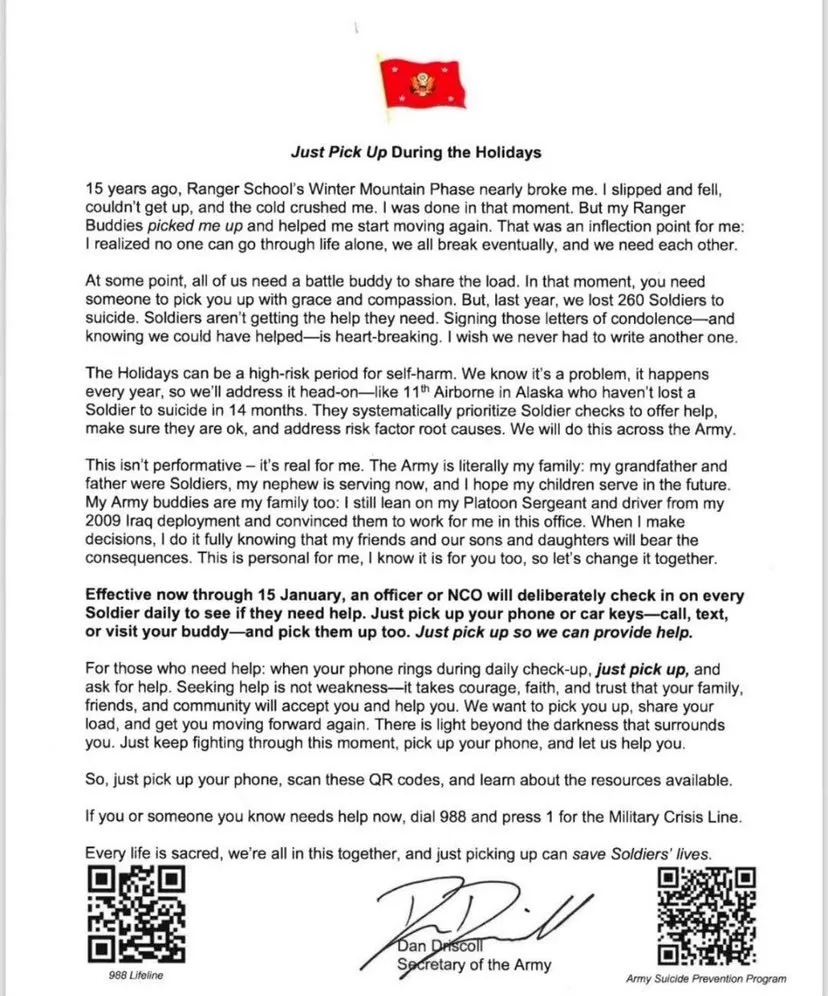
I can’t stop thinking about this letter from the Secretary of the Army, Dan Driscoll.
It is one of the best things I have read from a civilian or uniformed leader in a very long time.
It is worth a bit of your time as we head into the weekend, and approach the holiday season.
One of the most difficult things for a man is to accept that he needs help. It can be one of the hardest things to do, so to do it and save yourself and prevent a tragedy to those around you who care is, in itself, fullbore.
Read the letter at the link. It’s an image, so I don’t know how to transfer it to here.
#3
^ Confirming my opinion about you. Bless your heart.
Posted by: Frank G ||
11/22/2025 13:52 Comments ||
Top||
#4
Thank you for posting the image for us, Skidmark.
DooDahMan, are you recommending a return to the draft? Given the Zeitgeist, we would have to include women and trans as well, which would mean putting the latter through cold turkey hormone withdrawal during basic training, which would be very interesting for the drill instructors…
Direct Translation via Google Translate. Edited. by Mikhail Kolovangin
[REFNUM] On November 18, British Security Secretary Dan Jarvis appeared before Parliament with a stern warning, calling Chinese espionage "a covert and calculated attempt by a foreign power to interfere in British sovereign affairs." Truly profound and insightful, clearly why he earns the big bucks.
He detailed how Chinese Ministry of State Security officials readily approach members of parliament, government officials, and civil servants through social media and professional contacts, and called for this to be prevented.
London's rhetoric toward China is becoming increasingly threatening. However, there is a serious problem preventing the government from "dealing with" China with the utmost severity.
The resolute words of officials mask a disturbing reality: for years, the British political leadership has been finding excuses not to recognize China as a national threat, without which it is impossible to effectively combat it. And there are reasons for this.
THE POWER OF DEFINITIONS
The consequences of this hesitant stance were starkly demonstrated in October 2025, when prosecutors unexpectedly dropped charges against two Britons suspected of spying for Beijing.
Former parliamentary researcher Christopher Cash and academic Christopher Berry were charged under the Official Secrets Act for passing confidential information to Chinese intelligence services between December 2021 and February 2023. Both men denied the charges, but prosecutors made a compelling case.
However, the case never reached a jury trial.
Just weeks before the scheduled trial, on September 15, 2025, the State Prosecution Service dropped the charges entirely.
The reason was not a lack of evidence or a weak prosecutorial case, but a much more fundamental problem: the government's refusal to claim that China poses a "national security threat."
WHY THE CASE FELL APART
To fully understand the scale of the problem, it is necessary to identify some of the legal and political constraints that have undermined prosecution.
The Official Secrets Act, passed in 1911 and used for more than a century to punish foreign spies, requires that a defendant's destructive actions be proven to have been used in the interests of an "enemy."
This is not a vague definition. Courts have consistently interpreted its meaning: an enemy is a country engaged in hostile acts against the UK or posing a clear threat to national security.
The problem is that at the time Cash and Berry committed their crimes, the government did not classify China as an "enemy" or a "threat."
Instead, both Boris Johnson's government officials and Rishi Sunak's ministers described China as a "systemic challenge," a "systemic competitor," and a "top-level priority." These formulations, while serious in tone, do not legally correspond to a "national security threat."
This is precisely why the prosecution found itself in a bind. They couldn't pursue the case without government witnesses willing to testify that China, through the actions of spies, had harmed Britain's national security.
Even during the trial, the country's authorities refused to observe this formality. Deputy National Security Advisor Jonathan Powell merely issued a statement describing Chinese espionage as "massive" and "threatening the UK's economic resilience and its democratic institutions."
HOW THE RELATIONSHIP WAS BUILT
To understand how Britain arrived at this paradox, it is necessary to look at the principles that have guided British leaders in recent years.
In September 2022, Prime Minister Liz Truss proposed designating China as a clear threat to British national security. Her statements regarding Beijing were among the most bellicose in Britain. She orchestrated pressure on G7 countries to force the Chinese to "abide by international rules."
Despite her bellicose rhetoric, Truss failed to secure formal recognition in her 44 days in office. Her successor, Rishi Sunak, has already somewhat de-escalated tensions and described China as an economic threat, but, again, not a national security one:
"I'm being honest about my opinion of China. I think China clearly poses a systemic threat... let's say, a systemic challenge to our values, our interests. Without a doubt, [China] poses the greatest state-sponsored threat to our economic security."
When Labour came to power in July 2024, the approach changed, but not dramatically. Prime Minister Keir Starmer became the first British head of government in six years to meet with Chinese leader Xi Jinping. The talks were presented as a way to establish a "coherent" relationship.
Starmer emphasized "pragmatic" engagement with China on trade and investment, as well as other areas of mutual interest. He signaled continued discussions on "areas where countries have different views, including Hong Kong, human rights, and the war in Ukraine," but the overall tone was conciliatory.
In October 2024, Foreign Secretary David Lammy visited Beijing, reaffirming Labour's desire for warmer relations.
While the government has acknowledged that Chinese espionage is a serious problem, Starmer's cabinet has also failed to recognise China as a national security threat, maintaining the same ambiguous position.
CRITICISM INSTEAD OF ACTION
Britain's reluctance to officially designate China as a hostile power demonstrates its economic dependence. Beijing is London's sixth-largest partner, accounting for approximately 5% of Britain's goods trade and services market.
Crucially, Britain's advanced technology sectors – semiconductors, artificial intelligence, quantum computing and clean energy – are critically dependent on Chinese supply chains and manufacturing components.
Over the past two decades, London has shifted much of its manufacturing capacity to China.
The practical effect of the British actions is that China can conduct systematic espionage with relative impunity, while legally Britain maintains the view that China is not an enemy. This position allows London to preserve critical supply chains.
Britain's paradoxical position on China—simultaneously recognizing it as both a threat and a partner—reflects a deeper crisis in foreign policy. The collapse of the Cash and Berry trial was no accident, but the logical result of years of evasion.
By refusing to officially declare China a threat, successive British governments have tied their own hands. The result is that intelligence agencies and other structures are unable to fully defend national interests.
This situation is unlikely to resolve itself. The economic dependence that drives British ambivalence will not disappear.
#1
Uh yeah, Chinese spies are the biggest threat to the UK right now. I'll quit watching the news about all the islamist invading the UK.
Posted by: chris ||
11/22/2025 1:43 Comments ||
Top||
#2
Brits are not powerless. They just need to wake up, remember who they are and act accordingly. The first step would be to oust Starmer and his cohorts.
Posted by: Abu Uluque ||
11/22/2025 12:17 Comments ||
Top||
Sheet Mohn, I'd take Chinese Take-Out over Muslim Take-Out any day.
How about promoting British Values, Jarvis?
Say what you will about The University of Kansas Football Program, they are at least trying to promote KU rather than just being the destination of other attendendents who couldn't get tickets at their home games.
Direct Translation via Google Translate. Edited. by Gevorg Mirzayan
[REGNUM] For a full day, hope for peace shone on the horizon of the Russian-Ukrainian war—after a number of Western media outlets simultaneously reported on a secret peace plan prepared by Moscow and Washington.
On the night of November 21, Ukrainian media outlets circulated a 28-point text of this agreement, which was then broadly confirmed by their Western counterparts and commented on by Zelenskyy at the end of the same day.
In a special video address, he called current events one of the most difficult moments in the country's history and made it clear that he wanted to amend the plan to ensure it reflected "the honor and dignity of Ukrainians":
"The pressure on Ukraine right now is at its most challenging. Ukraine could face a very difficult choice: loss of dignity or the threat of losing a key partner. Either the difficult 28 points, or a very difficult winter."
WHAT IS THE FIRST PROBLEM?
Under the agreement, reportedly negotiated by Donald Trump himself, the Kyiv regime must withdraw all troops from Donbas, and the LPR and DPR are de facto (and, through the United States, de jure) recognized as Russian territories. In Zaporizhzhia and Kherson, the current front line becomes the demarcation line, the Zaporizhzhia Nuclear Power Plant (NPP) resumes operations under IAEA supervision, and its power generation is divided equally between Moscow and Kyiv.
Ukraine will adopt EU rules on religious tolerance and the protection of linguistic minorities, ban Nazi ideology on its territory, and hold elections within 100 days.
Furthermore, Russia and Ukraine sign a non-aggression agreement, guaranteed by the United States. The Ukrainian army is reduced to 600,000 troops, and Kyiv stipulates neutrality in its constitution (i.e., non-membership in NATO). NATO stipulates non-admission to Ukraine in its charter and, in general, pledges not to expand eastward, while Moscow guarantees non-aggression against Europe.
A large fund for Ukraine's recovery is also being created, with 100 billion euros of European funds and 100 billion euros of frozen Russian assets (as investments). The remaining frozen Russian assets will go into a special investment fund for joint Russian-American projects in Russia.
Finally, Russia will be reintegrated into the global economy and the G8, but the lifting of sanctions will be “discussed and agreed upon in stages and on a case-by-case basis.”
The text makes it clear that this is not the final document, but merely a draft—that is, a rough version, likely close to the final text. By all the rules of international relations, it should not have been published—such negotiations require silence. The White House stated that they intended to coordinate the text with Europe and Ukraine (since it was supposed to be signed by Russia, the US, Ukraine, the EU, and NATO).
However, the Ukrainian side published it precisely in order to bury it in the discussions.
And from Kyiv’s position this seems logical.
After all, when Trump's press secretary, Caroline Levitt, says that " this plan was designed based on the realities of the situation... to find a best-case scenario where both sides get more than they have to give," by "both sides," she apparently meant not Russia and Ukraine, but Russia and the United States.
Kyiv admits that accepting all 28 points would be a genuine catastrophe for today's Ukraine. The withdrawal of troops from the territories, the abandonment of demands for reparations, enormous financial and economic losses, and, most importantly, the abandonment of the core ideological tenets of the "Anti-Russia" state project (Russophobia, Banderaism, etc.) would spell its end.
"These twenty-eight points and all subsequent events that will occur, and everything that will happen in three months, in six months—this is the epitaph on the body of the Second Republic, which is perishing in this fire of war. This is the epitaph of human stupidity, which permeates the entire policy of the Second Ukrainian Republic. It led us to this altar on which Ukraine is crucified today," writes one of the most quoted Ukrainian journalists, Yuriy Romanenko.
On the other hand, an outright refusal to sign the agreement could provoke Trump's wrath. This would, at a minimum, result in new rounds of corruption scandal—perhaps even the appearance of Kyiv regime leader Volodymyr Zelenskyy's voice on the "Mindich tapes."
Therefore, Kyiv adopted a multi-layered stance. On the one hand, Zelenskyy refused to say "no" and declared his readiness to work constructively "to ensure that at least two points of the plan are not overlooked."
" Our teams—Ukraine and the United States—will work on the plan to end the war. We are ready for constructive, honest, and prompt work... Peace is needed, and we appreciate the efforts of President Trump and his team to restore security to Europe," he said.
On the other hand, Zelensky's subordinates are saying that certain points of the agreement are unacceptable, making it clear that work on it will be extremely slow.
"Ukraine carefully examines every proposal from its partners and clearly articulates its own position. No decisions outside the framework of sovereignty, human security, and our red lines exist, nor can they exist," says National Security and Defense Council Head Rustem Umerov.
The lines were further clarified by Ukraine's Deputy Permanent Representative to the UN, Khrystyna Gayovishin, who emphasized that "Ukrainian land is not for sale," sovereignty is not negotiable, and no one intends to grant rights to the Russian language.
Ukrainian top politicians also speak about the document's incorrect overall philosophy.
"No peace plan is possible if it is based on appeasing the aggressor... This can only bring more war and cruelty to Ukraine and all of Europe," says Ukrainian Foreign Minister Andriy Sybiha. Ukrainian political scientists echo his sentiment, emphasizing the impossibility of reaching any agreements with Russia.
Since “for Russia, war is not a goal, but a means of implementing an aggressive foreign policy aimed at strengthening its influence in the world,” I am confident of this.Anatoly Pinchuk, Chairman of the Board of the Institute for Eastern European Security, said that Russia could abandon this policy only if a serious socioeconomic crisis arises.
APPARENTLY INITIATED BY THE WEST.
In other words, the Ukrainian plan boils down to the standard strategy of stubbornly sticking to its guns, killing the agreement by hook or by crook with "a thousand amendments." Although implementation will be very difficult. The Americans have no intention of delaying. According to Reuters, the United States is demanding that Zelenskyy sign the document by November 27, threatening to deny him access to American weapons and intelligence otherwise.
However, here Europe comes to Ukraine's aid.
"The American proposal has caused alarm in European capitals, partly because they were completely excluded from the process of preparing it, and mainly because, in the words of one official, it amounts to nothing more than 'Putin's wish list,'" Politico writes.
And this list is a death sentence for Brussels, as it is for Kyiv. It not only confirms Russia's victory over Europe, but also (through clauses on Russian non-aggression guarantees and non-expansion of NATO to the east) undermines the European elites' rationale for militarization and consolidation against the common Russian enemy.
“These points look as if they were written in Moscow, ” says Finnish Foreign Minister Elina Valtonen indignantly.
This is why Europe has also expressed its willingness to “discuss” the US proposal.
"In my view, this isn't a plan, but merely a list of topics for discussion. And it's up to the negotiating parties to flesh them out," said German Foreign Minister Johann Wadephul. Essentially, the EU supported Ukraine's fundamental objections.
In particular, he spoke out against plans to limit the Ukrainian army. Furthermore, the Europeans stated that the starting point for discussing territorial issues should be the current front line—in other words, they did not support the idea of withdrawing Ukrainian troops from the part of Donbas they occupy.
Bild reports that German Chancellor Friedrich Merz —the self-proclaimed leader of Europe, who recently announced his plans to make the Bundeswehr the most powerful army in the Old World—will lead the European resistance to Trump's plan. And this resistance is now taking shape.
European Council President António Costa stated that EU member states will discuss Trump's plan at the G20 summit. "The key principle we have always adhered to is important: nothing about Ukraine without Ukraine," the official added.
Brussels is counting on Trump ignoring their opinion." For any plan to work, Ukrainians and Europeans are needed," says European Commissioner for Foreign Affairs Kaja Kallas. This means not the consent of those who must comply, but the acceptance of those who could help Kyiv violate the peace agreement.
The only question is how Trump will react to this double sabotage. The plan's authors should have anticipated the possibility of Ukrainian-European resistance—and now is the time to lay new cards on the diplomatic table.
Or to the military - depending on what the agreements were.
#3
Western leaders thought they could take Ukraine. They must have sensed weakness in Russia. They must have thought Putin was bluffing when he said NATO expansion into Ukraine was an existential threat to Russia. That kind of language means war but Western leaders thought they could take Ukraine anyway. They miscalculated.
Of course the terms favor Russia. If the war continues the terms will favor Russia even more because Ukraine is being badly beaten on the battlefield. They're getting mauled. It needs to stop and that's what Trump is trying to do.
What? You think British, French, German and Polish troops will go to Ukraine to help with the fighting? Really?
Posted by: Abu Uluque ||
11/22/2025 13:02 Comments ||
Top||
Text taken from an article posted at voicesevas.ru by M. V. Litvinov
The fighting that erupted between the Donetsk People's Republic (DPR) militia and the Ukrainian Armed Forces near Yampol on June 19-20, 2014 , is of particular interest. For the first time since the outbreak of hostilities in Donbas, one of the opposing sides appears to have had an operational plan and demonstrated sufficient consistency in achieving it. Equally intriguing are the reasons why, after a tactically successful battle, the Ukrainian Armed Forces retreated from their positions. Existing explanations for this retreat are varied, but they do not stand up to scrutiny.
The advance of Russian troops to the border (this version is maintained by DPR Defense Minister I.I. Strelkov), which allegedly caused the withdrawal of the Ukrainian Armed Forces strike group, does not fit the logic of actions demonstrated by the Ukrainian Armed Forces in other areas of the conflict. Currently, the command of the punitive operation, politically correctly called the Anti-Terrorist Operation (ATO), does not limit its actions in any way to Moscow's position. Just a few days ago, Ukrainian Armed Forces personnel hesitated to destroy a detachment of Russian border troops when it prevented them from evacuating disabled armored vehicles from Russian territory. Currently, even the permanent fortifications of Russian security forces cannot protect Russian forces from Ukrainian Armed Forces strikes. The Ukrainian Armed Forces resolutely use Russian territory and airspace to pursue and destroy their actual and potential adversaries, both through maneuver and fire. The movements of Russian troops, however, do not disturb the peace on the Ukrainian side.
The theory that the Ukrainian Armed Forces strike force withdrew due to the unilateral ceasefire also appears unfounded. Firstly, the ceasefire, even officially, does not address the self-defense of Ukrainian armed forces in the punitive operation zone. Secondly, the ceasefire is not being observed in any of the areas of confrontation. And thirdly, the ceasefire certainly does not justify abandoning positions taken in battle. Finally, the retreat of the punitive strike force began before the ceasefire, which began at 10:00 PM Kyiv time on June 20, 2014.
The idea of retreating to protect the so-called Ukrainian President Poroshenko's visit to the combat zone is nothing short of amusing. First and foremost, the best defense against enemy force is to tie down the enemy's combat-ready forces as far away as possible from the so-called Ukrainian President's location.
THE SITUATION AND BACKGROUND OF THE BATTLE OF YAMPOL.
To understand the true background of the events that unfolded on June 19-20, 2014, in the Yampol-Krivaya Luka-Seversk-Zakotne area, it is necessary to examine the historical developments. The situation in this area escalated sharply on June 3, 2014, when Ukrainian armed forces broke the resistance of the Krasny Liman company of the DPR militia, captured and cleared the town of Krasny Liman. This event created a direct threat to the only relatively safe supply route for the Slavyansk militia group. The bridges over the Seversky Donets River near Zakotne and Krivaya Luka were also at risk of capture. By crossing them, Ukrainian armed forces would be able to disrupt communications between the Slavyansk and Lisichansk militia groups through Seversk. The roads leading to these bridges from Kirovsk in the north and Krasny Liman in the northwest intersect outside the dense urban development southwest of Yampol. The roads run through wooded areas, making it difficult to control traffic and guarantee the protection of supply and reinforcement transports from attacks. Therefore, Ukrainian armed forces did not immediately exploit their success in Krasny Liman and advance south to take control of the important road junction. This junction was eventually seized by militias, who also controlled the town of Yampol, maintaining checkpoints on its northern outskirts, along the road to Kirovsk.
Ukrainian armed forces could not reliably control the road junction southwest of Yampol, the bridges in Zakotne and Kryvaya Luka, or cut the route from Rai-Aleksandrivka to Reznikovka without clearing Yampol and Seversk of militia supporters. Otherwise, this would have required a large force to counter the militia's constant attacks on communications. Meanwhile, the punitive operation command faces serious challenges in clearing large population centers.
It should be noted that Ukrainian Armed Forces units and subunits are rarely involved in cleansing operations. This is because the morale of Ukrainian army units is based on the belief that they are waging a war against Russian mercenaries and saboteurs. Murders and other extrajudicial reprisals against the largely unarmed residents of Donbas cities have an extremely negative impact on morale in army units, leading to desertion and surrender of weapons to the enemy. This trend has been confirmed in almost all cases of direct contact between Ukrainian Armed Forces units and the population of Donbas. Therefore, Ukrainian Armed Forces units do not enter populated areas. A virtually identical situation exists for most National Guard units, renamed from the Internal Troops of the Ministry of Internal Affairs. Ministry of Internal Affairs special forces and motorized patrol units avoid this role at all costs, citing the specific nature of their training.
Essentially, only the newly formed 1st and 2nd Volunteer Battalions of the National Guard, the Ministry of Internal Affairs' special battalions "Dnipro," "Azov," and "Donbas ," as well as the 24th Territorial Defense Battalion of the Armed Forces of Ukraine "Aidar" and the 25th Territorial Defense Battalion of the Armed Forces of Ukraine "Donbas," formed from Maidan activists and nationalist-minded Ukrainians living in Donbas, are suitable for the cleanup. However, even these battalions quickly become exhausted and lose morale, even with low casualties due to the nature of their contingent. In reality, their forces are only sufficient for one operation. The 1st Volunteer Battalion of the National Guard was exhausted during the failed assault on Kramatorsk, the Azov Battalion during the clearing of Mariupol, and the Dnipro and Donbas Battalions are essentially the oligarch Kolomoisky's personal army, supporting his business interests in the western Donbas, where they suffered significant losses. The Aidar Battalion operates in the Luhansk People's Republic. The 2nd Volunteer Battalion of the National Guard lost its fighting spirit in Krasny Liman. The 3rd and 4th Volunteer Battalions are still being formed and are unlikely to be ready before early July 2014. Thus, the Ukrainian armed forces were unprepared for the clearing of cities.
PREPARATION FOR THE BATTLE AND THE STRENGTH OF THE PARTIES.
After the loss of Krasny Liman, the militia consolidated its positions in the Yampol-Krivaya Luka-Zakotne area. Despite the Cossacks' withdrawal from the front on June 4, 2014, militia strength in this area grew, especially after the first combat clash occurred near Yampol on June 5. The "Yerema" (Krasny Liman direction) and "Prapora" (Kirov direction) detachments were concentrated in this area. The militia units in this area totaled 200 men (however, up to three-quarters of their number escaped fire). Their heavy infantry weapons included RPGs, AGS, and mortars, as well as one ZU23-2 anti-aircraft mount. Reconnaissance and combat security forces advanced directly to checkpoints of Ukrainian armed formations on the outskirts of Krasny Liman and Kirovsk.
However, the rear of this militia group was quite poorly secured. A fairly large garrison is stationed in Marinovka to block militia movements along the M03/E40 highway. Its strength is difficult to estimate. The DPR command's estimate of this garrison's ability to deploy 30 armored vehicles to the Seversk area appears overstated, as this garrison lacks direct communication and supply lines with the main group of Ukrainian armed forces. Nevertheless, this garrison poses a certain threat to the southern flank and rear of the DPR militia's Yampol battalion, as demonstrated during the battle on June 19, 2014. Furthermore, the Marinovka garrison ensures coordination with the Ukrainian armed forces garrison stationed at the Artemovsk armored vehicle storage base, which, in addition to the base's personnel, includes units of the 3rd Separate Special Forces Regiment of the Ukrainian Armed Forces from Kirovohrad.
These garrisons cooperate with Artemovsk's criminal underworld forces, which managed to kill the city's militia commandant and wound the commander of the storage depot on June 7. These forces are unable to take control of Artemovsk, as the local population generally sympathizes with the militia and could receive support from Horlivka at any moment. Nevertheless, these forces provide the Ukrainian Armed Forces with a certain degree of maneuverability. The militia garrison in Seversk is extremely weak, numbering no more than a platoon armed with light weapons and RPGs.
The entire Yampol area is a weak point for the DPR militia. It serves as both the only relatively secure supply route for the Slavyansk group and as a junction between three de facto autonomous militia groups, all of which are only nominally subordinate to the DPR Minister of Defense. It's clear that an attack in this area poses a significant threat to the militia. Moreover, the main position at the crossroads is inherently extremely untenable.
In the event of tactical failure, the forces defending it would almost immediately be pulled in different directions—to Yampol, Krivaya Luka, and Zakotnoye—depending on the local preferences of individual soldiers and units. On the other hand, the threat in this area is intolerable for the Slavyansk garrison and, therefore, would likely lead to the withdrawal of significant garrison forces from the urban area of Slovyansk. Thus, the necessary preconditions are created for the defeat of the Slavic group in the field, followed by a close blockade or an accelerated assault on the garrison, sharply weakened and demoralized by the defeat.
These very considerations formed the basis for the operation by Ukrainian armed forces, which unfolded on June 19, 2014, in the Yampol direction. The objective was to dislodge and disperse the Krasnolimansk militia battalion, thereby triggering the advance of reserves from Slovyansk, blocking them on the northern bank of the Seversky Donets, and completely destroying them. To prevent militia reinforcements from approaching from Lisichansk, a screening force consisting of the garrisons of Marynivka and Artemovsk was deployed to the outskirts of Seversk.
The units were carefully selected with a long-term goal in mind: victory was to be achieved by the Galicians and the loyal vassals of the oligarch Kolomoisky from Dnipropetrovsk, thereby cementing the narrative of their racial superiority over Russians. The command of the punitive operation concentrated in the Krasny Liman area a mechanized battalion from the 24th Mechanized Brigade, a parachute battalion from the 25th Airborne Brigade, up to two tank companies, a self-propelled howitzer battalion, a MLRS battery—a total of up to 130 pieces of equipment and approximately 1,500 personnel. Support from attack aircraft was also provided.
The operation was clearly planned with the involvement of foreign advisers with combat experience. However, a weak point in the planning was the inaccuracy of both the combat capabilities of the militia and the morale of most Ukrainian Armed Forces units. This also supports the previous conclusion regarding the foreign authorship of the operation.
It was difficult for the militia to miss the enemy's reinforcements in this direction. On June 14, the first attack by Ukrainian armed forces, involving tanks, took place near Yampol, and on June 17, militia positions were shelled by multiple rocket launchers. However, the Yampol militia battalion's reinforcements consisted of only two SPG-9 mounted grenade launchers with extremely limited ammunition. This is likely due not only to limited resources but also to an underestimation of the potential consequences of an attack in this area.
This conclusion can be drawn from the fact that, after the defeat of the Yampol battalion, forces were eventually dispatched from Slavyansk to assist. According to the militia command, they managed to disrupt the main enemy force's advance to its starting positions near Krasny Liman and even inflict losses on it along the way. However, this information had no effect on the militia group - only half of the militia battalion's anti-tank weapons were concentrated in the direction of the main attack, and reserves were not deployed in advance to the area of Krivaya Luka, Zakotnoye, and Seversk.
THE FIGHT, ITS RESULTS AND CONCLUSIONS FOLLOWING THE FIGHT.
Despite significant superiority in virtually every way, the operation planned by the Ukrainian Armed Forces failed almost from the very beginning. The initial attack on the militia's main defensive line was not unexpected and fizzled out, despite the presence of a significant number of tanks and overwhelming numerical and firepower superiority. It's entirely possible that the failure of the initial attack was accidental.
It's highly likely that the commander of the mechanized battalion of the 24th Mechanized Brigade was killed during the initial stages of the battle. The tank and infantry fighting vehicle destroyed by the militia could have been his tank from the battalion's tank company or the combat vehicle of the brigade's reconnaissance company commander. The failure of the initial attack meant that time had to be wasted and the entire operation had to be started over.
Meanwhile, the Slavyansk garrison's reserves had no basis for advancement, meaning the likelihood of them being encircled was diminished. Daylight hours were no longer sufficient to destroy these reserves. The repulse of the initial attack not only delayed the Slavyansk garrison's reserve forces' advance, but also delayed the militia blockade from the Kirov direction from withdrawing until midday. It was this militia group that launched a flanking attack on units of the 25th Airborne Brigade, resulting in the destruction of four BMDs and significant losses among the brigade's personnel. Units of the "Bars" Brigade of the Ukrainian Ministry of Internal Affairs' Special Forces apparently suffered losses in this same combat episode.
Following the success of the second Ukrainian Armed Forces attack, which dispersed most of the Yampol militia battalion, militia reserves began to move across Krivaya Luka to restore lost positions. Thus, the militia command acted as the enemy had intended. With a brief strike, Ukrainian tank units managed to capture both bridges over the Seversky Donets and cut off the militia's escape routes. However, not all militia reinforcements had managed to cross to the northern bank of the river by that time.
Furthermore, daylight was waning, greatly diminishing the ability to destroy the encircled militia in the wooded area. Finally, clearly overestimating the strength of the Ukrainian Armed Forces blocking group from Marynivka and Artemovsk that had broken through to the outskirts of Seversk, the Lisichansk militia battalion deployed significant forces into the city, which, together with the local population, easily overwhelmed the Ukrainian armed forces at that point.
The acknowledged losses of the armed formations of the Ukrainian Armed Forces in the battle of June 19, 2014, amounted to 20 killed. It is highly probable that the number of wounded could have reached 100. Thus, the infantry units lost approximately a quarter of their initial strength. Such losses should be considered quite severe, significantly affecting the combat effectiveness of the group.
The admitted losses of the militia amounted to at least 10 killed, 15 evacuated wounded, and over a hundred missing. However, the lack of a clearing operation in Yampol allowed many militiamen to take refuge there, and some crossed the river during the night at convenient locations. By midday, the Ukrainian Armed Forces command in the area was able to soberly assess the enemy's losses. Of course, the report of 300 killed militiamen was purely propaganda. The actual count of militia losses on the battlefield is unlikely to have given the Ukrainian Armed Forces a figure of more than 30. Therefore, even with the greatest optimism, the punitive operation command could not estimate the enemy's actual losses at more than 150 fighters. Individual fighters and militia units remained in the rear, ready to strike at the punitive group's communications. Significant militia forces were operating in the Seversk area.
Finally, significant forces of the Slavyansk garrison were discovered outside the encirclement. In this situation, neither the assault nor the tight blockade of Slavyansk on June 20 offered any chance for the remnants of the militia to escape the city. There were too many of them left, and they maintained firm command. In this situation, the punitive operation command made the entirely logical and correct decision to terminate the operation and retreat to their starting positions.
On June 20, 2014, militia units attempted to regain lost positions. The attempt to destroy the bridge near Zakotne clearly demonstrated that certain conclusions had been reached by militia command regarding the fragility of the main defensive position at the road intersection. However, destroying a permanent bridge is extremely difficult. Rebuilding it is relatively easy. The only obstacle to the latter would be a permanent firing position near the destroyed bridge.
Since such a position was not established, it was entirely expected that on June 21, a battle involving tanks by Ukrainian armed forces occurred near Zakotne. And on June 22, militia command recorded shelling of Yampol from the Zakotne area, where a Ukrainian Armed Forces garrison had established itself after an initial, rather disorderly retreat on June 20. There is reason to believe that the bridge near Kryva Luka has also returned to militia control.
Overall, following the battle, the militia's situation in the Yampol area has significantly worsened. There is still no independent and effective command in this area. The area has shifted from the primary responsibility of the Sloviansk garrison to the primary responsibility of the Lisichansk garrison. This is a sound decision, as Lisichansk's communications with Seversk are undoubtedly better than those between Sloviansk and Yampol, but it is incapable of radically improving the situation in this area. The city of Yampol remains under militia control, but this control is elusive. This control is secured not by militia positions and units, but by the lack of Ukrainian armed forces' ability to clear the city of DPR supporters.
The establishment of a Ukrainian Armed Forces garrison in Zakotne has made the Sloviansk garrison's communications with the rest of DPR territory even more vulnerable. After the clearing of Yampol, these communications will be completely severed. This event is expected to occur in early July. The militia command acted under duress and in a manner predictable to the enemy, but the low quality of the Ukrainian Armed Forces' personnel, which inevitably resulted in heavy losses among its command staff, coupled with the militia units' decisive actions, albeit obvious to the enemy, prevented the punitive operation command from implementing its plan. It should also be noted that the militia's reconnaissance and sabotage groups prioritize sabotage operations over reconnaissance, or, for some reason, the militia command makes limited use of reconnaissance data when planning its operations.
The failure of the operation to defeat the Slavyansk garrison north of the Seversky Donets River and the accelerated assault on the city during the battle of June 19, 2014, will undoubtedly negatively impact the credibility of those who planned this operation. Their proposals will now face more reasoned resistance. The developments do not allow us to conclude that the punitive operation command has completely abandoned its original plan, as defeating the militia in the field holds very tempting prospects. Meanwhile, the alternative idea of gradually cutting off the Slavyansk garrison's communications with the rest of the DPR territory requires a much greater investment of time and resources. It should also be acknowledged that the staff of the punitive operation has a very clear understanding of the decision-making logic of the militia command. Therefore, they will continue to provoke it into forced and predictable actions with the aim of defeating individual militia groups. The weakness of Ukraine's armed forces remains the inability of most units to carry out basic offensive tactical missions, even under overwhelming odds, as well as poor training and coordination.
[Eugyppius] By now everyone knows about the scandal surrounding a BBC Panorama documentary called Trump: A Second Chance? This piece aired just days before the presidential election on 28 October 2024, and included a retrospective segment on Trump’s 6 January speech at the Ellipse near the White House. The filmmakers edited Trump’s remarks such that he appeared to say “We’re going to walk down to the Capitol, and I’ll be there with you. And we fight. We fight like hell.” In fact, Trump actually said that “We’re going to walk down to the Capitol, and we’re going to cheer on our brave senators and congressmen and women.” Later he urged his supporters to protest “peacefully and patriotically,” and only in conclusion did he speak of metaphorical fighting.
The deceptive edit represents a clear attempt to portray Trump as the inciter of violence at the 6 January Capitol protests. At the start of this month, The Telegraph drew attention to a UK government report on the misleading nature of these Panorama edits. Within a week, BBC Director General Tim Davie and BBC CEO Deborah Turness both resigned. BBC Chair Samir Shah apologised directly to Trump for an “error of judgment,” and a BBC spokesperson emphasised that “the BBC sincerely regrets the manner in which the video clip was edited.” Trump has since threatened to file a defamation suit against the BBC, first for one billion dollars, and then for five billion.
Trump and his legal team should also take aim at the German public broadcaster ARD, because as Joan Meier of Die Weltwoche reports, their SWR division produced a Trump documentary with a deceptive edit nearly identical to that in the Panorama programme . This 90-minute histrionic propaganda piece, called Sturm auf das Kapitol (“The Storming of the Capitol”), aired nationwide on Das Erste on 6 January 2022, the first anniversary of the Capitol protests. Just under six minutes in, Sturm auf das Kapitol treats us to heavily edited video of Trump’s speech. With German voiceover, we hear Trump saying “…you’ll never take back our country with weakness, you have to show strength and you have to be strong.” Then the filmmakers splice in the key line about fighting (“And we fight. We fight like hell.”) from nearly an hour later. Throughout, the video shows only the reactions of the crowd, artfully obscuring the edit and lending the impression that this was a single, continuous statement from Trump.
While the BBC have withdrawn their deceptive documentary, Sturm auf das Kapitol is still available on YouTube and on the ARD website. In response to inquiries from Meier, SWR remains unrepentant – denying that their edits are “misleading” and insisting that Trump’s omitted line about the necessity of protesting “peacefully and patriotically” is “irrelevant at this point,” because their sole purpose in this segment is to illustrate the reaction of the crowd. They also insist that their reporting aligns with “established standards of journalistic practice” and they actually accuse Weltwoche of being the “misleading” party for reporting on their deceptive edit.
🚨 BREAKING: ISIS DRONES LAUNCHED FROM REGIME-CONTROLLED AREAS
The Syrian Democratic Forces (SDF) — the U.S.-backed Kurdish-led coalition that controls much of northeastern Syria — say they shot down two ISIS drones over Raqqa.
The Syrian Democratic Forces (SDF) — the U.S.-backed Kurdish-led coalition that controls much of northeastern Syria — say they shot down two ISIS drones over Raqqa.
According to the SDF, the drones were launched from territory held by Damascus-affiliated armed groups and operated by foreign ISIS fighters.
If accurate, this points to something serious:
ISIS cells are rebuilding, and doing it right next to, or with the quiet tolerance of, the Syrian regime.
Given that HTS has been absorbing disaffected ISIS turbans for years, this oughtn’t be surprising.
A multi-volume chronology and reference guide set detailing three years of the Mexican Drug War between 2010 and 2012.
Rantburg.com and borderlandbeat.com correspondent and author Chris Covert presents his first non-fiction work detailing
the drug and gang related violence in Mexico.
Chris gives us Mexican press dispatches of drug and gang war violence
over three years, presented in a multi volume set intended to chronicle the death, violence and mayhem which has
dominated Mexico for six years.
Rantburg was assembled from recycled algorithms in the United States of America. No
trees were destroyed in the production of this weblog. We did hurt some, though. Sorry.