[BBC] The Australian Transport Safety Bureau released footage of the moment a skydiver's parachute wrapped around a plane horizontal stabiliser on 20 September 2025, in Far North Queensland.
Video shows the handle from the skydiver's reserve parachute snagged on the plane's left horizontal stabiliser and accidentally deploying, leaving them hanging from the stabiliser by the parachute.
The skydiver cut himself free and survived the incident with minor injuries.
Direct Translation via Google Translate. Edited.
[Regnum] Four solar flares of the penultimate power class were recorded on December 10. This was reported by the Institute of Applied Geophysics.
“At 02:27 Moscow time, an M1.5 flare lasting 20 minutes was recorded in the X-ray range in the sunspot group 4296 (S18W46),” the institute’s website reported.
Later, three more M-class flares were recorded, which lasted 10, 11 and 16 minutes, respectively.
On the night of December 8, a rare "black" flare occurred on the Sun. A cloud of dense, cold hydrogen was torn apart and scattered across the solar disk for approximately 1 million kilometers. This dark, faintly glowing, cold substance, against the bright background of the Sun, created the appearance of either a ghostly black flame dancing in the Sun's atmosphere or a mysterious dark fog. By morning, the cloud had completely disappeared, as most of it "evaporated" in the Sun's heat, and the rest dissipated.
Refilling military supplies has been on President Trump’s Urgent list. Secretary of War Hegseth has been working on process: stripping out inefficiencies and figuring out the which projects are worth pursuing and which should be dropped.
[FoxNews] Defense expert says China's military buildup exposes how far behind America's industrial base remains.
"The U.S. struggle with China is the single greatest competition the United States has ever faced," defense analyst Seth Jones writes in his new book "The American Edge."
And in an interview with Fox News Digital, Jones warned that if war broke out over Taiwan, the United States could burn through key long-range missiles "after roughly a week or so of conflict" — a shortfall he says exposes how far behind the U.S. industrial base remains as Beijing moves onto what he calls a wartime footing.
Jones is a former Pentagon official and president of the Defense and Security Department at the Center for Strategic and International Studies (CSIS). He argues the United States isn’t dealing with a superpower like the Soviet Union, whose system was brittle and economically isolated. China’s economy, he noted, is roughly the size of the U.S. and deeply tied into global production. That economic weight is fueling a military buildup across every major domain, from fifth- and sixth-generation aircraft to an enormous shipbuilding sector he describes as "upwards of 230 times the size of the United States." The effect, he said, is unmistakable. "The gap is shrinking."
In "The American Edge," Jones lays out how great powers historically win long wars through production, not just innovation — and that’s where he believes the U.S. has the most to worry about. China’s missile forces now field a wide range of weapons designed to hold U.S. ships and aircraft at risk far from Taiwan. That makes stockpiles and throughput central to any American strategy in the Indo-Pacific.
"When you look at the numbers right now of those long-range munitions, we still right now would run out after roughly a week or so of conflict over Taiwan," he said. "That’s just not enough to sustain a protracted war."
Jones stressed that China’s strengths often overshadow a major vulnerability: its limited ability to hunt submarines. He said Beijing "still can’t see that well undersea," a gap the U.S. could exploit in any fight over Taiwan. If China tried to ferry troops across the Strait or impose a blockade, American attack submarines — along with a larger fleet of unmanned underwater vehicles — would pose a serious threat. He called the undersea environment one of the few places where the U.S. retains a decisive advantage, and one where production should accelerate quickly.
China has other problems as well. Jones pointed to corruption inside the PLA, inefficiency across its state-owned defense firms, ongoing struggles with joint operations and command-and-control and the fact the Chinese military hasn’t fought a war since the late 1970s. Its ability to project power beyond the first island chain also remains limited. But none of those challenges, he said, change the broader trajectory: China is building weapons in mass and at high speed — and the U.S. is still trying to catch up.
That theme sits at the center of his book. Jones describes a U.S. defense industrial base constrained by long acquisition timelines, aging shipyards, complicated contracting rules and production lines that aren’t built for a modern great-power conflict. In his view, the United States must rediscover the industrial urgency that once allowed it to surge output in wartime.
That responsibility is now falling to the Trump administration, which has pushed the Pentagon and the services to move faster on drones, munitions and new maritime capabilities. Over the past year, the Army, Air Force and Navy have launched new rapid-acquisition offices and programs aimed at fielding systems more quickly and helping smaller companies survive the long, expensive path to production. Senior defense officials have started using the phrase "wartime footing" to describe the moment — language Jones said is overdue.
"That is exactly the right wording," he said. "The Chinese and the Russian industrial bases right now … are both on a wartime footing."
He said identifying a set of priority munitions for multiyear procurement is a meaningful step, and early moves to streamline contracting are encouraging. But he cautioned that the scale of the problem is much larger than the reforms announced so far. "The Pentagon writ large is a massive bureaucracy," he said. "It’s going to take a lot to break that bureaucracy. There’s been some progress, but it’s trench warfare right now."
Jones said parts of the new National Defense Authorization Act move the needle in the right direction — especially support for expanding shipbuilding and efforts to strengthen the defense workforce. He also pointed to growing interest in leveraging allied shipyards in Japan and South Korea to relieve America’s overburdened maritime industry. But he argued that Washington is still not investing at a level that matches the threat.
"As a percentage of gross domestic product, [defense spending] is about three percent," he said. "It’s lower than at any time during the Cold War. I think we need to start getting closer to those numbers and increase the amount of that budget that goes into procurement and acquisition."
Artificial intelligence is another area Jones believes will reshape the battlefield faster than Washington anticipates. He noted that missile and drone threats now move at a volume and speed no human operator can manually track. "You can’t do things like air defense now without an increasing role of artificial intelligence," he said. The same applies to intelligence and surveillance, where AI-driven systems are already sorting vast amounts of satellite and sensor data.
But Jones said the United States will fall behind unless the Pentagon brings commercial AI leaders — companies like Nvidia and Google — more directly into national security programs. He argued that the United States needs the opposite of the consolidation that collapsed the defense industry in the 1990s. "We’ve got to get to a first breakfast," he said, meaning more tech firms competing in the defense space, not fewer.
Despite his warnings, Jones said the United States still has time to rebuild its industrial advantage. But it must act quickly. The Trump administration is talking about a wartime footing. China, he warned, is already living it.
#1
I thought using Ukraine to deplete all of our missile stores was the PLAN.
Posted by: Super Hose ||
12/11/2025 5:37 Comments ||
Top||
#2
...We never had all that much in the first place, and believe me, we weren't the worst. During the Cold War, officially we were supposed to have about 45 days worth of ammo on hand - but the DOD had to do some pretty fancy tapdancing to be able to say, "Yeah, we got 45 days." Realistically, it was closer to 21-30 days. The UK was far, far worse - the Falklands War just about blew through their wartime stocks, and I was at one of many bases that were transferring ammo to the Brits. Had the Russians come across then, the UK would have run out of ammo in a matter of days.
Fancy toys get money. Dull, boring ammo doesn't. We destroyed the infrastructure to make it, the places to store it, and the means to transport it.
#5
The US has never had good ammo stockpiles. Before it was just a matter of spinning up a few more factories. Today it is a web of supply points and chips that aren't made in one location. Good luck spinning that up quickly.
Posted by: Matt ||
12/11/2025 9:19 Comments ||
Top||
#7
They have the same problem, Matt. Plus they are at the end of a very long supply chain and two destroyers in the Malacca strait can cut off 40% of their food imports and 60% of their fuel/oil. They are building up stockpiles but don't have enough yet to survive a blockade.
#8
It may also be a question of how many young Chinese can die before the Chinese Communist Party loses the Mandate of Heaven. If their first move is a cross-channel invasion of Taiwan they're going to lose 10,000 guys in a day or in an hour. (But they talk about Taiwan so much I wonder if that's not a diversion.)
Posted by: Matt ||
12/11/2025 10:06 Comments ||
Top||
#9
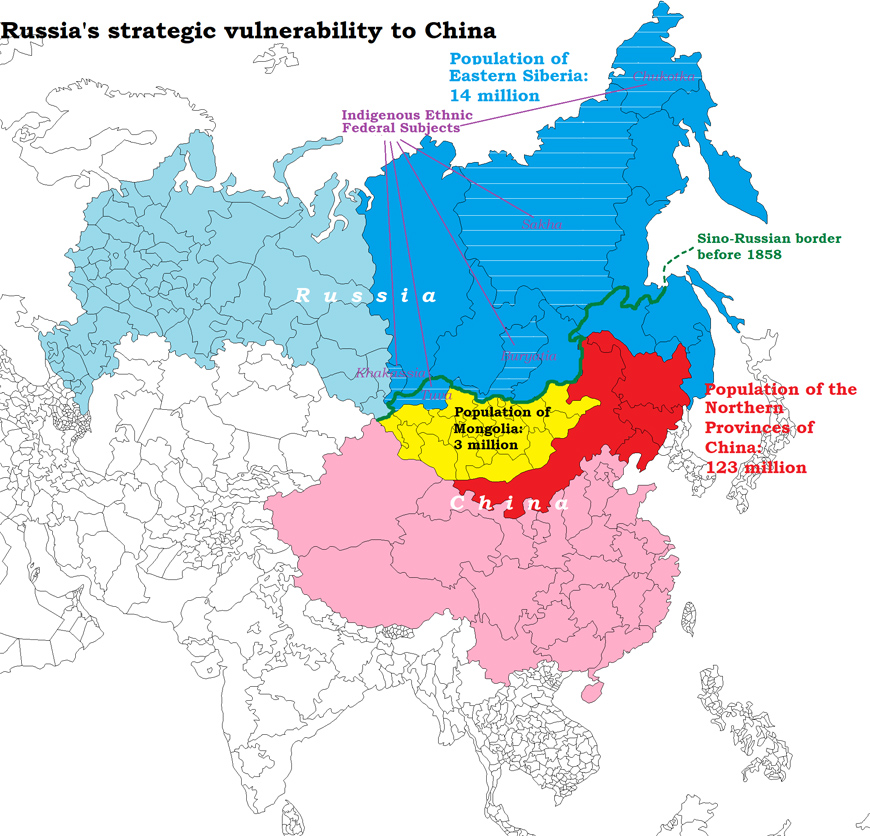
^Taiwan is a matter of face. Russian far east is lebensraum.
China’s population is already falling — by 2050 they'll be down to 500 million, if I recall correctly. Given all the empty new-built cities they have already in China proper, what point is there for them to reach out for extra living space in Russia?
Direct Translation via Google Translate. Edited.
[Regnum] The United Kingdom has confirmed its full commitment to the AUKUS partnership by allocating six billion pounds to develop nuclear submarine construction infrastructure. This was announced by the UK government press service on Wednesday, December 10.
"We're moving full steam ahead towards AUKUS. Our reviews are complete. Now we get down to business... AUKUS is too significant a project, and the stakes are too high, to be allowed to progress unchecked," the press service quoted British Defence Secretary John Healey as saying.
At a meeting at the Pentagon with US Secretary of Defense Pete Hegseth and Australian Defense Minister Richard Marles, the parties agreed to shift the focus from planning to practical implementation of the agreement. Under AUKUS, the UK intends to build up to 12 state-of-the-art SSN-AUKUS-class nuclear attack submarines, creating over 20,000 jobs at peak production. A six-billion-pound investment is being directed toward modernizing critical infrastructure in Barrow and Derby, enabling the production of one new submarine every 18 months. By 2030, the UK's defense nuclear sector is projected to support approximately 65,000 jobs.
On December 8, the Commander-in-Chief of the Royal Navy, First Lord General Sir Gwyn Jenkins, stated that the UK was close to losing its dominance in the Atlantic due to Russia's rise. He emphasized that Russia was investing billions in developing its naval capabilities, particularly its Northern Fleet. Jenkins called on the UK to act more proactively, lest it lose its strategic advantage in the Atlantic, which is unacceptable.
Earlier, experts from the IMEMO RAS stated that Russia had entered the top three global leaders in naval power. The experts compiled a ranking of 10 countries whose potential, or naval power index, accounted for 58% of the global total. The remaining 42% was distributed among the remaining 90 countries.
#3
"We are not, supercilious Yank,
More Islamic than Russia!" [a clank]
As she slides down the ways,
The chameleon brays
Like Slim Pickens: "Haw-haw!" [Mary Sank]
Wiki cite:
"Nuclear-powered attack submarines come in at a slightly lower cost, typically ranging from $2-$5 billion. Conventional submarines are comparatively less expensive, costing anywhere from $500 million to $800 million.Mar 21, 2024"
[BBC] Mexican lawmakers have approved a package of new tariffs, impacting hundreds of products, many of which come from China.
The measures, which President Claudia Sheinbaum has said are needed to boost domestic production, were passed by the Mexican Senate on Wednesday.
The levies are set to take effect on 1 January 2026 and will apply to goods like metals, cars, clothing and appliances. Dozens of countries that do not have a free trade agreement with Mexico will be affected, including Thailand, India and Indonesia.
The move comes as Mexico is in negotiations with the US over steep import taxes that President Donald Trump has threatened to impose on the country.
The measures will impose tariffs of up to 50% on more than 1,400 products.
The levies will "substantially harm the interests of trading partners, including China," said a spokesperson for Beijing's commerce ministry on Thursday.
An investigation into Mexico's trade policy is in progress, they added, urging the country to "correct" its decision.
This week, China also signalled its plans for more involvement with Latin American and Caribbean countries, as it aims to deepen its relationships in the region through trade and innovation.
Chinese companies have been expanding their footprint in Mexico in recent years, with car brands like BYD and MG establishing operations in the country.
But Washington has said Beijing may be using Mexico as a way to bypass US tariffs.
The BBC has contacted the embassies in Mexico of Thailand, India and Indonesia for comment.
Sheinbaum's government is in talks with the Trump administration as it tries to reduce tariffs on the country. They include 50% duties on Mexican steel and aluminium.
Trump has also threatened to impose extra tariffs on Mexico for various reasons, including a 25% levy as part of Washington's measures to pressure countries to do more to stop the flow of the synthetic opioid fentanyl into America.
On Monday, Trump threatened to impose a new 5% tariff on Mexico, accusing it of violating an agreement that gives American farmers access to water.
"It is very unfair to our US Farmers who deserve this much needed water," he posted on social media.
Trump was referring to a more than 80-year-old treaty that grants the US water from Rio Grande tributaries.
For decades the US has accused Mexico of not meeting the terms of the agreement.
See new posts
Grok, according to news reports the US seizen an oil tanker near Venezuela today. Can you tell me who owns the tanker and what it's been shipping for the past couple of years?
Thoughts
According to recent reports, the U.S. seized the oil tanker named Skipper (IMO 9304667) off the Venezuelan coast on December 10, 2025, in an operation involving the Coast Guard, as it was en route to Cuba after loading cargo at Venezuela's José port between December 4 and 5.
politico.com +2
This very large crude carrier (VLCC), built in 2005 with a deadweight tonnage of about 310,000 metric tons, flies the flag of Guyana and has undergone several name changes, including Adisa (from around March 2021), Maera (until 2019), and Toyo earlier.
vesselfinder.com
The vessel is controlled by Russian national Viktor Artemov through a front company called Petro Naviero (in which he holds a 50% stake), according to U.S. Treasury designations.
iranintl.com
Artemov's network has been sanctioned since at least 2022 for facilitating illegal Iranian oil transports on behalf of groups like Hezbollah and Iran's IRGC-Quds Force.
home.treasury.gov
Over the past couple of years, the Skipper (under its previous name Adisa until recently) has primarily been involved in shipping sanctioned Iranian crude oil as part of the so-called "shadow fleet." For instance, in April 2024, it completed its first known voyage delivering Iranian oil to Syria.
unitedagainstnucleariran.com
Tracking data shows it spent much of 2025 anchored off Khor al Fakkan in the UAE for extended periods (e.g., June 30 to July 2, July 3-4, July 26, and August 21 to September 1), likely awaiting cargos or evading detection, before departing on September 19.
vesselfinder.com
Its most recent cargo was Venezuelan Merey heavy crude, loaded for delivery to Cuba, aligning with patterns of transporting oil from sanctioned nations like Iran and Venezuela to destinations such as Syria or allied countries.
cbc.ca +1
Detailed voyage logs beyond these are limited due to the vessel often operating with AIS transponders off or under deceptive practices common to shadow fleets.
Posted by: Thing From Snowy Mountain ||
12/11/2025 00:00 ||
Comments ||
Link ||
[1797 views]
Top|| File under: Tin Hat Dictators, Presidents for Life, & Kleptocrats
#1
This escalation will impact Cuba as well as Venezuela. Sort of a twofer.
Posted by: Super Hose ||
12/11/2025 5:41 Comments ||
Top||
#2
and don't discount the fact that "Victor" may be a catspaw...
Direct Translation via Google Translate. Edited.
[Regnum] On December 10, a Paris court issued Google France an immediate seizure order for 100% of its shares. This decision was made in connection with the upcoming hearing of a lawsuit filed by Russian Google LLC against Google International LLC.
Google International LLC is the parent company of both the Russian Google LLC and the French Google France. The Moscow Arbitration Court is currently considering the bankruptcy case of the Russian subsidiary.
A Paris court is set to consider a Russian company's application to enforce a Moscow Arbitration Court ruling to recover €112 million in dividends illegally withdrawn from Google LLC on the eve of its bankruptcy.
Google LLC's claim is based on a ruling by the Moscow Arbitration Court issued in the bankruptcy case against Google LLC. The arbitration court and higher courts found that the dividend payment was intentionally made by the debtor to evade repayment of its debt to creditors.
The arrest was imposed as a security measure to prevent Google from attempting to initiate bankruptcy proceedings against its French subsidiary GoogleFrance, similar to what Google did with its Russian subsidiary, pending the completion of the French court's review of Google LLC's application.
According to William Julie, a French lawyer for Google LLC, the outcome of the application goes beyond the scope of a typical commercial dispute.
"This raises questions about the liability of an American big tech company (GAFAM) for the actions of its subsidiary, as well as the ability of national judicial systems to ensure compliance by large corporations. A company cannot profit for years through its local subsidiary and then suddenly withdraw all assets from it in violation of its obligations to employees, suppliers, and customers," he noted.
As Artur Zurabyan, a partner at ART DE LEX, the law firm coordinating the international legal team on the project, pointed out, in addition to dividends, the Google LLC bankruptcy case also challenges the withdrawal of funds from Russia after 2018 through a series of harmful transactions totaling over 140 billion rubles (US$1.8 billion). Given Google's lack of assets in Russia (which was, in fact, its objective in withdrawing assets), the relevant Russian court decisions, once issued, may also be subject to exequatur (recognition and enforcement in foreign countries).
Google's asset seizure in France is not unique. The South African Supreme Court previously, in May 2025, seized Google LLC's assets in the country on similar grounds. Overall, the Russian subsidiary has now initiated proceedings to recognize and enforce Russian court decisions to recover funds from its parent company in more than a dozen jurisdictions worldwide.
#7
In France they use Qwant.com, a competing European search engine. They don't censor conservative thought like Google does nor elevate left content so much it's basically getting free advertising like Google does.
It's a different web when you use Qwant, Yandex or any of the other non-controlled search engines.
[ZERO] Palantir Technologies is becoming a deeper partner to the US military as the Navy launches ShipOS, a $448 million effort to use the company’s AI and data tools to improve submarine production, according to a new report from Bloomberg.
The deal will provide Palantir’s Foundry and Artificial Intelligence Platform across select shipyards and suppliers.
The Navy wants to fix chronic delays and overruns affecting its Virginia- and Columbia-class programs. Secretary of the Navy John Phelan said the goal is to speed up an industry that has struggled with labor issues and subcontractor delays: "By enabling industry to adopt AI and autonomy tools at scale, we’re helping the shipbuilding industry improve schedules, increase capacity, and reduce costs."
Text taken from the Telegram channel of darpaandcia
[ColonelCassad] On December 2, the US Missile Defense Agency announced the results of the $151 billion SHIELD megatender. 2,463 companies participated in the tender, of which 1,014 were selected to form a so-called "pool" of suppliers that may subsequently be awarded contracts for the Golden Dome project. Under this project, companies will be involved in sensors, interceptors, control systems, electronic warfare, cybersecurity, and artificial intelligence—in other words, building all the "layers" of the Golden Dome.
The list includes US defense industry heavyweights: Lockheed Martin, Northrop Grumman, Raytheon (RTX), BAE Systems, General Dynamics, L3Harris, Booz Allen Hamilton, CACI, Accenture Federal, Google Public Sector, and Palantir Technologies. Plus, many medium and small companies—more than a thousand in total. The contract runs through 2035, or 10 years.
The actual assignments will begin to be handed out later, once all the formalities are completed. On November 24–25, the US Space Force issued the first prototype contracts for the development of space interceptors designed to shoot down missiles in space during their boost phase. Approximately six contracts were awarded, but the Americans tried to keep everything classified.
However, journalists from Reuters and other publications, through their sources in the Pentagon, nevertheless found out who received them: -Lockheed Martin -Northrop Grumman -Anduril Industries -True Anomaly -Apex Each company was given only $120,000 at the start. This is a sort of "prize" to conduct ground tests. Everything else—development, testing, and the flying hardware—the companies must finance themselves.
In other words, the Pentagon said, "Guys, show us what you can do first, and then we'll see." The prize money will be bigger later: - For ground tests – up to $150 million - For the second flight (the critical stage) – $340 million will be divided between those who make it (first place will get $125 million, fifth – $40 million)
But if someone makes it to 2028 and does everything right, then they will receive serious money – production contracts from $1.8 to $3.4 billion per year. In addition to SHIELD, MDA has launched another mechanism – MAA. This is for more specific and “breakthrough” technologies: kinetic interceptors, hypersonic defense, space components, electronic warfare systems, and the like.
Startups can submit proposals through MAA – that is, those who want to offer something new. The program opened in July 2025 and will run until March 2030. In short, they are moving forward. It seems to be just words for now, but the amounts are already being announced at over $155 billion. We'll watch.
A multi-volume chronology and reference guide set detailing three years of the Mexican Drug War between 2010 and 2012.
Rantburg.com and borderlandbeat.com correspondent and author Chris Covert presents his first non-fiction work detailing
the drug and gang related violence in Mexico.
Chris gives us Mexican press dispatches of drug and gang war violence
over three years, presented in a multi volume set intended to chronicle the death, violence and mayhem which has
dominated Mexico for six years.
Rantburg was assembled from recycled algorithms in the United States of America. No
trees were destroyed in the production of this weblog. We did hurt some, though. Sorry.