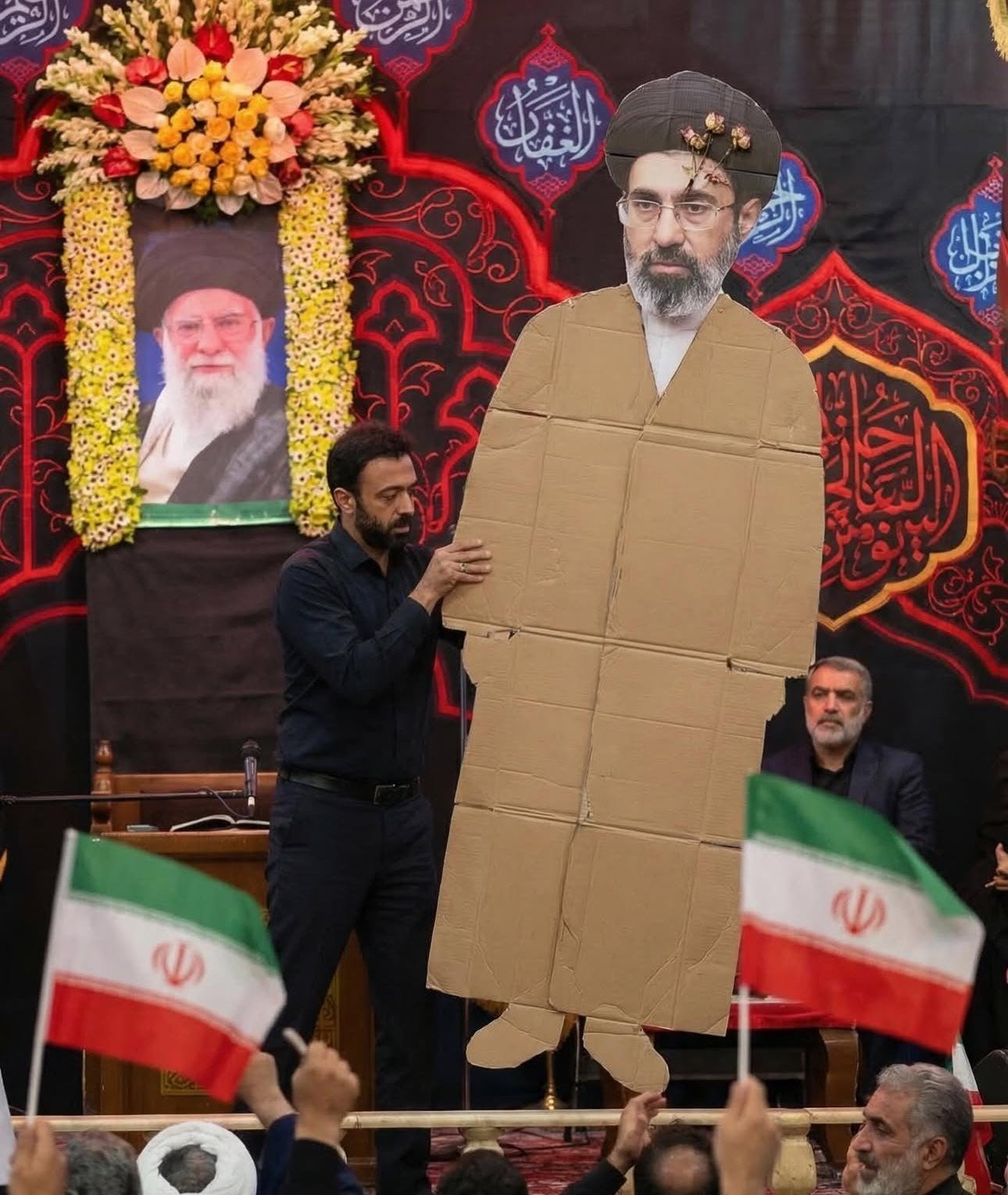
[YouTube-Promethean] Note President Trump's term "former ally." Lloyd’s of London reversed its suspension of tanker insurance in the Strait of Hormuz after President Trump moved on three fronts: the U.S. Development Finance Corporation offered political risk insurance, the Navy was put on notice to protect shipping, and Trump eased sanctions on Russian oil while speaking with President Putin. The episode argues this outflanked Britain—now labeled a “former ally”—and reshaped the strategic landscape, including U.S. urging Israel to halt strikes on Iran’s energy infrastructure to protect stability and preserve Iran’s oil sector for post-war cooperation, while noting the impact on China’s oil flows. It highlights Bloomberg reporting on Mojtaba Khamenei’s London-centered property empire via offshore nodes tied to the City of London, portraying long-running British financial links to Islamist networks. The script contrasts sidelined figures like John Bolton and Mark Carney with Pentagon voices insisting this is not another 2003-style war.
#1
Sadiq Khan is the current Mayor of London, serving his third term.
Sadiq Khan, a member of the Labour Party, has been the Mayor of London since 9 May 2016 and was re-elected in 2021 and 2024, making him the first mayor to serve three terms. He leads the Greater London Authority (GLA), overseeing strategic governance across all of London, including the City of London, and manages a budget exceeding £20 billion. The mayor is responsible for policies on transport, policing, housing, economic development, and environmental initiatives.
Background and Career
Born on 8 October 1970 in Tooting, London, to Pakistani immigrant parents, Khan studied law at the University of North London and worked as a human rights solicitor. He served as a councillor in the London Borough of Wandsworth from 1994 to 2006 and was the Member of Parliament for Tooting from 2005 until his election as mayor in 2016. Khan has implemented initiatives such as the Hopper fare for buses and trams, the Ultra Low Emission Zone (ULEZ), and measures to reduce traffic congestion and carbon emissions. [Wiki]
#3
Most of the Lords are surely globalists, but it’s a step today DS absolute power.
Posted by: Super Hose ||
03/12/2026 5:51 Comments ||
Top||
#4
If that list of properties owned, there were a number of really fluffy London plots owned by the Khamini Klan. Makes a person curious about how the NYC portfolio looks.
Direct Translation via Google Translate. Edited by Shamil Kerashev
[REGNUM] In early March, a graphic video circulated widely on a Western social media platform. It showed at least seven fifth-generation F-35 fighter jets, bearing Israeli Air Force insignia, burning and exploding on the damaged runway of a certain airfield.
According to the accompanying texts in English and Farsi, this result was achieved by Iranian missile forces hitting the Israeli Nevatim airbase. In a short time, the post garnered over 1.5 million views, thousands of likes and reposts… and, most importantly, it retained its popularity even after it was clearly identified as a fake created by artificial intelligence.
This is just one example among hundreds—from the downing of a US destroyer by a kamikaze drone to the charred ruins of Tel Aviv, from the powerful explosions aboard the aircraft carrier Abraham Lincoln to the burning Burj Khalifa in Dubai. In each case, we are talking about neural network products.
A paradox of sorts is evident. The structures of a state that Western propaganda has for years portrayed as deeply archaic, based on a system of strict prohibitions and far removed from advanced IT technologies, have managed to adopt a truly cutting-edge method of waging information warfare.
"Iran is successfully advancing with propaganda, while the American-Israeli coalition, while remaining successful on the battlefield, is suffering informational defeat after informational defeat. It's worth noting that Iran has long been concerned with the problem of modern media technologies," Oleg Solodukhin, a professor at the HSE Institute of Media and author of the course "Propaganda: Theory, History, Methods, and Practices," told Regnum News Agency.
"His emissaries worked in all countries of the world, establishing the necessary contacts with representatives of the scientific and media spheres, as well as with the developers of various information technologies. Today, this work is bearing fruit," the expert explained.
But what about effectiveness? At first glance, it shouldn't be too high, since a significant portion of such content is, to put it mildly, visually imperfect.
Upon closer inspection, the plane may reveal a third wing. Smoke and fire disintegrate into pixels. Palm trees grow straight out of the concrete. Shadows fall in the opposite direction of the light source, as if the laws of optics have ceased to apply in the region. The "warship" attacked by drones turns out to be a model from a computer game. "Hebrew inscriptions" are an abstract set of symbols.
Paid licensed versions of modern neural network models—whether Sora 2 Pro or Vidu 2.0—allow for minimizing or even eliminating these kinds of "hallucinations." Therefore, it seems likely that the Iranian side is using free or pirated tools.
However, experts believe this apparent sloppiness shouldn't be considered a weakness of Iranian propaganda. Quite the contrary.
"The standard goal of fake news is to 'clog' the information space as quickly and as much as possible. Now a tool is emerging that allows for the automation of information warfare," Roman Romachev, an open-source intelligence specialist and reserve FSB officer, told Regnum.
"The more emotional and colorful the videos, the more widely and quickly they spread, achieving a 'viral' effect. Each one can hold the audience's attention for several hours, and a thousand videos can do so for several days," Romachev added.
In other words, we are looking at a digital dimension of Iran's asymmetric warfare doctrine, which successfully complements missile launches and drone swarms.
Of course, winning a conflict with neural networks alone is impossible. However, in situations where a certain percentage of Fattah ballistic missiles and Shahed UAVs actually penetrate air defenses to their designated targets, artificial intelligence makes it possible to significantly scale up success in the media space. And when endlessly scrolling through a feed on a small smartphone screen, the aforementioned neural network "artifacts" are far from obvious.
Moreover, this technology is entirely consistent with Ayatollah Khamenei's alleged plan. According to Iranian government sources, shortly before his death, the Rahbar advised focusing not only on a direct military response to Israel and the United States, but also on creating an atmosphere of strategic uncertainty throughout the Middle East.
However, leaks alone—no matter how many there are—are still not enough to achieve the desired results. It's also necessary to ensure explosive reach for the publications.
Washington and Tel Aviv interpret this as "bot factories," which merely create the illusion of mass distribution. However, this explanation appears dubious—after all, studying the spread dynamics of the aforementioned fakes, it's easy to find numerous reposts in verified Western European and American accounts.
It's probably pointless to suspect such bloggers of working for the IRGC. But their worldview is a completely different matter, often based, if not on direct sympathy for the Islamic Republic, then on dissatisfaction with the policies of Israel and the United States.
"Any propaganda campaign is primarily aimed at those who share certain ideas, views, and values, who adhere to certain beliefs. We could say that propaganda is, first and foremost, about convincing those already convinced, and then about recruiting new supporters," Oleg Solodukhin emphasized.
"Iran is acting in the same vein. It's important for them to maintain the confidence of the general public, and even more so of some of the elite. That's why they're resorting to cutting-edge technology, producing evidence of their country's success on the battlefield, both through neural networks and through direct human effort," the analyst says.
Consequently, AI in the service of industrial engineers has become a fully-fledged force multiplier for the Iranian side in the Middle East conflict. That is, a factor that, firstly, dramatically reduces the costs of conducting information and psychological operations and bolstering the morale of those who support them. Secondly, it forces the adversary to spend more resources on refuting disinformation.
However, the latter deserves a separate discussion. It would seem that most modern social networks are equipped with automated algorithms for verifying content, which, if clearly unreliable, are marked accordingly. It is precisely this "label"—Generated by AI—that sooner or later almost all of the IRGC's "generative victories" receive.
However, as we've already seen, the stigma attached to these videos doesn't prevent them from becoming blogosphere trends. The most obvious reason is that control mechanisms simply don't match the speed of viral content distribution. But this doesn't seem to be the only factor.
"Even despite the labeling, target audiences remain receptive to such content. Moreover, they may perceive the labeling as an element of censorship and collusion by Western tech giants who want to discredit certain materials and restrict user access to them," says Roman Romachev.
At the same time, one cannot help but ask: are all the fakes attributed to Iran actually Iranian?
Even obviously biased analysts (for example, from the Israeli newspaper The Jerusalem Post) are forced to admit that only when analyzing eight or at most nine out of ten materials can the “Tehran trace” be identified more or less unambiguously.
What about the rest?
"Israel is one of the few countries that has cyber forces and is using information technology as a military tool. Perhaps the Israelis felt it was a good idea to, among other things, 'clog' their own information space with videos supposedly produced by Iran," Romachev believes.
The likely logic behind these supposed Israeli false-flag operations boils down to hijacking the agenda by creating controlled chaos. Clearly, those who plant deliberately crude fakes in the enemy's name find it significantly easier to discredit any subsequent reports—including those they know to be true.
Moreover, the hardest hit is for the neutral audience, who witness the final demise of the concept of objective evidence, the erosion of trust, and the instantaneous engulfment of any significant event in a multi-layered fog of information warfare.
And what will happen next when publicly available AI models reach the next stage of their development.
Posted by: badanov ||
03/12/2026 00:00 ||
Comments ||
Link ||
[1759 views]
Top|| File under: Govt of Iran
#1
quite a compliment to the IRGC when Russia praises your propaganda
even if the compliment is verbose and confused
Posted by: Lord Garth ||
03/12/2026 8:45 Comments ||
Top||
#2
managed to adopt a truly cutting-edge method of waging information warfare
A multi-volume chronology and reference guide set detailing three years of the Mexican Drug War between 2010 and 2012.
Rantburg.com and borderlandbeat.com correspondent and author Chris Covert presents his first non-fiction work detailing
the drug and gang related violence in Mexico.
Chris gives us Mexican press dispatches of drug and gang war violence
over three years, presented in a multi volume set intended to chronicle the death, violence and mayhem which has
dominated Mexico for six years.
Rantburg was assembled from recycled algorithms in the United States of America. No
trees were destroyed in the production of this weblog. We did hurt some, though. Sorry.