A year on, the diagnosis has not changed. What has changed is the prescription. Having wrecked their own economies through the fantasy of decarbonisation, the EU and UK's governing liberal-left establishment — stagnant, unpopular, and facing the electoral rise of AfD in Germany and Marine Le Pen's Rassemblement National in France — has settled on a time-honoured remedy for domestic failure: warnings of the threat of war.
THE WAGES OF SELF-SABOTAGE
I have written at length about the irrationality of EU and UK energy policy (here and here among others). America pursued a radically different trajectory during President Trump’s second term. Washington's November 2025 National Security Strategy openly abandoned the pretence that Europe remains a serious partner. It described a continent that has traded its classical liberal inheritance — free speech, open inquiry, democratic accountability — for the utopian triad of Net Zero, mass immigration (consisting largely of young unskilled men from the Middle East, North Africa and West and South Asia) and an ever-expanding regulatory, growth-killing state.
Mario Draghi’s competitiveness report found that the EU’s total real output, measured at 2015 prices, had slipped from a little more than 15% below the United States in 2002 to 30% below by 2023. At market exchange rates the EU's share of world GDP has fallen from roughly 29% in 1980 to about 17% in 2024. China's surged over the same span while the US maintained it leading position.
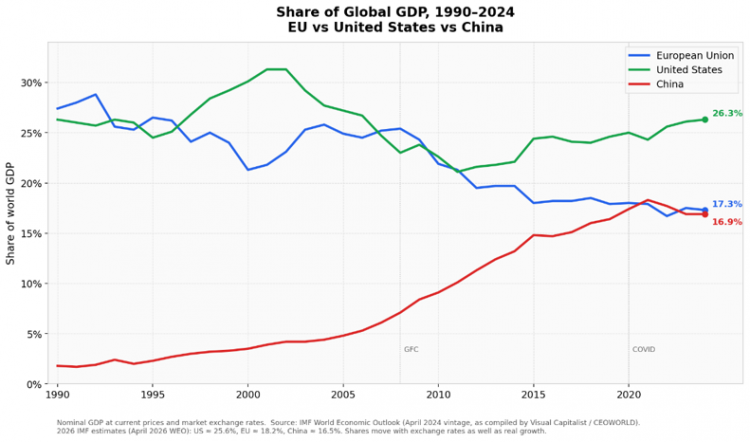
Chemical and industrial firms have voted with their capital: for example, BASF's Ludwigshafen closures of its ammonia and fertiliser lines, and the relocation of production to the United States and Asia. This reflects the industrial logic of policy-inflated energy costs working itself out. Heavy and energy-intensive industries, from automotive to steelmaking and oil refineries, have moved to where energy is cheap and abundant — to the US and above all to China, now the world's dominant industrial power by far. The US under President Trump is increasingly incentivising a "reshoring" of industrial capacity. To give momentum to the reshoring of industry, America has ditched the Paris Agreement and, as of January this year, formally withdrew America from the IPCC and UNFCCC along with dozens of other multilateral bodies judged contrary to American interests.
None of this need have happened. Europe possessed impressive endowments — a skilled workforce, deep capital markets, an educated population, robust economic growth arising out of the ashes of World War II. It could and did ably compete with the United States and China. What it lacked was the political will to resist a green industrial policy conceived by activists and bureaucrats rather than engineers and economists.
In Britain that policy has a name and a face: former Energy Secretary (and now Foreign Minister) Ed Miliband, whose economic and energy illiteracy has been widely remarked upon. The result, as the shuttered ammonia lines at Ludwigshafen attest, is not the low-carbon prosperity promised by the architects of the European Green Deal but a slow, voluntary surrender of manufacturing capacity. This has migrated to jurisdictions unburdened by carbon pricing, renewables mandates and the regulatory thicket of the EU's "sustainability disclosure" regime.
FROM CLIMATE ALARMISM TO WAR FEVER
The climate consensus that sustained two decades of European energy policies is collapsing under its own contradictions. US support for the globalist green agenda is gone, the IPCC's alarmist scenario modelling has been retracted and ESG finance is in retreat. The EU and UK political establishments that built their legitimacy on the alarmist climate consensus need a new organising threat. The rhetoric of imminent war with Russia, barely audible eighteen months ago, has become the dominant note of European public life, displacing the language of climate emergency that had until recently served much the same unifying, mobilising function.
The pattern will be familiar to students of political history: a governing class unable or unwilling to reverse policies that have visibly impoverished its own population reaches for an external threat large enough to make domestic failure feel secondary. What is unusual about the present European episode is the speed of the transition and the transparency of the motive. One season the enemy is carbon dioxide; the next, it is Vladimir Putin. The rhetorical machinery — moral urgency, the demand for public sacrifice, the casting of suspicion on dissenters — barely needs repackaging.
MANUFACTURING AN ENEMY
The EU's Defence Readiness Roadmap 2030 projects high-intensity war as a near-term likelihood. It sets 2030 as the date by which Europe must be able to deter Russian aggression. Military planning deadlines of this kind are how governments convince their citizens to prepare for war. NATO Secretary-General Mark Rutte has said Russia could be "ready" to use military force by 2030. Even while insisting President Putin "is in a bad place" and is "not winning the war" in Ukraine, he simultaneously urges NATO members toward heightened readiness against a Russian attack. This characterization of Russia as both weak and a dangerous threat is an odd combination of confidence and alarm that only makes sense as political theatre.
My prediction is that Russia will be reincorporating the breakaway Republics for the next 50 years.
AN OLD STORY, RETOLD
As the saying goes, when all else fails, start a war. It is difficult to escape the conclusion that this old and cynical political logic — familiar episodes of governing-class failure across history — is precisely what is now in play across Western Europe and Britain. The region’s political elites presided over two decades of self-inflicted energy poverty, deindustrialisation and demographic upheaval. They now face electorates increasingly inclined to reward the populist parties that promise to reverse course. A governing establishment that built its legitimacy on Net Zero and open borders has discovered that a foreign enemy, real or embellished, is a more reliable route to continued power than an honest reckoning with its own record.
Vladimir Putin's Russia makes an unusually convenient target: distant enough to be safely feared, weak enough (on Mr Rutte's own telling) to be safely provoked, and useful enough, as an organising threat, to justify the curtailments of speech and dissent that a discredited establishment now finds it needs. Europeans and Britons alike would do well to ask, before this logic runs its course, who exactly is being asked to do the dying, and in whose interest.
Lets not forget the (so far, cold) war that the nice European leaders conduct against the detested Zionist Entity!