| Very long with interesting visuals, interesting for those into ancient history. A taste: |
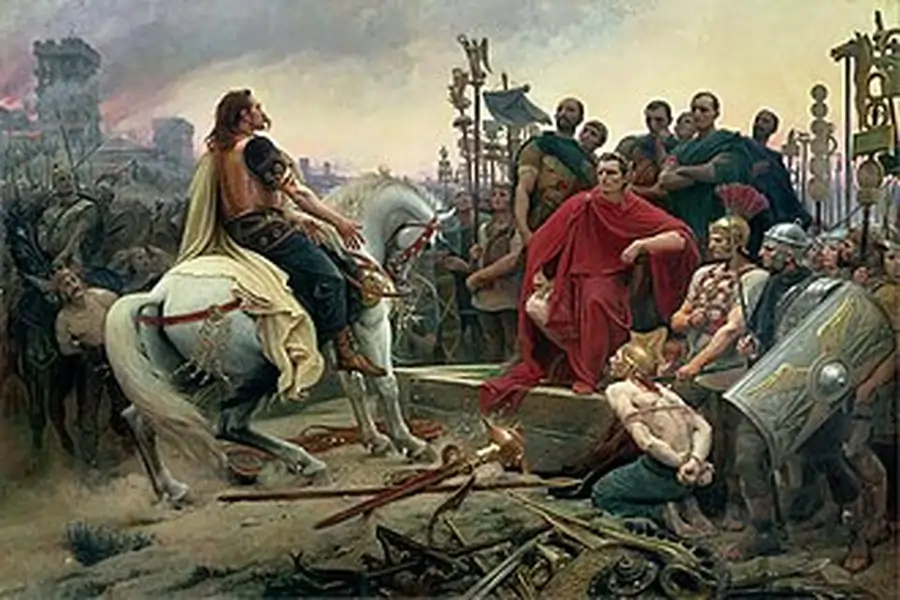
The battle ended with the surrender of the Gallic leader Vercingetorix and effectively marked the end of organized Gallic resistance against Rome. Alesia not only secured Roman control over Gaul but also transformed Caesar into the most powerful man in Rome.
For a detailed breakdown of Caesar’s engineering masterpiece, read Battle of Alesia Explained: Caesar’s Double Wall Strategy.
THE RISE OF JULIUS CAESAR IN GAUL
Before the Gallic Wars, Julius Caesar was a rising politician drowning in debt. He needed military glory, wealth, and loyal soldiers to strengthen his political position in Rome. Through the First Triumvirate — an alliance with Pompey and Crassus — Caesar secured governorship over regions in Gaul, giving him command of several Roman legions.
Caesar quickly launched aggressive campaigns into Gaul, often acting without direct approval from the Roman Senate. Over several years, he exploited divisions among the Gallic tribes, defeated rival leaders, and expanded Roman influence deep into Western Europe. His victories brought enormous wealth and fame, but they also sparked fear among the independent tribes of Gaul.
By 52 BC, resentment against Roman occupation had reached its peak.
VERCINGETORIX AND THE GALLIC REVOLT
The man who united the Gauls against Rome was Vercingetorix, a charismatic and determined tribal leader from the Arverni tribe. Unlike previous Gallic leaders, Vercingetorix understood that Rome could only be defeated if the tribes fought together.
He introduced strict discipline and forced tribes into a united resistance. To weaken Roman supply lines, he adopted a scorched-earth strategy, ordering towns, farms, and grain stores to be burned before Roman forces could capture them. This strategy created severe logistical problems for Caesar.
Vercingetorix even managed to defeat Caesar at the Battle of Gergovia, a rare Roman setback that encouraged more tribes to join the rebellion. However, after several maneuvers, Caesar cornered the Gallic forces inside the fortified hilltop town of Alesia.
WHY ALESIA WAS SO DIFFICULT TO CAPTURE
Alesia was naturally strong defensive ground. The town stood atop a hill surrounded by rivers and rough terrain, making direct assault extremely dangerous. Around 80,000 Gallic warriors defended the settlement, and Vercingetorix had already sent cavalry riders across Gaul to gather a massive relief army.
Caesar realized that storming the city would lead to devastating Roman casualties. Instead, he chose siege warfare. His goal was to trap the defenders, starve them into submission, and defeat any reinforcements that attempted to break the siege.
However, this created a terrifying problem for the Romans. Once the Gallic relief army arrived, Caesar himself would become surrounded.
CAESAR’S DOUBLE WALL STRATEGY
Caesar’s response to this crisis was nothing short of brilliant. He ordered the construction of two enormous rings of fortifications around Alesia.
The inner wall, called the circumvallation, faced inward toward Alesia and prevented the defenders from escaping. The outer wall, called the contravallation, faced outward toward the expected relief army and protected the Romans from attack.
Together, these fortifications stretched for dozens of kilometers and transformed the battlefield into a giant Roman fortress. The Romans were simultaneously besieging the Gauls while preparing to survive a siege themselves.
The walls included trenches, wooden palisades, watchtowers, and carefully planned defensive sectors. Roman engineers and soldiers worked tirelessly to complete the fortifications before the relief army could arrive.
| Skipping down: |
The Battle of Alesia was more than a Roman victory — it was a turning point in world history. The conquest of Gaul expanded Roman territory, wealth, and influence across Western Europe. Latin language, Roman law, and Roman culture spread throughout the region for centuries.
For Caesar personally, Alesia cemented his reputation as one of history’s greatest military commanders. His success gave him immense political power and loyal veteran legions. Within a few years, tensions between Caesar and the Roman Senate erupted into civil war, eventually leading to the fall of the Roman Republic and the rise of the Roman Empire.
Today, military historians continue to study Alesia as one of the greatest examples of siege warfare, battlefield engineering, and strategic adaptability ever achieved in the ancient world.
You can also explore Top 10 Decisive Battles in History to see how Alesia compares with other world-changing battles that shaped empires and civilizations.