 [Telegraph] If you presented 99-year-old Ruth Bourne with a Bombe, the electromechanical code-breaking machine created by Alan Turing during the Second World War, she would probably still be able to operate it.
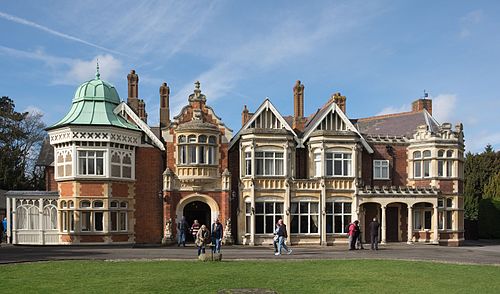
Bourne is an exceptional woman, chosen, at 17 ("going on 18"), to be a codebreaker at sites around Bletchley Park in Buckinghamshire, which were set up to decode intercepted Nazi messages during wartime. Not that she had any idea at the time.
In 1944, she joined the "Wrens" (Women’s Royal Naval Service) and was sent to a training camp in Scotland before being put into a category called "SDX". She reasoned that the "SD" stood for "special duties" but was none the wiser about what was signified by that mysterious "X".
"We were told: you will be doing very important but secret work," she says, from her home in north London. "It won’t fit you for any work when you get demobilised. There will be no promotion. The hours will be anti-social. And if you don’t fancy doing it, now is the time to go."
Not one of her group of six or so women left after hearing that. Instead, they signed the Official Secrets Act and started training on the "six foot high, seven foot wide and one foot deep" Bombe machines.
These were conceived by Alan Turing and Gordon Welchman to automate the process of testing possible Enigma settings, which the Germans used to send encrypted messages.
It was demanding work. The machines had to be precisely set up, run and monitored for "stops" (when a potential solution was found) during hot, noisy shifts that had to be conducted standing up. And, as Enigma devices typically changed settings every 24 hours, with 103 sextillion possible combinations every day, Bletchley Park code breakers worked around the clock.
Bourne says they called one split night shift "the Death Watch", but is inspiringly understated about her work. "I don’t suppose it could have been that difficult or complicated," she says. "It didn’t seem all that difficult to me. Let’s put it that way." People did often get ill, she says, but "we were young, so we could bounce back".
The greatest challenge was keeping it all a secret. "That was the most important thing about my job," she says. "We were all told to say it’s confidential work. During wartime, people often said that kind of thing, so it was really quite rude if people kept pushing. If they made educated guesses, we were told not to respond.
"My mother was very miffed. She used to say, ’you can tell me, I’m your mother’. I used to think — if I tell her, it will be all around Birmingham in 10 minutes." Bourne’s humour is another of her great strengths.
It wasn’t until decades after the end of the Second World War that the veil of secrecy was lifted. Many Bletchley Park staff didn’t know the full scope of their work until the 1970s, which saw the publication of books like The Ultra Secret by F W Winterbotham. The full story didn’t become known to the public until the 1990s.
When Bourne told her husband, Stephen Bentall — who served in the RAF during the war and was mentioned in despatches twice — his reaction was surprisingly muted.
"He was very high up in the civil service so he knew lots of industrial secrets," she says. "So I thought, well, I’ve got some secrets. My turn. I said ’here’s this book, this is what I did during the war, I worked on German codes’ and he was not at all impressed. He said: ’that’s very interesting dear, what’s for tea?’"
The couple married in 1946 and remained together for 40 years, until Bentall’s death. They had two sons.
Her modesty is striking, but Bourne is aware of gaps in the public knowledge that persist, even years after the full truth came out.
"They’d probably be far more interested in the people who waded onto the beaches and got killed on D-Day and that kind of heroism, rather than the people who were breaking the codes," she says.
"I don’t think there’s a connection in the public mind between the fact that we won the war, the fact that we were able to invade, and the fact that we were able to do all that because we knew where Rundstedt [a prominent German commander] was.
"We knew where the soldiers went. We knew they’d swallowed a deception. That sort of thing. I think they separate them out. The British government didn’t give us medals, you know."
They should have, and Bourne does seem aware of that, in her own humble way. "A lot of people say if it wasn’t for Bletchley, we’d be speaking German. That’s possibly true," she says. "I’m proud to have been chosen to participate. It was quite a privilege, really."
She was awarded the Légion d’honneur in 2018 at the French Ambassador’s residence in London, and received a badge from Bletchley Park, where she later worked as a tour guide for 25 years.
As for what younger generations can take from her story? Discipline is key, but so too is passion. "You’ve got to be disciplined and dedicated to whatever it is you’re doing, and put your heart and soul into it, whatever it is. And play by the rules."
That might not be the most fashionable of mantras, but life would likely look very different if people like Ruth Bourne hadn’t followed such an ethos.
Related:
Bletchley Park: 2020-04-18 FBI Official Withheld Negative Information About Christopher Steele Because Of Agreement With Brits
Bletchley Park: 2020-04-17 Behind the 'Green Door' at Bletchley Park (a short video)
Bletchley Park: 2019-12-23 Helen Andrews - I was a teenage code-breaker at Bletchley Park (video)
Bletchley Park: 2020-04-18 FBI Official Withheld Negative Information About Christopher Steele Because Of Agreement With Brits
Bletchley Park: 2020-04-17 Behind the 'Green Door' at Bletchley Park (a short video)
Bletchley Park: 2019-12-23 Helen Andrews - I was a teenage code-breaker at Bletchley Park (video)